Order two or more copies of the same title and we'll automatically give you 5% off list price on that title.
To get 2+ Pricing , just add two or more copies of a title to your shopping cart. Your discount will be immediately applied to your order.
Sale titles, hymnals, and ShowKits (MTI's Broadway Junior Collection, Getting to Know... Collection (G2K) and MTI's Kids Collection) do not qualify for 2+ Pricing
If you have any questions or comments regarding 2+ Pricing , please visit our Help Center to find more information or chat with our support team
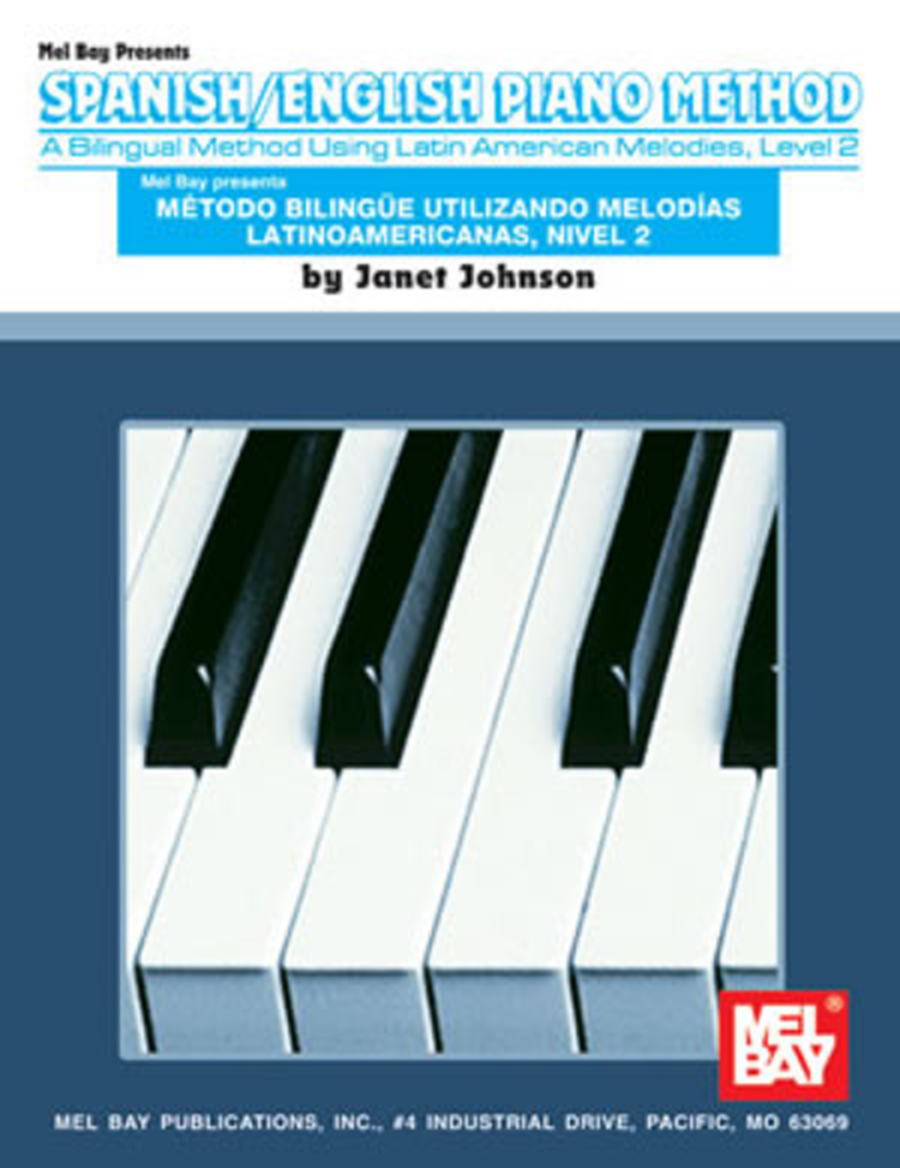
A Bilinqual Method Using Latin American Melodies. Composed by Janet Johnson. This edition: Saddle Stitch. Piano and Keyboard, World, Classical, Jazz, Latin, Saddle-stitched. Classical. Book. 48 pages. Mel Bay Publications, Inc #20571. Published by Mel Bay Publications, Inc (MB.20571).
ISBN 9780786669011. UPC: 796279090834. 8.5 X 11 inches.
Mientras vivía en México, Janet enseñó piano y educación musical en el Seminario Bautista Mexicano desde 1984 hasta 2000. Pronto descubrió que sus estudiantes mexicanos no se relacionaban con las melodías populares que se encuentran en los métodos de piano traducidos. Janet escribió este nuevo método que utiliza muchas melodías infantiles y populares originales de la cultura mexicana. A pesar de que varias de las melodías en el libro de primer nivel no se usan actualmente o no son conocidas, estas canciones brindan una mejor base para la enseñanza de elementos musicales básicos en cualquier cultura de la lengua española. Para capturar el flujo de la música más completamente, la secuencia de la introducción de algunos elementos varía algo de los métodos tradicionales. Por ejemplo, las octavas notas se enseñan mucho antes de lo habitual, de modo que las canciones pueden fluir con más autenticidad. Este material se ha utilizado con éxito como herramienta de enseñanza en el Seminario Bautista Mexicano y en todo México desde 1994. While living in Mexico, Janet taught piano and music education at the Mexican Baptist Seminary from 1984 until 2000. She soon found that her Mexican students did not relate to the folk tunes found in translated piano methods. Janet wrote this new method which uses many children's and folk melodies original to the Mexican culture. Even though several of the melodies in the first level book are not currently used or well-known, these songs provide a better foundation for teaching basic musical elements in any Spanish language culture. In order to capture the flow of the music more completely, the sequence of the introduction of some elements varies somewhat from traditional methods. For instance, eighth notes are taught much earlier than is customary so that the songs can flow with more authenticity. This material has been used successfully as a teaching tool at the Mexican Baptist Seminary and throughout Mexico since 1994.
A Bilinqual Method Using Latin American Melodies. Composed by Janet Johnson. This edition: Saddle Stitch. Piano and Keyboard, World, Classical, Jazz, Latin, Saddle-stitched. Classical. Book. 48 pages. Mel Bay Publications, Inc #20571. Published by Mel Bay Publications, Inc (MB.20571).
ISBN 9780786669011. UPC: 796279090834. 8.5 X 11 inches.
Mientras vivía en México, Janet enseñó piano y educación musical en el Seminario Bautista Mexicano desde 1984 hasta 2000. Pronto descubrió que sus estudiantes mexicanos no se relacionaban con las melodías populares que se encuentran en los métodos de piano traducidos. Janet escribió este nuevo método que utiliza muchas melodías infantiles y populares originales de la cultura mexicana. A pesar de que varias de las melodías en el libro de primer nivel no se usan actualmente o no son conocidas, estas canciones brindan una mejor base para la enseñanza de elementos musicales básicos en cualquier cultura de la lengua española. Para capturar el flujo de la música más completamente, la secuencia de la introducción de algunos elementos varía algo de los métodos tradicionales. Por ejemplo, las octavas notas se enseñan mucho antes de lo habitual, de modo que las canciones pueden fluir con más autenticidad. Este material se ha utilizado con éxito como herramienta de enseñanza en el Seminario Bautista Mexicano y en todo México desde 1994. While living in Mexico, Janet taught piano and music education at the Mexican Baptist Seminary from 1984 until 2000. She soon found that her Mexican students did not relate to the folk tunes found in translated piano methods. Janet wrote this new method which uses many children's and folk melodies original to the Mexican culture. Even though several of the melodies in the first level book are not currently used or well-known, these songs provide a better foundation for teaching basic musical elements in any Spanish language culture. In order to capture the flow of the music more completely, the sequence of the introduction of some elements varies somewhat from traditional methods. For instance, eighth notes are taught much earlier than is customary so that the songs can flow with more authenticity. This material has been used successfully as a teaching tool at the Mexican Baptist Seminary and throughout Mexico since 1994.
Sharing melody, Madam White, The Shepherdess
Dotted Quarter Note, Nonsense Game
Nonsense Game, Michael’s Boat
Love, Love; The Carnation’s Romance
Whole Steps, Half Steps, Tetrachords
Major Scale
C Major Scale
Joy to the World, the Lord is Come!
6/8 Time Signature, John Pirulero
Broken Chord, Galloping
The Little Horses, The Louse
I Want to Sing a Pretty Song
Accidentals, Sharp Sign, Flat Sign, Natural Sign
Intervals 6-8, Go Round the Village
G Major, Key Signature
G Major, D S al Fine, I Will Praise
The Cockroach
G Major chords, John Jacob Jingleheimer Schmidt
Praise to Jehova
The Birthday Song
From One to Two
The Crippled Person; Come, Young Shepherds
Staccato, Beautiful Heaven
The Pedals on the Piano
Damper Pedal, Arpeggio, Study
F Major
Mother, Look at Mr. Joseph
Ode to Joy, 1st and 2nd Endings
More About Chords, Chord Inversions
Transposition; Look, Mother at Mr. Joseph; John Jacob Jingleheimer Schmidt
Sixteenth Note, Diana
Minor Scale
More About Thirds, Minor Thirds
D Minor, Alfonso XII
I Will Exalt You, My God and King
Come Friend to Jesus
La Sanduga, Dance from the Isthmus
I Come to Tell You
God Is Here
Only in Christ
Eighth Note Triplets; Lord, Who may Enter?
Major Scales with Sharps
Major Scales with Flats
Finger Exercises
Melodía compartida, Madam White, La pastora
Corteza con puntillo, Juego de tonterías
Juego de tonterías, El barco de Michael
Amor, amor; El romance del clavel
Tonos enteros, Semitonos, Tetracordios
Escala mayor
Escala de Do Mayor
¡Alegría al mundo, el Señor ha venido!
Compás de 6/8, John Pirulero
Acorde roto, Galopando
Los caballitos, El piojo
Quiero cantar una canción bonita
Alteraciones, Signo de sostenido, Signo bemol, Signo natural
Intervalos 6-8, Go Round the Village
Sol mayor, Armadura de clave
Sol mayor, Re S al fino, Alabaré
La Cucaracha
Acordes de Sol mayor, John Jacob Jingleheimer Schmidt
Alabanza a Jehová
La canción del cumpleaños
Del uno al dos
La persona lisiada; Venid, jóvenes pastores
Staccato, Cielo hermoso
Los pedales del piano
Pedal de sordina, Arpegio, Estudio
Fa mayor
Madre, mira al señor José
Oda a la alegría, 1.ª y 2.ª terminaciones
Chiapanecas
Más sobre acordes, inversiones de acordes
Transposición; Mira, madre al señor José; John Jacob Jingleheimer Schmidt
Semicorchea, Diana
Escala menor
Más sobre terceras, terceras menores
Re menor, Alfonso XII
Te exaltaré, mi Dios y Rey
Ven, amigo de Jesús
La Sanduga, Danza del Istmo
Vengo a decirte
Dios está aquí
Solo en Cristo
Tresillos de corcheas; Señor, ¿quién puede entrar?
Escalas mayores con sostenidos
Escalas mayores con bemoles
Ejercicios de dedos
Preview: Spanish/English Piano Method, Level 2
Tell A Friend
Tell a friend (or remind yourself) about this product. We'll instantly send an email containing product info and a link to it. You may also enter a personal message.
We do not use or store email addresses from this form for any other purpose than sending your share email.
After purchase, you can download your MP3 from your Sheet Music Plus Digital Library - no software installation is necessary! You can also listen to your MP3 at any time in your Digital Library.
Learn about Smart Music
After purchase, you can download your Smart Music from your Sheet Music Plus Digital Library - no software installation is necessary! You can also download at any time in your Digital Library.
Learn about Digital Video
After purchase you can download your video from your Digital Library. Your video is in XX format and is playable on most pre-installed video players.