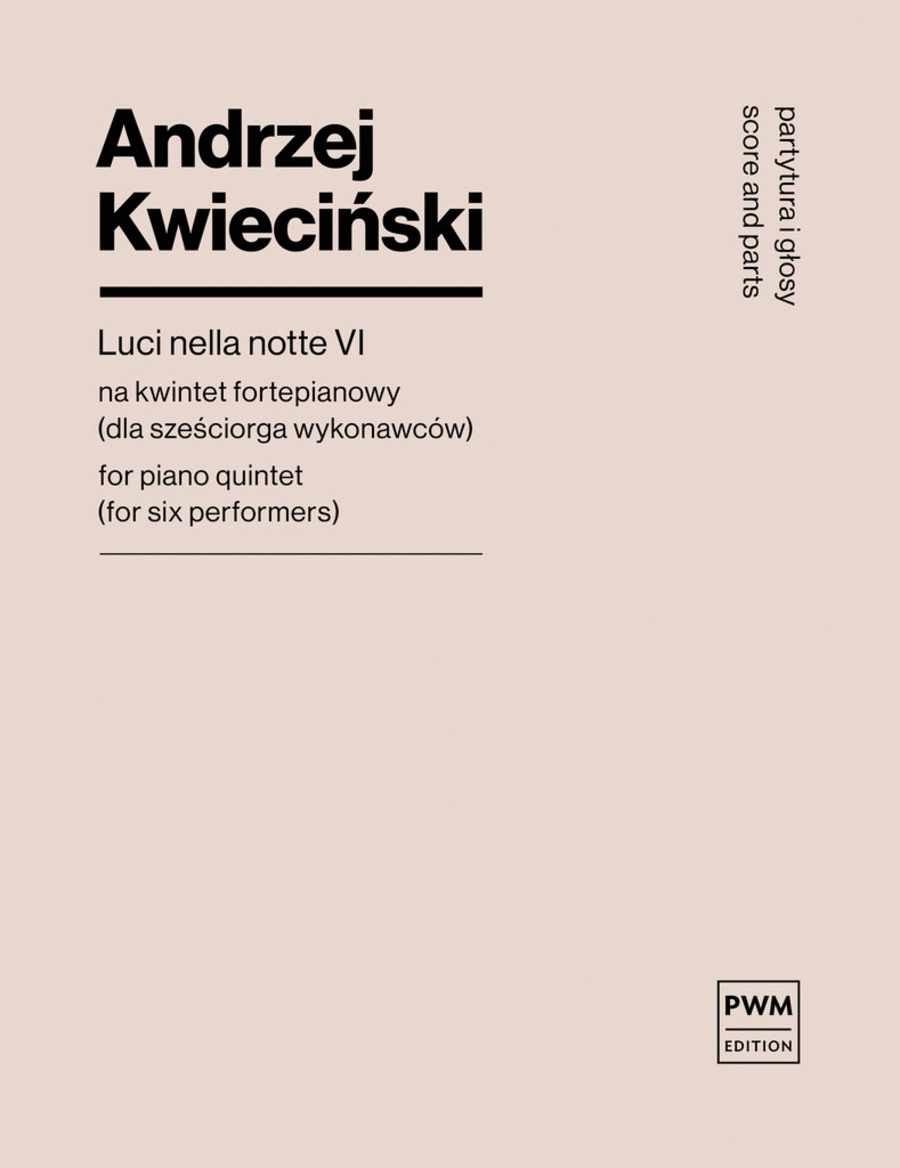
For six performers. Composed by Andrzej Kwieciński. Set (Score & Parts). Composed 2022. 76 pages. Polskie Wydawnictwo Muzyczne #PWM12644. Published by Polskie Wydawnictwo Muzyczne (BT.PWM12644).
Luci nella notte is the sixth and last (thus far) composition in Andrzej Kwieciński’s cycle of the same title, consisting of works for various forces. It is in one movement and displays an evolutionary form, although the changes occur almost imperceptibly. The Italian title Luci nella notte may be translated as ‘Lights in the night’, but the word ‘luci’ (‘lights’, ‘eyes’) also triggers associations with early music, particularly the madrigal of the sixteenth and early seventeenth century, and also the output of Salvatore Sciarrino, which drew on similar sources (especially the opera Luci mie traditrici (‘My treacherous eyes’). Both those associations are confirmed in the musical fabric of the composition. The seemingly static form tends towards an emotional climax: the colour changes become denser, and snatches of distorted melody and harmony appear alongside the long-held notes – veiled and brief allusions to Carlo Gesualdo’s Moro lasso al mio duolo, also arranged by Sciarrino in Le voci sottovetro (Kwieciński quoted from one of Gesualdo’s madrigals in Luci nella notte IV, as well – a madrigal that Sciarrino also arranged in Le voci sottovetro). Thus Luci nella notte VI is a work that treats not only of colour, but also of nostalgic remembrance. The madrigal becomes a glimmer of the old world in the darkness of oblivion. Dominika Micał translated by John Comber.
For six performers. Composed by Andrzej Kwieciński. Set (Score & Parts). Composed 2022. 76 pages. Polskie Wydawnictwo Muzyczne #PWM12644. Published by Polskie Wydawnictwo Muzyczne (BT.PWM12644).
Luci nella notte is the sixth and last (thus far) composition in Andrzej Kwieciński’s cycle of the same title, consisting of works for various forces. It is in one movement and displays an evolutionary form, although the changes occur almost imperceptibly. The Italian title Luci nella notte may be translated as ‘Lights in the night’, but the word ‘luci’ (‘lights’, ‘eyes’) also triggers associations with early music, particularly the madrigal of the sixteenth and early seventeenth century, and also the output of Salvatore Sciarrino, which drew on similar sources (especially the opera Luci mie traditrici (‘My treacherous eyes’). Both those associations are confirmed in the musical fabric of the composition. The seemingly static form tends towards an emotional climax: the colour changes become denser, and snatches of distorted melody and harmony appear alongside the long-held notes – veiled and brief allusions to Carlo Gesualdo’s Moro lasso al mio duolo, also arranged by Sciarrino in Le voci sottovetro (Kwieciński quoted from one of Gesualdo’s madrigals in Luci nella notte IV, as well – a madrigal that Sciarrino also arranged in Le voci sottovetro). Thus Luci nella notte VI is a work that treats not only of colour, but also of nostalgic remembrance. The madrigal becomes a glimmer of the old world in the darkness of oblivion. Dominika Micał translated by John Comber.
Preview: Luci nella notte VI for piano quintet
Tell A Friend
Tell a friend (or remind yourself) about this product. We'll instantly send an email containing product info and a link to it. You may also enter a personal message.
We do not use or store email addresses from this form for any other purpose than sending your share email.
After purchase, you can download your MP3 from your Sheet Music Plus Digital Library - no software installation is necessary! You can also listen to your MP3 at any time in your Digital Library.
Learn about Smart Music
After purchase, you can download your Smart Music from your Sheet Music Plus Digital Library - no software installation is necessary! You can also download at any time in your Digital Library.
Learn about Digital Video
After purchase you can download your video from your Digital Library. Your video is in XX format and is playable on most pre-installed video players.