Composed by John Frith. Contemporary. Solo part and Piano. Cherry Classics #CC2309. Published by Cherry Classics (CY.CC2309).
John Frith began composing the `Sonata for Bass Trombone and Piano` for Stephen Fissel of the Seattle Symphony Orchestra in 2008. Originally it was intended to write only a single movement. When Mr. Fissel requested more did the idea of a three movement Sonata begin to take shape.
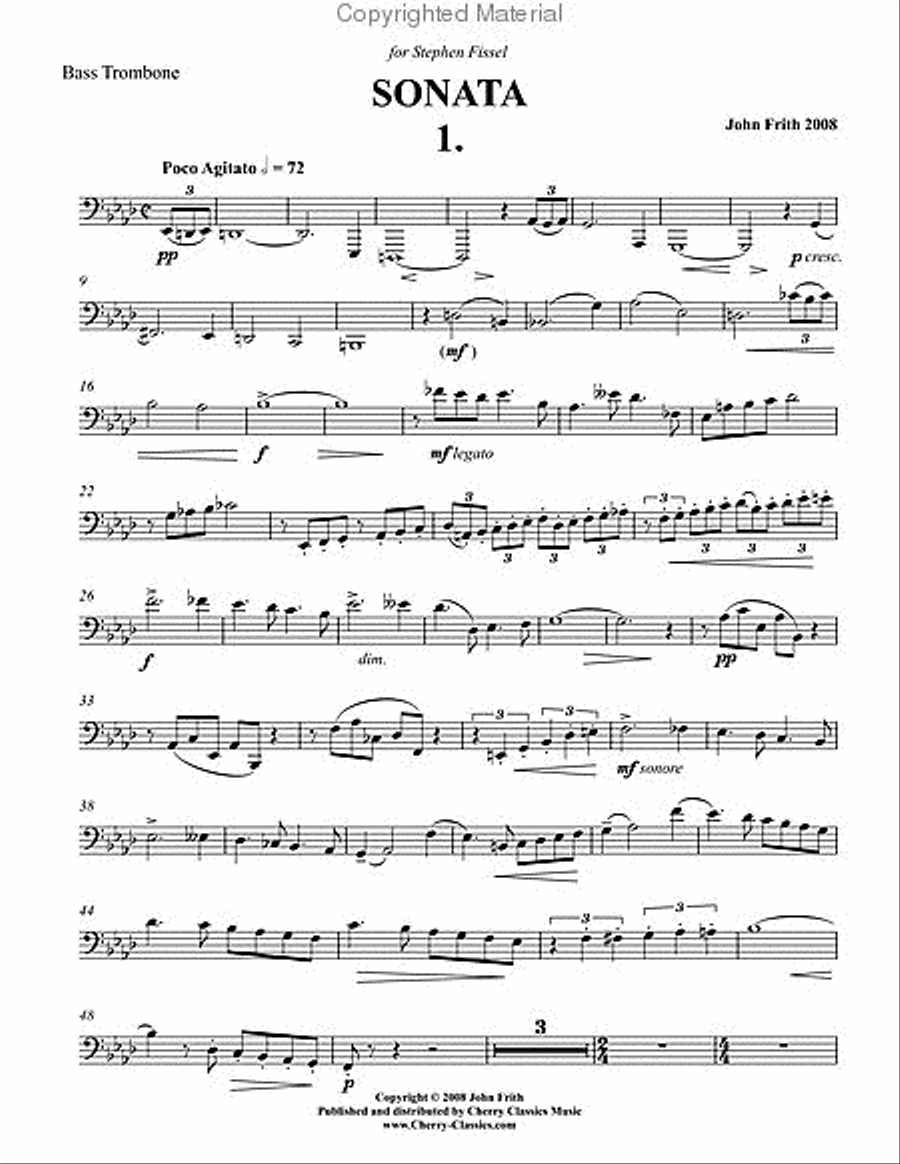
In order to create a cohesive piece, Mr. Frith decided to use the opening Trombone figure of F-E-F as the thread to create a thematic unity within the three movement structure. The Piano introduction to the slow second movement bears this `motto` in reverse (EFE) and this is duly adopted by the Trombone and continues to be evident throughout the movement.
The third movement, likewise, uses (EFE) but this time beginning with the Trombone. The composer remembers describing this movement to Stephen Fissel as a "manic Waltz" and it does,indeed, reach fever-pitch by the Coda.
The relationship between the two instruments in this Sonata is never that of soloist and accompanist, rather as a conversation between two equal players, each in partnership with the composer’s ideas, committed to creating something of beauty.The work is written for very advanced performers and is about 14 minutes in length.
Composed by John Frith. Contemporary. Solo part and Piano. Cherry Classics #CC2309. Published by Cherry Classics (CY.CC2309).
John Frith began composing the `Sonata for Bass Trombone and Piano` for Stephen Fissel of the Seattle Symphony Orchestra in 2008. Originally it was intended to write only a single movement. When Mr. Fissel requested more did the idea of a three movement Sonata begin to take shape.
In order to create a cohesive piece, Mr. Frith decided to use the opening Trombone figure of F-E-F as the thread to create a thematic unity within the three movement structure. The Piano introduction to the slow second movement bears this `motto` in reverse (EFE) and this is duly adopted by the Trombone and continues to be evident throughout the movement.
The third movement, likewise, uses (EFE) but this time beginning with the Trombone. The composer remembers describing this movement to Stephen Fissel as a "manic Waltz" and it does,indeed, reach fever-pitch by the Coda.
The relationship between the two instruments in this Sonata is never that of soloist and accompanist, rather as a conversation between two equal players, each in partnership with the composer’s ideas, committed to creating something of beauty.The work is written for very advanced performers and is about 14 minutes in length.
Tell a friend (or remind yourself) about this product. We'll instantly send an email containing product info and a link to it. You may also enter a personal message.
We do not use or store email addresses from this form for any other purpose than sending your share email.
After purchase, you can download your MP3 from your Sheet Music Plus Digital Library - no software installation is necessary! You can also listen to your MP3 at any time in your Digital Library.
Learn about Smart Music
After purchase, you can download your Smart Music from your Sheet Music Plus Digital Library - no software installation is necessary! You can also download at any time in your Digital Library.
Learn about Digital Video
After purchase you can download your video from your Digital Library. Your video is in XX format and is playable on most pre-installed video players.