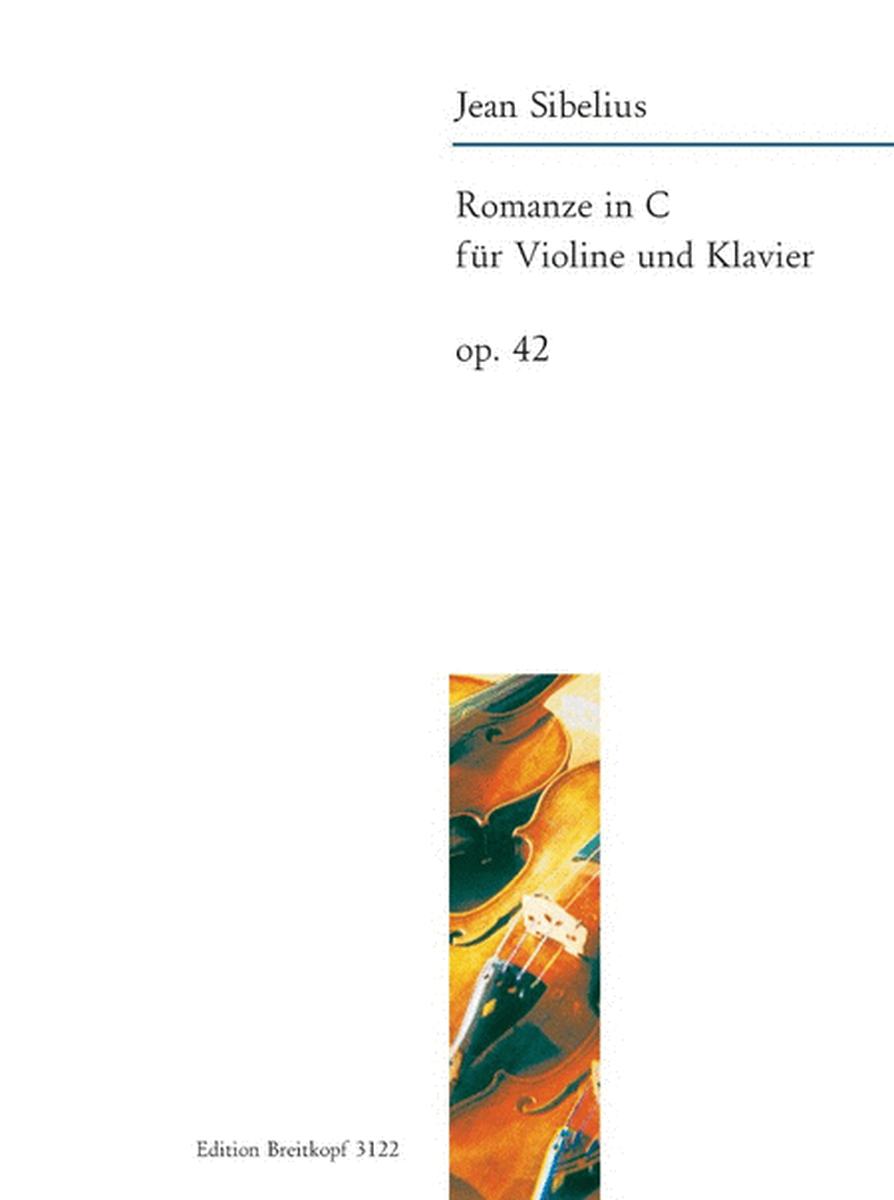
Composed by Jean Sibelius. Arranged by Otto Taubmann. Solo instruments; stapled. Edition Breitkopf. Early modern; Late-romantic. Score. 10 pages. Duration 5:00. Breitkopf and Haertel #EB 3122. Published by Breitkopf and Haertel (BR.EB-3122).
ISBN 9790004182666. 9 x 12 inches.
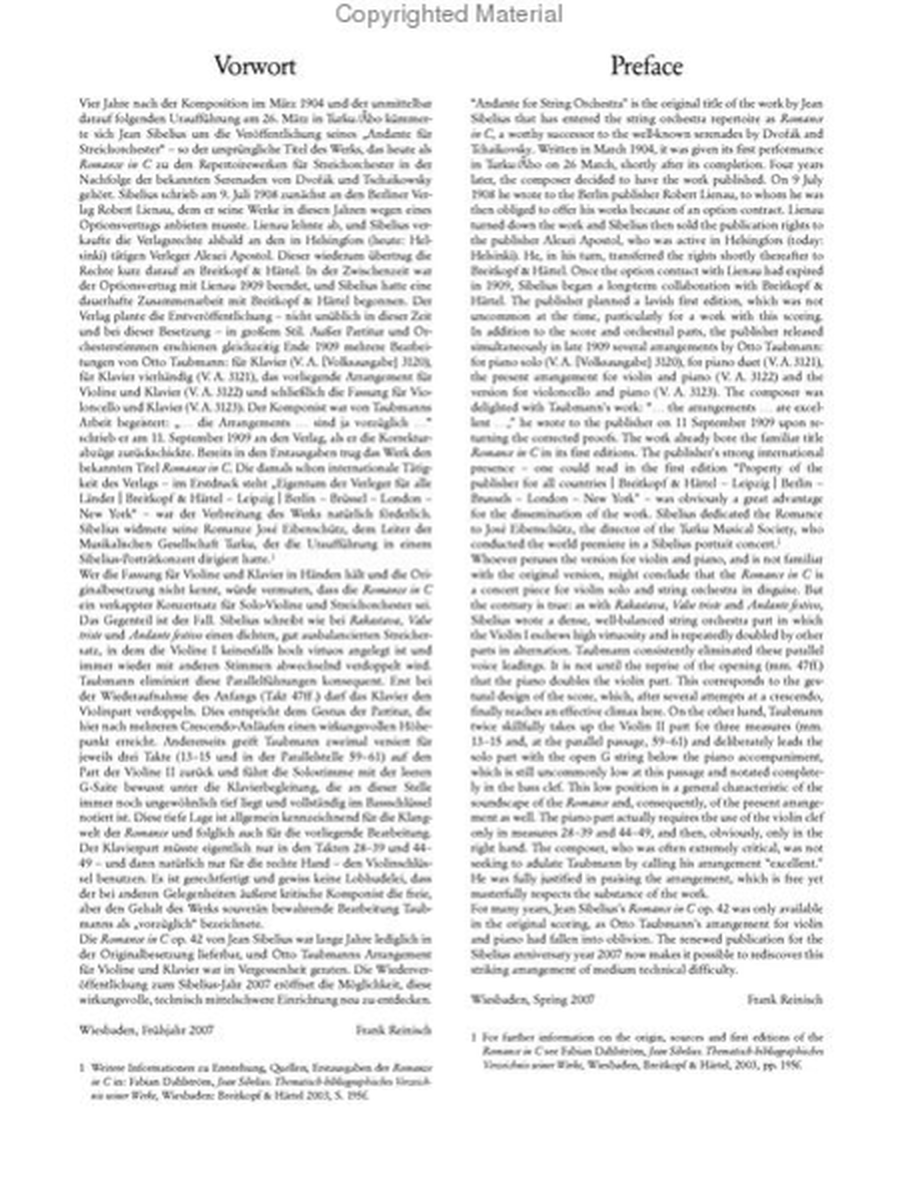
When Breitkopf & Hartel published the "Romance in C" in 1909, it did so on a rather grand scale, which included the publication of Otto Taubmann's arrangement for violin and piano. The otherwise rather critical Sibelius enthusiastically gave it a thumbs-up to the publisher, calling it "excellent!" Nevertheless, this version soon fell into oblivion, while the original found its way into the repertoire as a worthy successor to the serenades of Dvorak and Tchaikovsky. Taubmann solved his demanding assignment with amazing skill. The Romance is not a concerto movement in disguise, but features the dark, dense string writing typical of Sibelius. Taubmann literally draws the solo part from out of the string texture. With a masterly sense of dramaturgy, he doubles the piano and violin only in a few measures. Taubmann also sometimes deliberately leads the solo part with its open G string below the piano accompaniment, which is basically unusually low and notated over wide stretches only in the bass clef. This new publication now makes it possible to rediscover this effective arrangement of medium technical difficulty.
Sibelius composed this short (only five minutes long) Romance in C Op. 42 in 1903; the work was first performed in Turku in March 1904. The Romance is not a concerto movement in disguise, but features the dark, dense string writing typical of Sibelius.
Composed by Jean Sibelius. Arranged by Otto Taubmann. Solo instruments; stapled. Edition Breitkopf. Early modern; Late-romantic. Score. 10 pages. Duration 5:00. Breitkopf and Haertel #EB 3122. Published by Breitkopf and Haertel (BR.EB-3122).
ISBN 9790004182666. 9 x 12 inches.
When Breitkopf & Hartel published the "Romance in C" in 1909, it did so on a rather grand scale, which included the publication of Otto Taubmann's arrangement for violin and piano. The otherwise rather critical Sibelius enthusiastically gave it a thumbs-up to the publisher, calling it "excellent!" Nevertheless, this version soon fell into oblivion, while the original found its way into the repertoire as a worthy successor to the serenades of Dvorak and Tchaikovsky. Taubmann solved his demanding assignment with amazing skill. The Romance is not a concerto movement in disguise, but features the dark, dense string writing typical of Sibelius. Taubmann literally draws the solo part from out of the string texture. With a masterly sense of dramaturgy, he doubles the piano and violin only in a few measures. Taubmann also sometimes deliberately leads the solo part with its open G string below the piano accompaniment, which is basically unusually low and notated over wide stretches only in the bass clef. This new publication now makes it possible to rediscover this effective arrangement of medium technical difficulty.
Sibelius composed this short (only five minutes long) Romance in C Op. 42 in 1903; the work was first performed in Turku in March 1904. The Romance is not a concerto movement in disguise, but features the dark, dense string writing typical of Sibelius.
Preview: Romance in C major Op. 42
Tell A Friend
Tell a friend (or remind yourself) about this product. We'll instantly send an email containing product info and a link to it. You may also enter a personal message.
We do not use or store email addresses from this form for any other purpose than sending your share email.
After purchase, you can download your MP3 from your Sheet Music Plus Digital Library - no software installation is necessary! You can also listen to your MP3 at any time in your Digital Library.
Learn about Smart Music
After purchase, you can download your Smart Music from your Sheet Music Plus Digital Library - no software installation is necessary! You can also download at any time in your Digital Library.
Learn about Digital Video
After purchase you can download your video from your Digital Library. Your video is in XX format and is playable on most pre-installed video players.