About Alexander Scriabin
Alexander Scriabin (1872–1915) was a Russian composer and pianist, renowned for his highly original and mystical musical style that bridged the late Romantic and early Modern eras. He is considered a pivotal figure in music history due to his innovative harmonic language, which often transcended traditional tonality, and his profound engagement with philosophical and mystical ideas, particularly theosophy and synesthesia, which greatly influenced his compositions. Scriabin's work is characterized by its intense emotionalism, complex harmonies, and a quest for spiritual transcendence, solidifying his place as a visionary and one of the most distinctive voices of his time.
- Scriabin possessed synesthesia, a neurological phenomenon where the stimulation of one sensory or cognitive pathway leads to automatic, involuntary experiences in a second sensory or cognitive pathway. For him, this meant associating colors with musical notes and harmonies, which he famously incorporated into works like "Prometheus: The Poem of Fire" through a "color organ" designed to project lights during performances.
- His musical style evolved significantly throughout his relatively short life, moving from an early Romantic idiom heavily influenced by Chopin to a unique, highly chromatic, and almost atonal language that often featured his distinctive "mystic chord."
- Scriabin harbored grandiose philosophical and spiritual ambitions, envisioning a colossal multimedia work called "Mysterium." This unfinished project was intended to be a week-long performance in the Himalayas, combining music, dance, visual effects, and even scents, to bring about a new era of human consciousness and spiritual transformation.
- Despite suffering from small hands that limited his reach on the piano, he became a celebrated virtuoso pianist, even composing pieces for the left hand alone after injuring his right hand.
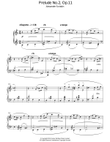
Scriabin's sheet music offers a profoundly rewarding experience for pianists and advanced students seeking to delve into a unique and transformative musical world. While many of his later works present considerable technical and interpretive challenges due to their complex harmonies, angular runs, large leaps, and polyrhythms, some earlier preludes and shorter pieces are accessible to intermediate players. Performing Scriabin's compositions allows musicians to explore a vast emotional landscape, from lush Romanticism to ecstatic mysticism, and to engage with a harmonic language that pushes boundaries. It's an opportunity to connect with a composer who believed music could transcend the physical, offering a deeply intellectual and spiritual journey for those ready to embrace his visionary sound world.