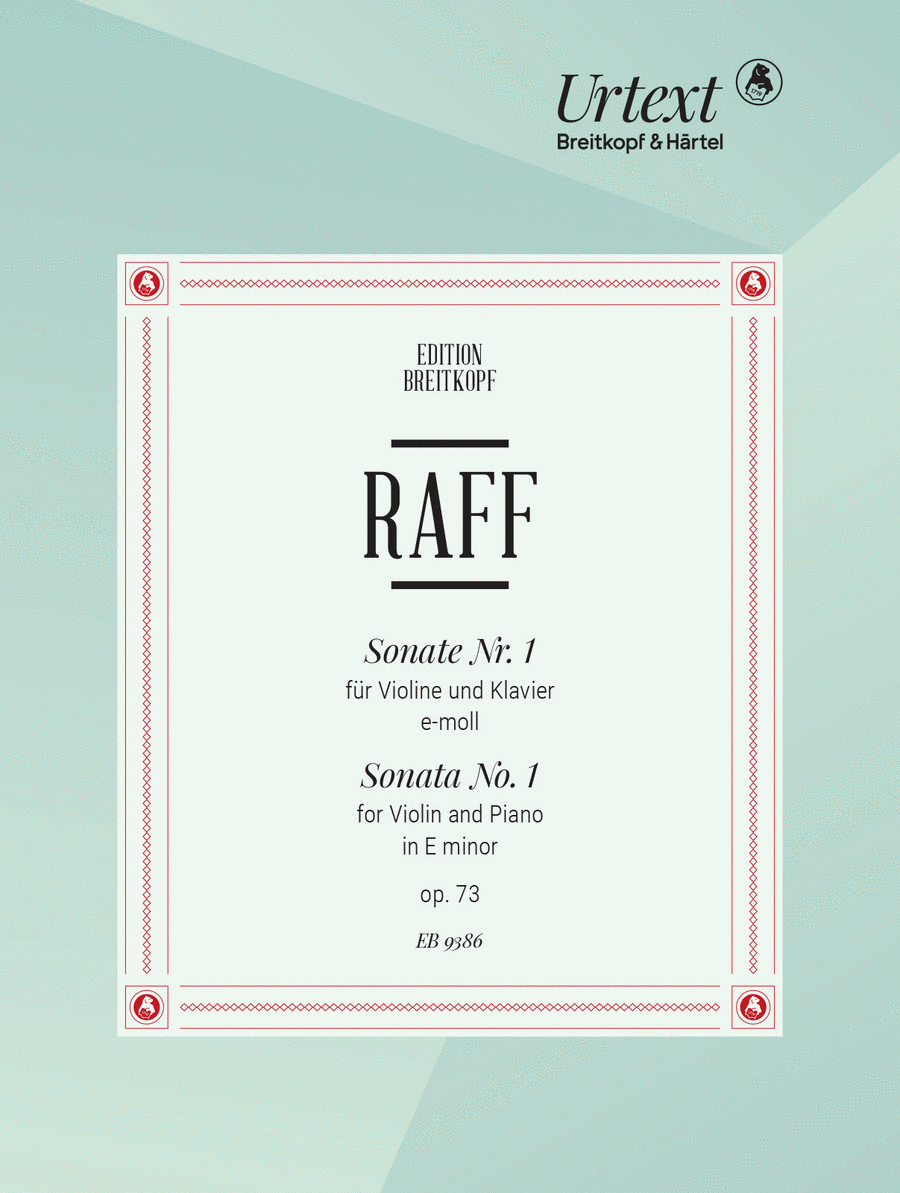
Urtext. Composed by Joachim Raff. Edited by Lion Gallusser Franziska Gallusser. This edition: stapled. Solo instruments; stapled. Edition Breitkopf. First Urtext Edition of the "Grand Sonata for Violin and Piano". Sonata; Romantic. Score and part. 88 pages. Duration 27:00. Breitkopf and Haertel #EB 9386. Published by Breitkopf and Haertel (BR.EB-9386).
ISBN 9790004188569. 9 x 12 inches.
The Violin Sonata No. 1 in E minor, op. 73, a "Grand Sonata for Violin and Piano," occupies an important position in Joachim Raff’s oeuvre: it reflects numerous artistic, aesthetic, biographical, and reception-historical aspects characteristic of Raff. The work was composed in Weimar in 1854, when Raff was going through a process of artistic self-discovery. He increasingly distanced himself from his mentor Franz Liszt and intensively explored Wagner as well as the ideal of absolute music – this is also reflected in the music of the sonata. While Raff described the first two movements as "objectified," he perceived the last two movements as "a piece of" him, that is, not free of extra-musical influences.
The 1st movement, with its expansive main theme, is reminiscent of Mendelssohn; the 2nd movement reveals the refinement of classical-romantic work with musical material. The 3rd movement, with its partly rhythmic, virtuoso accompanying figures and harmonically advanced passages, allows a deeply "romantic," almost tormented insight into a soul life à la Sturm und Drang. The partly irascible last movement revisits already familiar themes and thus creates a musical framework.
First Urtext Edition of the "Grand Sonata for Violin and Piano".
Urtext. Composed by Joachim Raff. Edited by Lion Gallusser Franziska Gallusser. This edition: stapled. Solo instruments; stapled. Edition Breitkopf. First Urtext Edition of the "Grand Sonata for Violin and Piano". Sonata; Romantic. Score and part. 88 pages. Duration 27:00. Breitkopf and Haertel #EB 9386. Published by Breitkopf and Haertel (BR.EB-9386).
ISBN 9790004188569. 9 x 12 inches.
The Violin Sonata No. 1 in E minor, op. 73, a "Grand Sonata for Violin and Piano," occupies an important position in Joachim Raff’s oeuvre: it reflects numerous artistic, aesthetic, biographical, and reception-historical aspects characteristic of Raff. The work was composed in Weimar in 1854, when Raff was going through a process of artistic self-discovery. He increasingly distanced himself from his mentor Franz Liszt and intensively explored Wagner as well as the ideal of absolute music – this is also reflected in the music of the sonata. While Raff described the first two movements as "objectified," he perceived the last two movements as "a piece of" him, that is, not free of extra-musical influences.
The 1st movement, with its expansive main theme, is reminiscent of Mendelssohn; the 2nd movement reveals the refinement of classical-romantic work with musical material. The 3rd movement, with its partly rhythmic, virtuoso accompanying figures and harmonically advanced passages, allows a deeply "romantic," almost tormented insight into a soul life à la Sturm und Drang. The partly irascible last movement revisits already familiar themes and thus creates a musical framework.
First Urtext Edition of the "Grand Sonata for Violin and Piano".
Preview: Violin Sonata No. 1 in E minor op. 73
Tell A Friend
Tell a friend (or remind yourself) about this product. We'll instantly send an email containing product info and a link to it. You may also enter a personal message.
We do not use or store email addresses from this form for any other purpose than sending your share email.
After purchase, you can download your MP3 from your Sheet Music Plus Digital Library - no software installation is necessary! You can also listen to your MP3 at any time in your Digital Library.
Learn about Smart Music
After purchase, you can download your Smart Music from your Sheet Music Plus Digital Library - no software installation is necessary! You can also download at any time in your Digital Library.
Learn about Digital Video
After purchase you can download your video from your Digital Library. Your video is in XX format and is playable on most pre-installed video players.