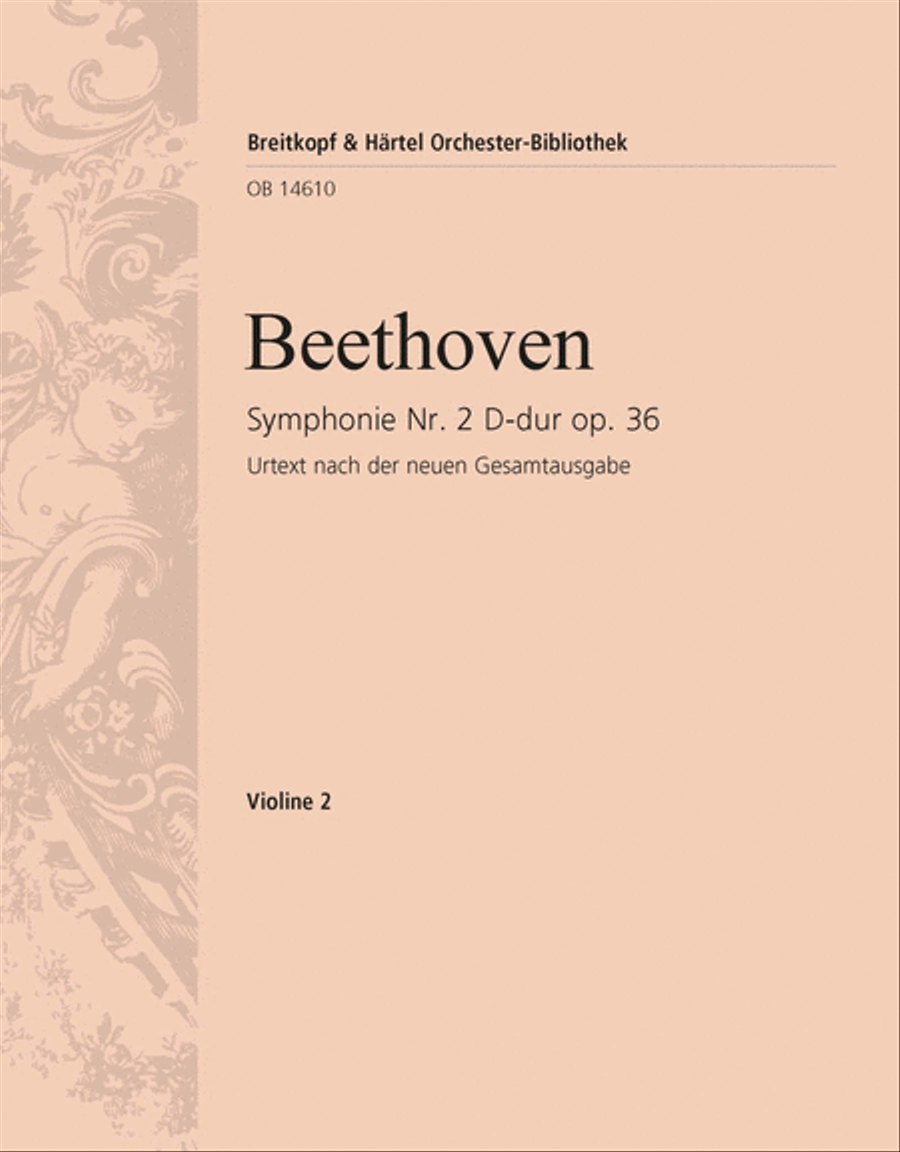
Urtext from the new Beethoven Complete Edition. Composed by Ludwig van Beethoven. Edited by Armin Raab. Stapled. Orchester-Bibliothek (Orchestral Library).
The study score (,,Studien-Edition) is available at G. Henle Verlag.
Symphony; Classical. Part. 16 pages. Duration 35:00. Breitkopf and Haertel #OB 14610-16. Published by Breitkopf and Haertel (BR.OB-14610-16).
ISBN 9790004336526. 10 x 12.5 inches.
Beethoven did not work continuously on this symphony and interrupted his work a couple of times. As the sketches show, he presumably wrote down first ideas in the autumn of 1800.No other autograph material has survived. As Ferdinand Ries, a pupil of Beethoven, bitterly reports, Beethoven gave him the autograph, but it was "unfortunately stolen by a friend, out of pure friendship." In April 1803, the composition was premiered publicly, together with the first symphony and the third piano concerto with Beethoven himself as soloist. Although Beethoven's first two symphonies are still influenced by Haydn and Mozart, novelties can already be discovered. The second symphony starts breaking away from traditional forms and lets us surmise the monumentality of Beethoven's innovation. The editor, Armin Raab, critically illuminates the transmission of the work and its sources. He also clears up a wide spread belief in older literature, that this cheerful work might have been composed parallel to the "Heiligenstadter Testament". The practical performance material by Breitkopf & Hartel is based on the music text of the New Beethoven Complete Edition and constitutes the authoritative reading of Beethoven research.
Urtext from the new Beethoven Complete Edition. Composed by Ludwig van Beethoven. Edited by Armin Raab. Stapled. Orchester-Bibliothek (Orchestral Library).
The study score (,,Studien-Edition) is available at G. Henle Verlag.
Symphony; Classical. Part. 16 pages. Duration 35:00. Breitkopf and Haertel #OB 14610-16. Published by Breitkopf and Haertel (BR.OB-14610-16).
ISBN 9790004336526. 10 x 12.5 inches.
Beethoven did not work continuously on this symphony and interrupted his work a couple of times. As the sketches show, he presumably wrote down first ideas in the autumn of 1800.No other autograph material has survived. As Ferdinand Ries, a pupil of Beethoven, bitterly reports, Beethoven gave him the autograph, but it was "unfortunately stolen by a friend, out of pure friendship." In April 1803, the composition was premiered publicly, together with the first symphony and the third piano concerto with Beethoven himself as soloist. Although Beethoven's first two symphonies are still influenced by Haydn and Mozart, novelties can already be discovered. The second symphony starts breaking away from traditional forms and lets us surmise the monumentality of Beethoven's innovation. The editor, Armin Raab, critically illuminates the transmission of the work and its sources. He also clears up a wide spread belief in older literature, that this cheerful work might have been composed parallel to the "Heiligenstadter Testament". The practical performance material by Breitkopf & Hartel is based on the music text of the New Beethoven Complete Edition and constitutes the authoritative reading of Beethoven research.
Preview: Symphony No. in 2 D major Op. 36
Tell A Friend
Tell a friend (or remind yourself) about this product. We'll instantly send an email containing product info and a link to it. You may also enter a personal message.
We do not use or store email addresses from this form for any other purpose than sending your share email.
After purchase, you can download your MP3 from your Sheet Music Plus Digital Library - no software installation is necessary! You can also listen to your MP3 at any time in your Digital Library.
Learn about Smart Music
After purchase, you can download your Smart Music from your Sheet Music Plus Digital Library - no software installation is necessary! You can also download at any time in your Digital Library.
Learn about Digital Video
After purchase you can download your video from your Digital Library. Your video is in XX format and is playable on most pre-installed video players.