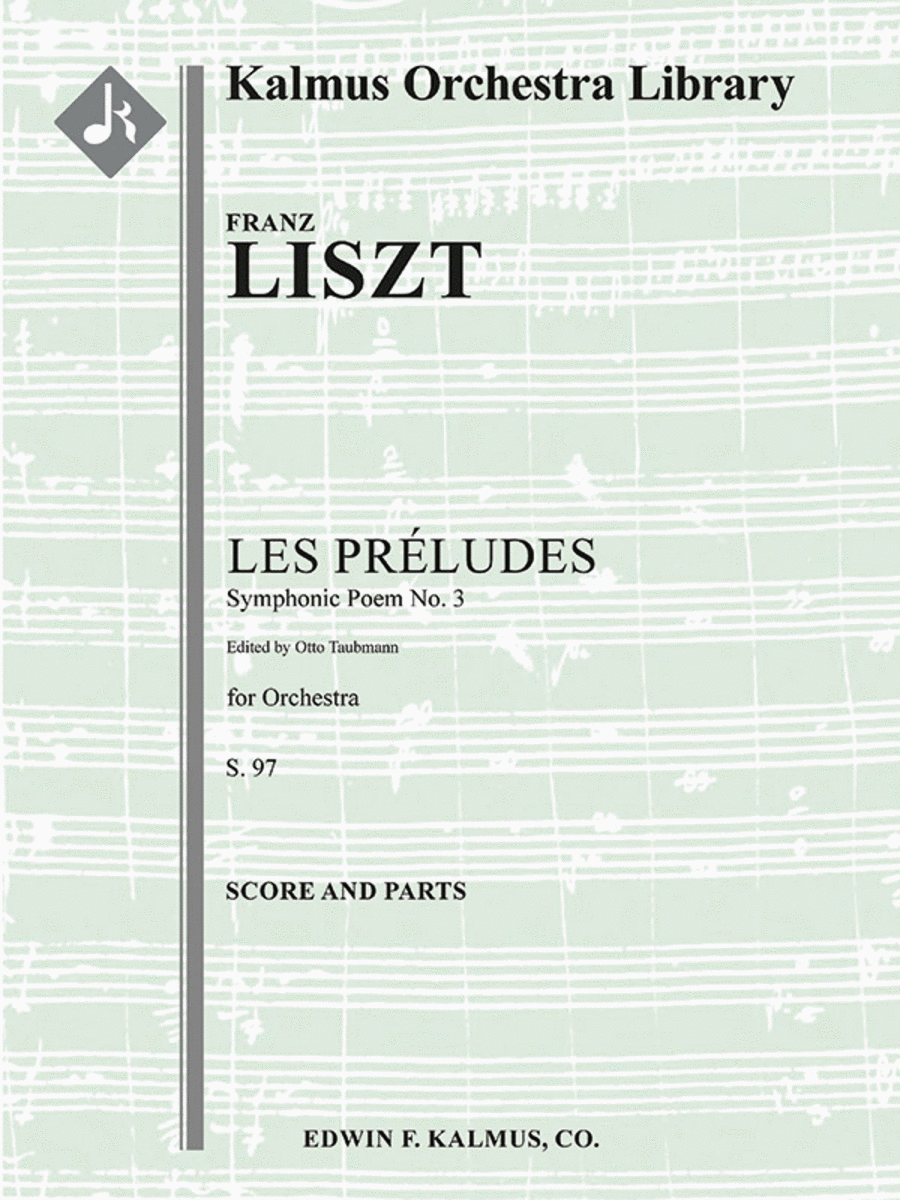
Orchestra 3(3rd dPicc).2.2.2: 4.2.3.1: Timp.Perc(2-3): Hp: Str (9-8-7-6-5 in set)
SKU: AP.36-A163802
Arranged by Otto Taubmann and ed./arr. by Otto Taubmann. Full Orchestra. Kalmus Orchestra Library. Score and Part(s). LudwigMasters Publications #36-A163802. Published by LudwigMasters Publications (AP.36-A163802).
UPC: 659359868511. English.
Hungarian virtuoso pianist and composer Franz Liszt (1811-1886) began to develop the concept of the symphonic poem (symphonische dichtung; poème symphonique) following his 1847 retirement from concert performances at the piano and settlement in Weimar. The Western music world was entrenched in a debate about non-programmatic versus programmatic music and the future of the symphonic form. Liszt's symphonic poems put him firmly in the programmatic camp, while he also adapted Beethoven's cyclic form so that the entire work could be contained in a single movement. His SYMPHONIC POEM No. 3: LES PRÉLUDES (Preludes or The Beginnings), S. 97 is the actual first use of the term symphonic poem. It was originally intended as an overture for a choral cycle titled LES QUATRE ÉLÉMENS (The Four Elements), based on four poems by Joseph Autran. When the overture concept was abandoned for the symphonic poem, the inspiration also changed to an ode by the French poet Alphonse de Lamartine, also titled LES PRÉLUDES, resulting in some confusion about the programmatic inspiration. Further controversy resulted from Liszt's recruitment of composer Joachim Raff to help assist Liszt in orchestration, and area of weakness the great pianist. Despite later research proving that Liszt had a dominant hand and final say in all orchestration matters, often rejecting or modifying Raff's proposals, Raff's public proclamations that he was responsible for the orchestration created doubts about Liszt's role in that for decades. The work premiered in Weimar on February 23, 1854, Liszt himself conducting, and it has remained the most popular of his symphonic poems in the orchestral repertoire, performed frequently today. Instrumentation: 3(3rd dPicc).2.2.2: 4.2.3.1: Timp.Perc(2-3): Hp: Str (9-8-7-6-5 in set).
These products are currently being prepared by a new publisher. While many items are ready and will ship on time, some others may see delays of several months.
Orchestra 3(3rd dPicc).2.2.2: 4.2.3.1: Timp.Perc(2-3): Hp: Str (9-8-7-6-5 in set)
SKU: AP.36-A163802
Arranged by Otto Taubmann and ed./arr. by Otto Taubmann. Full Orchestra. Kalmus Orchestra Library. Score and Part(s). LudwigMasters Publications #36-A163802. Published by LudwigMasters Publications (AP.36-A163802).
UPC: 659359868511. English.
Hungarian virtuoso pianist and composer Franz Liszt (1811-1886) began to develop the concept of the symphonic poem (symphonische dichtung; poème symphonique) following his 1847 retirement from concert performances at the piano and settlement in Weimar. The Western music world was entrenched in a debate about non-programmatic versus programmatic music and the future of the symphonic form. Liszt's symphonic poems put him firmly in the programmatic camp, while he also adapted Beethoven's cyclic form so that the entire work could be contained in a single movement. His SYMPHONIC POEM No. 3: LES PRÉLUDES (Preludes or The Beginnings), S. 97 is the actual first use of the term symphonic poem. It was originally intended as an overture for a choral cycle titled LES QUATRE ÉLÉMENS (The Four Elements), based on four poems by Joseph Autran. When the overture concept was abandoned for the symphonic poem, the inspiration also changed to an ode by the French poet Alphonse de Lamartine, also titled LES PRÉLUDES, resulting in some confusion about the programmatic inspiration. Further controversy resulted from Liszt's recruitment of composer Joachim Raff to help assist Liszt in orchestration, and area of weakness the great pianist. Despite later research proving that Liszt had a dominant hand and final say in all orchestration matters, often rejecting or modifying Raff's proposals, Raff's public proclamations that he was responsible for the orchestration created doubts about Liszt's role in that for decades. The work premiered in Weimar on February 23, 1854, Liszt himself conducting, and it has remained the most popular of his symphonic poems in the orchestral repertoire, performed frequently today. Instrumentation: 3(3rd dPicc).2.2.2: 4.2.3.1: Timp.Perc(2-3): Hp: Str (9-8-7-6-5 in set).
These products are currently being prepared by a new publisher. While many items are ready and will ship on time, some others may see delays of several months.
Preview: Symphonic Poem No. 3: Les Preludes, S. 97
Tell A Friend
Tell a friend (or remind yourself) about this product. We'll instantly send an email containing product info and a link to it. You may also enter a personal message.
We do not use or store email addresses from this form for any other purpose than sending your share email.
After purchase, you can download your MP3 from your Sheet Music Plus Digital Library - no software installation is necessary! You can also listen to your MP3 at any time in your Digital Library.
Learn about Smart Music
After purchase, you can download your Smart Music from your Sheet Music Plus Digital Library - no software installation is necessary! You can also download at any time in your Digital Library.
Learn about Digital Video
After purchase you can download your video from your Digital Library. Your video is in XX format and is playable on most pre-installed video players.