Order two or more copies of the same title and we'll automatically give you 5% off list price on that title.
To get 2+ Pricing , just add two or more copies of a title to your shopping cart. Your discount will be immediately applied to your order.
Sale titles, hymnals, and ShowKits (MTI's Broadway Junior Collection, Getting to Know... Collection (G2K) and MTI's Kids Collection) do not qualify for 2+ Pricing
If you have any questions or comments regarding 2+ Pricing , please visit our Help Center to find more information or chat with our support team
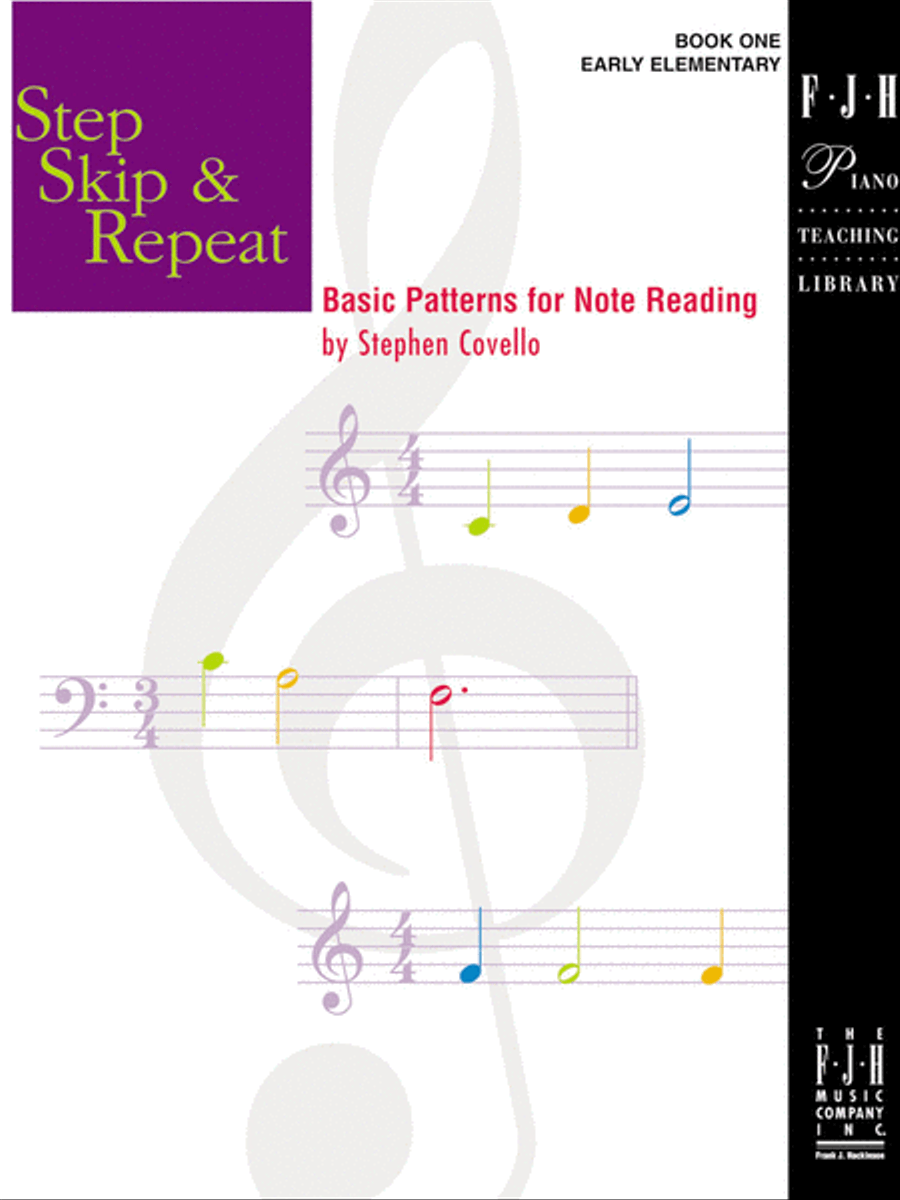
1. Basic Patterns for Note Reading. Composed by Stephen Covello. Piano Musicianship; Technique Musicianship. The FJH Piano Teaching Library. Book 1 contains: instructional material with written work; etudes-progressive melodic pieces consisting of steps, skips, and/or repeated notes; and songs-well-known folk, traditional, and classic tunes. Book. The FJH Music Company Inc #98-FJH1128. Published by The FJH Music Company Inc (AP.98-FJH1128).
ISBN 9781569390528. UPC: 674398201723. English.
The first of a two-volume reading course designed to enable students of all ages to read music using the three basic patterns of step, skip, and repeat. Book I contains: basic instructional material with written work; etudes - progressive melodic pieces consisting of steps, skips and/or repeated notes; and songs - well-known folk, traditional, and classic tunes.
1. Basic Patterns for Note Reading. Composed by Stephen Covello. Piano Musicianship; Technique Musicianship. The FJH Piano Teaching Library. Book 1 contains: instructional material with written work; etudes-progressive melodic pieces consisting of steps, skips, and/or repeated notes; and songs-well-known folk, traditional, and classic tunes. Book. The FJH Music Company Inc #98-FJH1128. Published by The FJH Music Company Inc (AP.98-FJH1128).
ISBN 9781569390528. UPC: 674398201723. English.
The first of a two-volume reading course designed to enable students of all ages to read music using the three basic patterns of step, skip, and repeat. Book I contains: basic instructional material with written work; etudes - progressive melodic pieces consisting of steps, skips and/or repeated notes; and songs - well-known folk, traditional, and classic tunes.
French Folk song No. 1
French Folk Song No. 2
Go Tell Aunt Rhody
Lightly Row
Love of My Heart
Merrily We Roll Along
Oats, Peas and Beans
Snake Charmer
The Cuckoo
Theme From Beethoven's Ninth Symphony
Yankee Doodle
Ratings + Reviews
★Based on 1 Reviews
★
Anonymous
October 17, 2011
great for sight reading
This book uses the step skip and repeat method for teaching sight reading. You start first with lines of steps, where the child learns to recognize that one note is one step above or one step below another. Then the 2nd section of the book goes to skips, where the child recognizes skips (two steps above or below the first), and plays a sequence of skips. Then the 3rd section goes to a combination of steps and skips. In this way, the child doesn't have to recognize the note as say an A; she learns directional relations, which is obviously much easier to begin with.
Preview: Step Skip & Repeat, Book 1
Tell A Friend
Tell a friend (or remind yourself) about this product. We'll instantly send an email containing product info and a link to it. You may also enter a personal message.
We do not use or store email addresses from this form for any other purpose than sending your share email.
After purchase, you can download your MP3 from your Sheet Music Plus Digital Library - no software installation is necessary! You can also listen to your MP3 at any time in your Digital Library.
Learn about Smart Music
After purchase, you can download your Smart Music from your Sheet Music Plus Digital Library - no software installation is necessary! You can also download at any time in your Digital Library.
Learn about Digital Video
After purchase you can download your video from your Digital Library. Your video is in XX format and is playable on most pre-installed video players.