For violin and Cello. Composed by Richard Wernick. This edition: saddle-wire stitch. Sws. Contemporary. Performance scores. With Standard notation. Composed April 9 2014. 48 pages. Duration 0:12:00. Theodore Presser Company #114-41659. Published by Theodore Presser Company (PR.114416590).
ISBN 9781598069464. UPC: 680160624133. 9 x 12 inches.
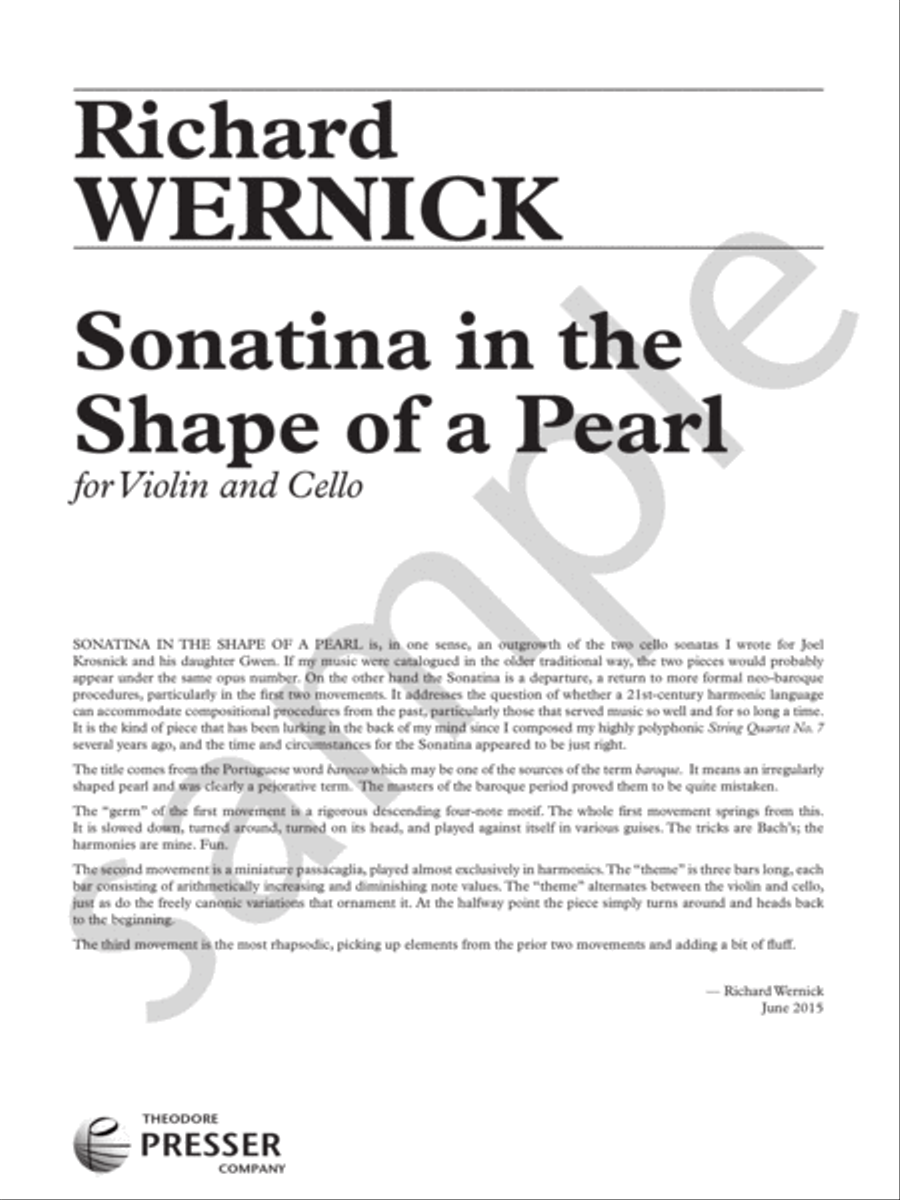
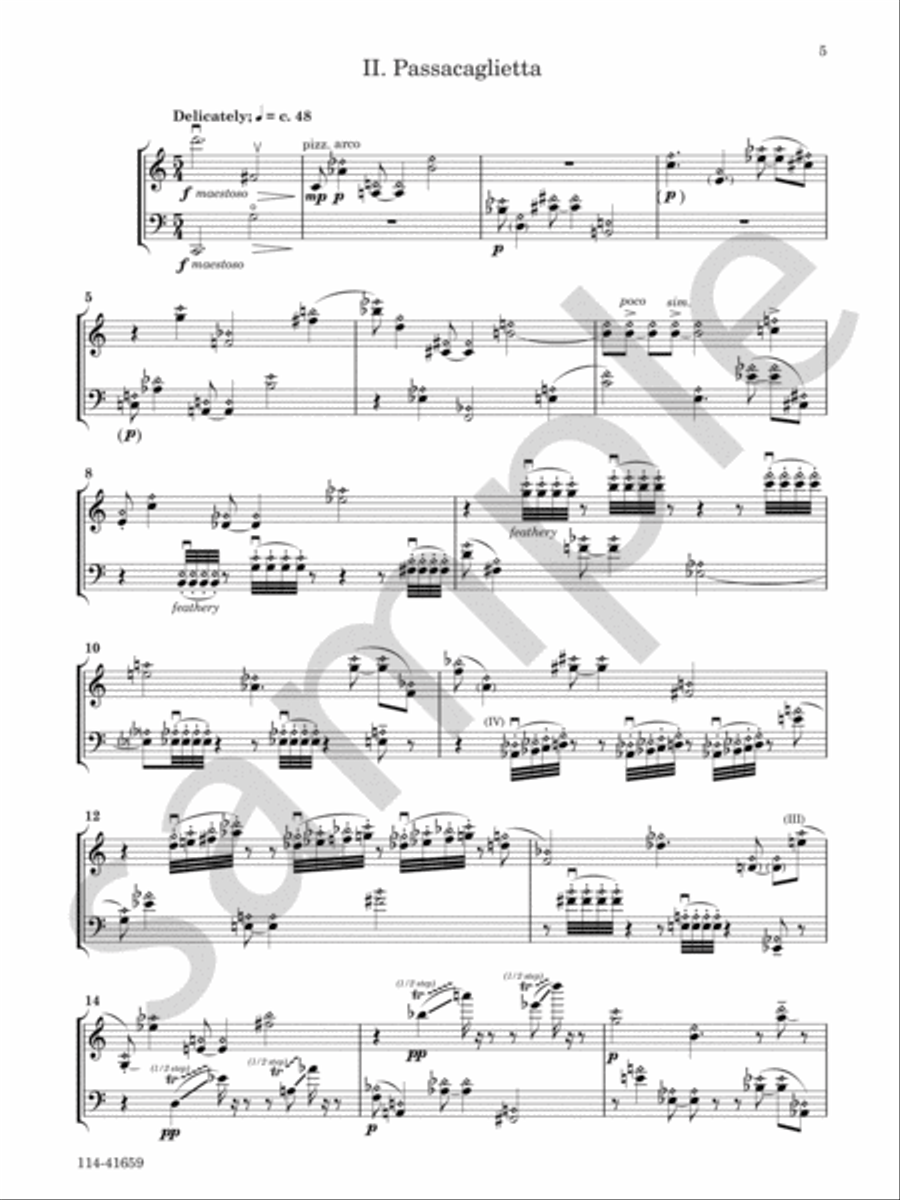
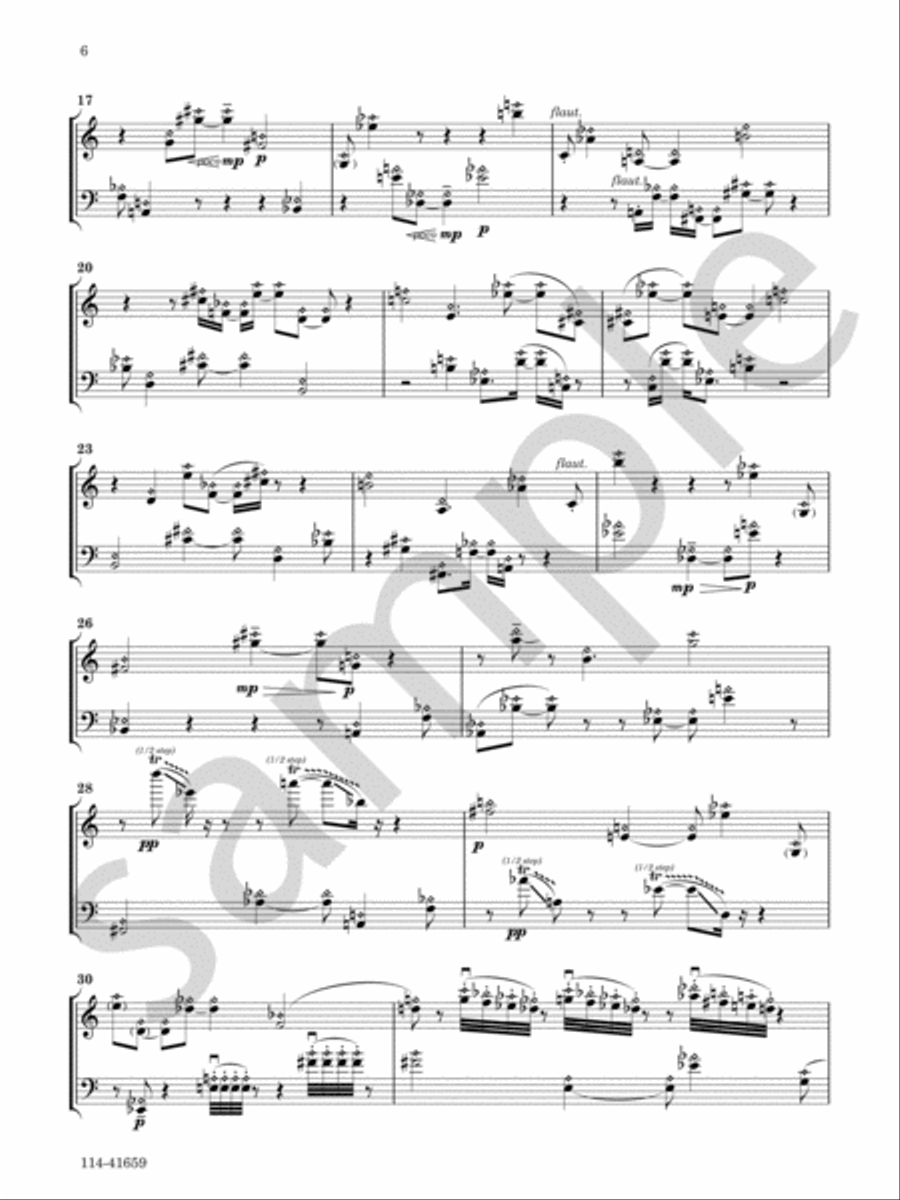
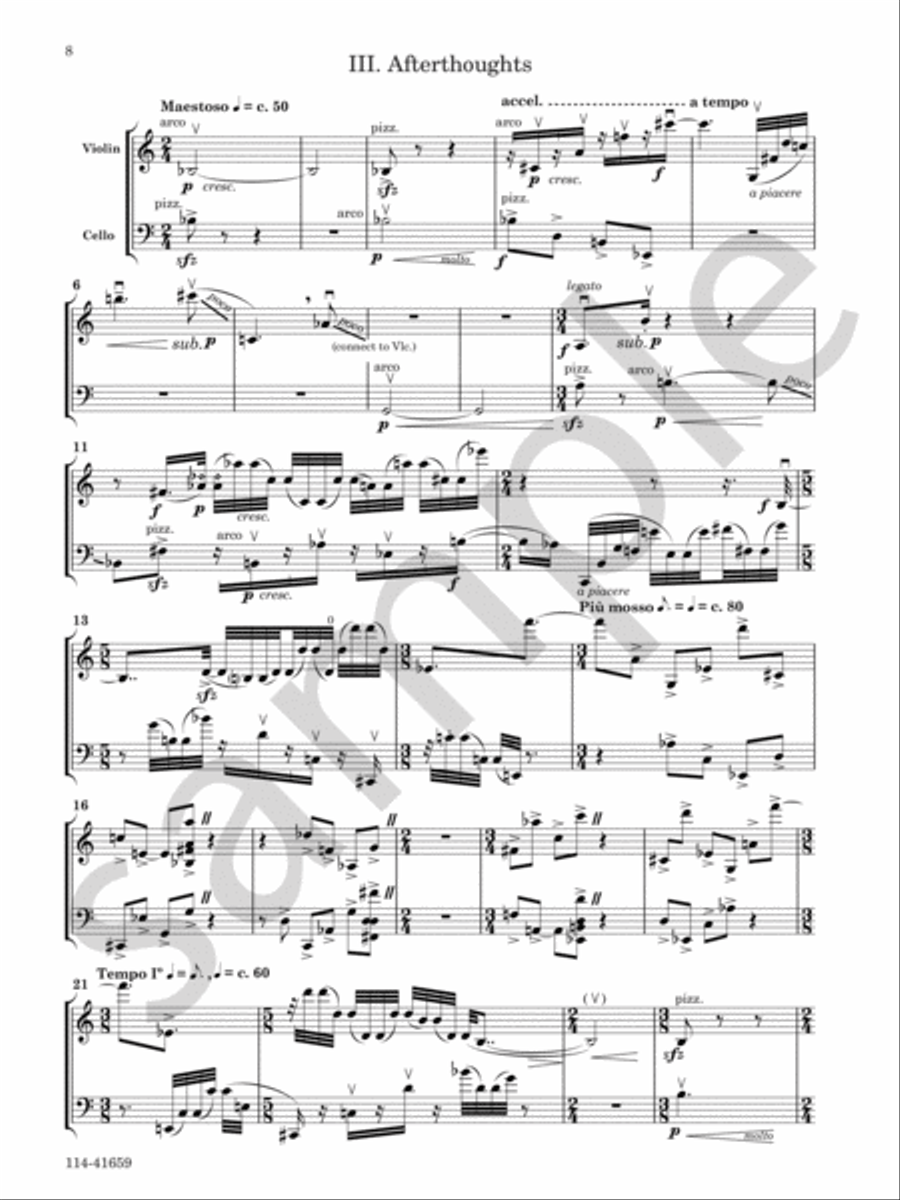
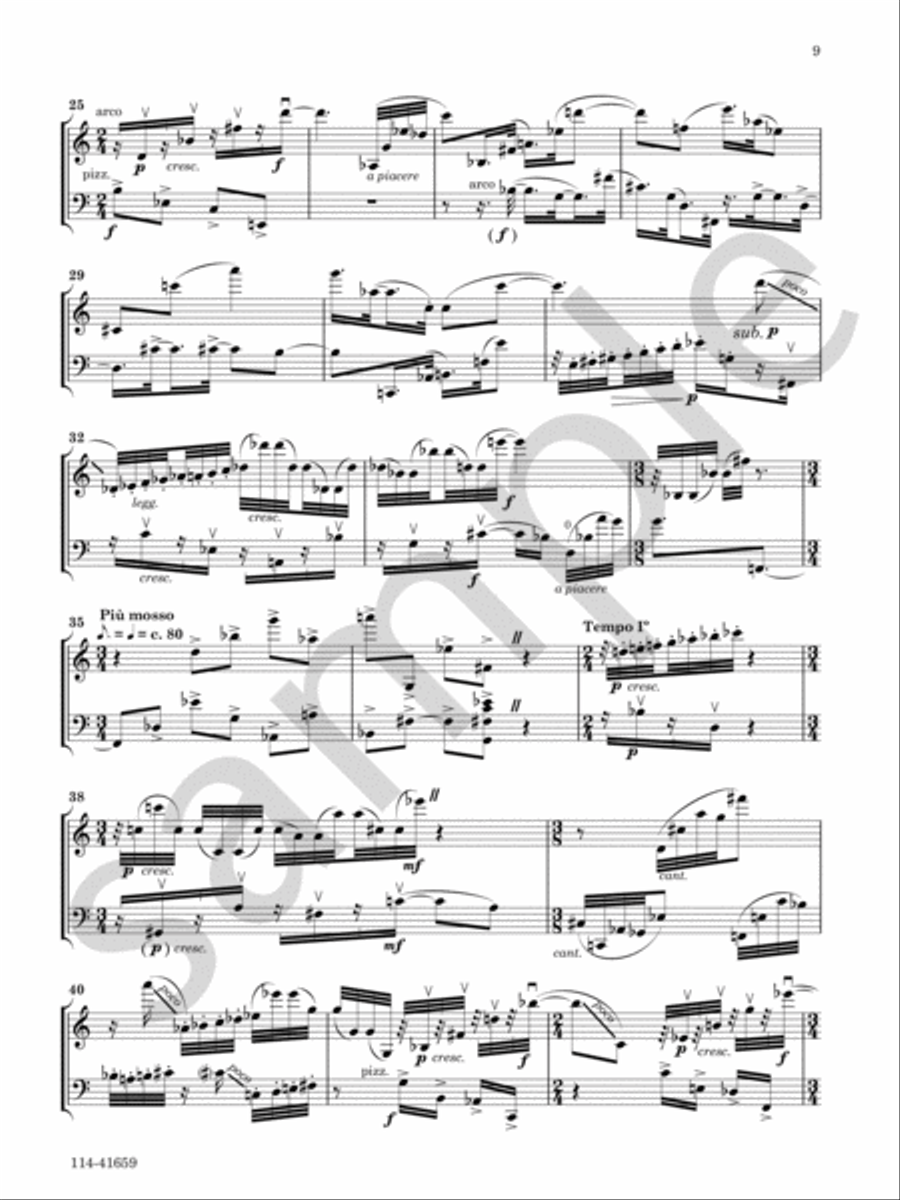
An outgrowth of Wernick's Sonata for Two (for two cellos), composed for Joel Krosnick and his daughter Gwen, Sonatina in the Shape of a Pearl is a return to more formal neo-baroque procedures. The title comes from the Portuguese word barocco, thought to be the source of the term baroque, and a pejorative term for an irregularly shaped pearl. The first movement is based on a four-note motif that is slowed down, turned around, turned on its head, and played against itself in various guises. The second movement is a miniature passacaglia, played almost exclusively in harmonics. The third movement is the most rhapsodic, picking up elements from the prior two movements and adding a bit of fluff. SONATINA IN THE SHAPE OF A PEARL is, in one sense, an outgrowth of the two cello sonatas I wrote for Joel Krosnick and his daughter Gwen. If my music were catalogued in the older traditional way, the two pieces would probably appear under the same opus number. On the other hand the Sonatina is a departure, a return to more formal neo-baroque procedures, particularly in the first two movements. It addresses the question of whether a 21st-century harmonic language can accommodate compositional procedures from the past, particularly those that served music so well and for so long a time. It is the kind of piece that has been lurking in the back of my mind since I composed my highly polyphonic String Quartet No. 7 several years ago, and the time and circumstances for the Sonatina appeared to be just right.The title comes from the Portuguese word barocco which may be one of the sources of the term baroque. It means an irregularlyshaped pearl and was clearly a pejorative term. The masters of the baroque period proved them to be quite mistaken.The “germ” of the first movement is a rigorous descending four-note motif. The whole first movement springs from this.It is slowed down, turned around, turned on its head, and played against itself in various guises. The tricks are Bach’s; theharmonies are mine. Fun.The second movement is a miniature passacaglia, played almost exclusively in harmonics. The “theme” is three bars long, eachbar consisting of arithmetically increasing and diminishing note values. The “theme” alternates between the violin and cello,just as do the freely canonic variations that ornament it. At the halfway point the piece simply turns around and heads backto the beginning.The third movement is the most rhapsodic, picking up elements from the prior two movements and adding a bit of fluff.— Richard WernickJune 2015.
For violin and Cello. Composed by Richard Wernick. This edition: saddle-wire stitch. Sws. Contemporary. Performance scores. With Standard notation. Composed April 9 2014. 48 pages. Duration 0:12:00. Theodore Presser Company #114-41659. Published by Theodore Presser Company (PR.114416590).
ISBN 9781598069464. UPC: 680160624133. 9 x 12 inches.
An outgrowth of Wernick's Sonata for Two (for two cellos), composed for Joel Krosnick and his daughter Gwen, Sonatina in the Shape of a Pearl is a return to more formal neo-baroque procedures. The title comes from the Portuguese word barocco, thought to be the source of the term baroque, and a pejorative term for an irregularly shaped pearl. The first movement is based on a four-note motif that is slowed down, turned around, turned on its head, and played against itself in various guises. The second movement is a miniature passacaglia, played almost exclusively in harmonics. The third movement is the most rhapsodic, picking up elements from the prior two movements and adding a bit of fluff. SONATINA IN THE SHAPE OF A PEARL is, in one sense, an outgrowth of the two cello sonatas I wrote for Joel Krosnick and his daughter Gwen. If my music were catalogued in the older traditional way, the two pieces would probably appear under the same opus number. On the other hand the Sonatina is a departure, a return to more formal neo-baroque procedures, particularly in the first two movements. It addresses the question of whether a 21st-century harmonic language can accommodate compositional procedures from the past, particularly those that served music so well and for so long a time. It is the kind of piece that has been lurking in the back of my mind since I composed my highly polyphonic String Quartet No. 7 several years ago, and the time and circumstances for the Sonatina appeared to be just right.The title comes from the Portuguese word barocco which may be one of the sources of the term baroque. It means an irregularlyshaped pearl and was clearly a pejorative term. The masters of the baroque period proved them to be quite mistaken.The “germ” of the first movement is a rigorous descending four-note motif. The whole first movement springs from this.It is slowed down, turned around, turned on its head, and played against itself in various guises. The tricks are Bach’s; theharmonies are mine. Fun.The second movement is a miniature passacaglia, played almost exclusively in harmonics. The “theme” is three bars long, eachbar consisting of arithmetically increasing and diminishing note values. The “theme” alternates between the violin and cello,just as do the freely canonic variations that ornament it. At the halfway point the piece simply turns around and heads backto the beginning.The third movement is the most rhapsodic, picking up elements from the prior two movements and adding a bit of fluff.— Richard WernickJune 2015.
Preview: Sonatina in the Shape Of A Pearl
Tell A Friend
Tell a friend (or remind yourself) about this product. We'll instantly send an email containing product info and a link to it. You may also enter a personal message.
We do not use or store email addresses from this form for any other purpose than sending your share email.
After purchase, you can download your MP3 from your Sheet Music Plus Digital Library - no software installation is necessary! You can also listen to your MP3 at any time in your Digital Library.
Learn about Smart Music
After purchase, you can download your Smart Music from your Sheet Music Plus Digital Library - no software installation is necessary! You can also download at any time in your Digital Library.
Learn about Digital Video
After purchase you can download your video from your Digital Library. Your video is in XX format and is playable on most pre-installed video players.