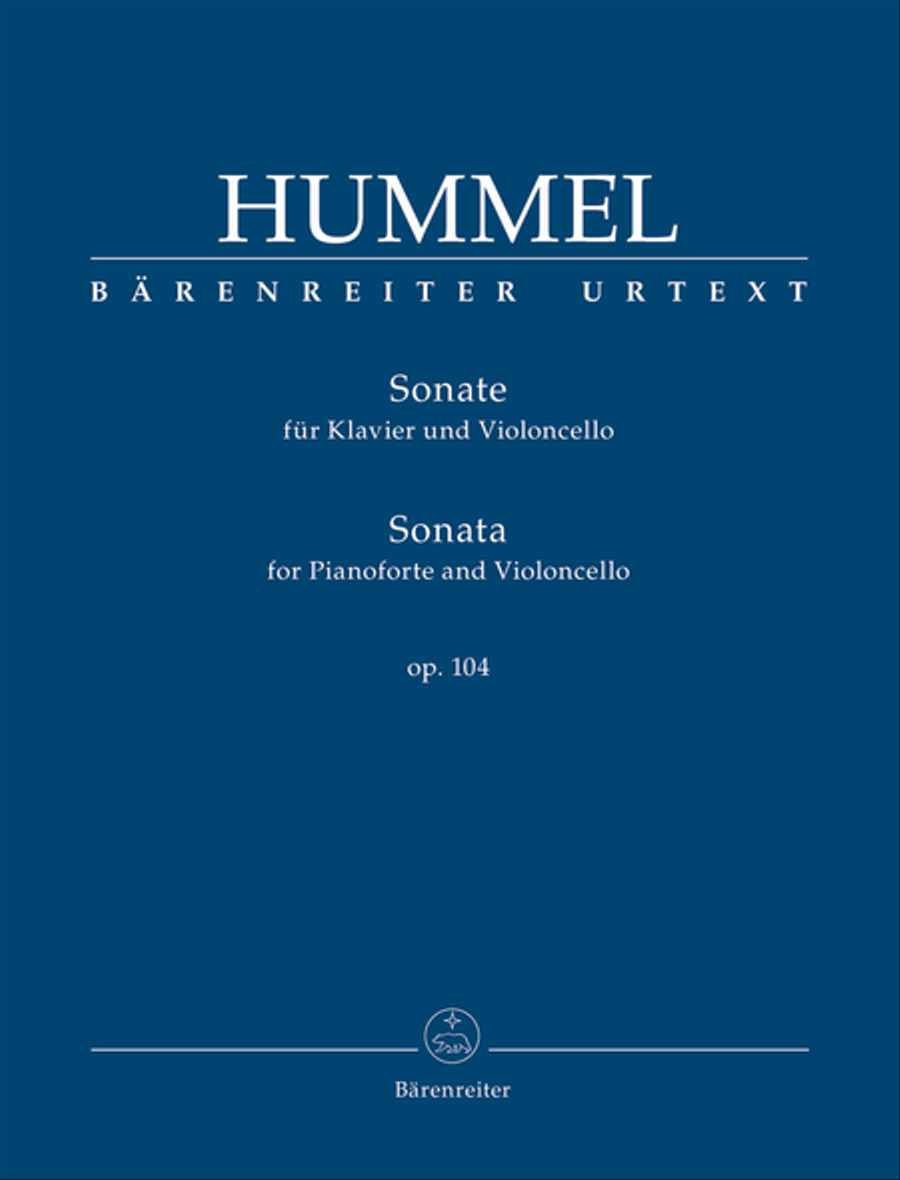
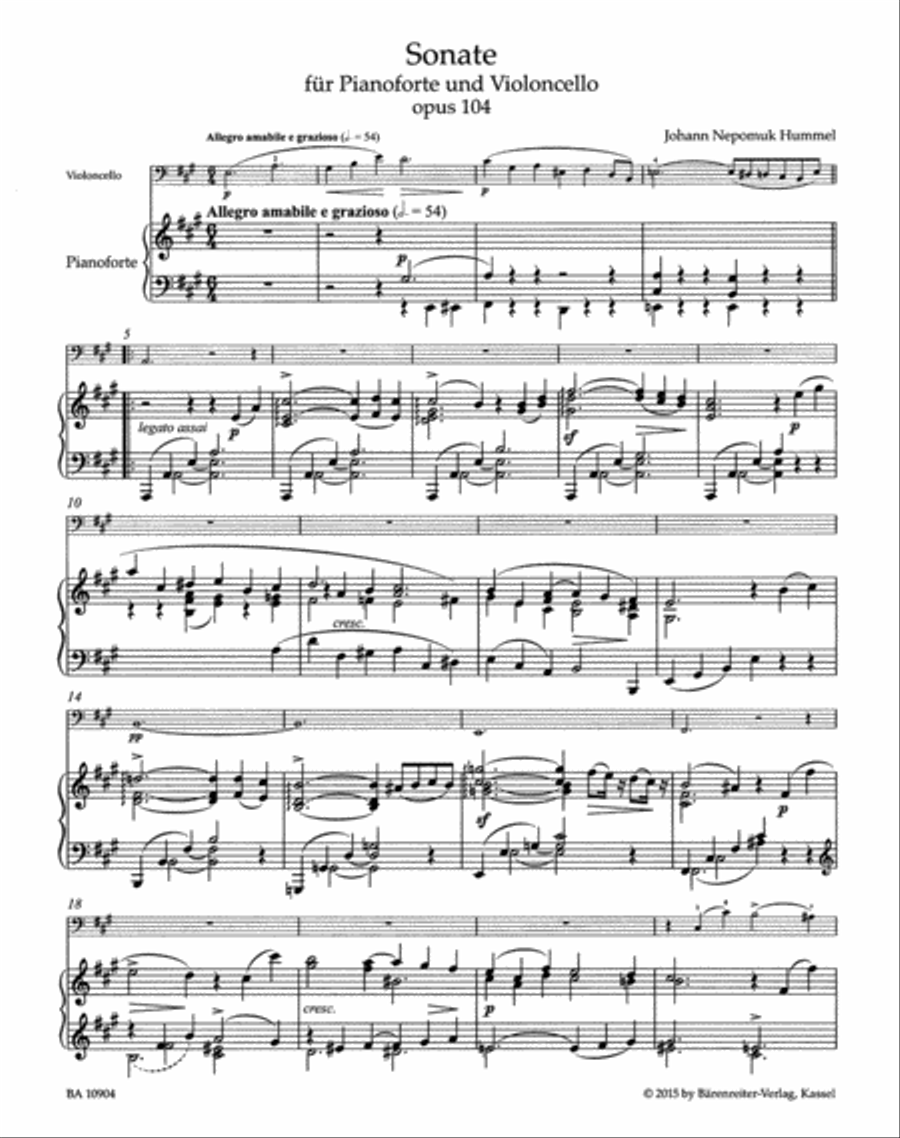
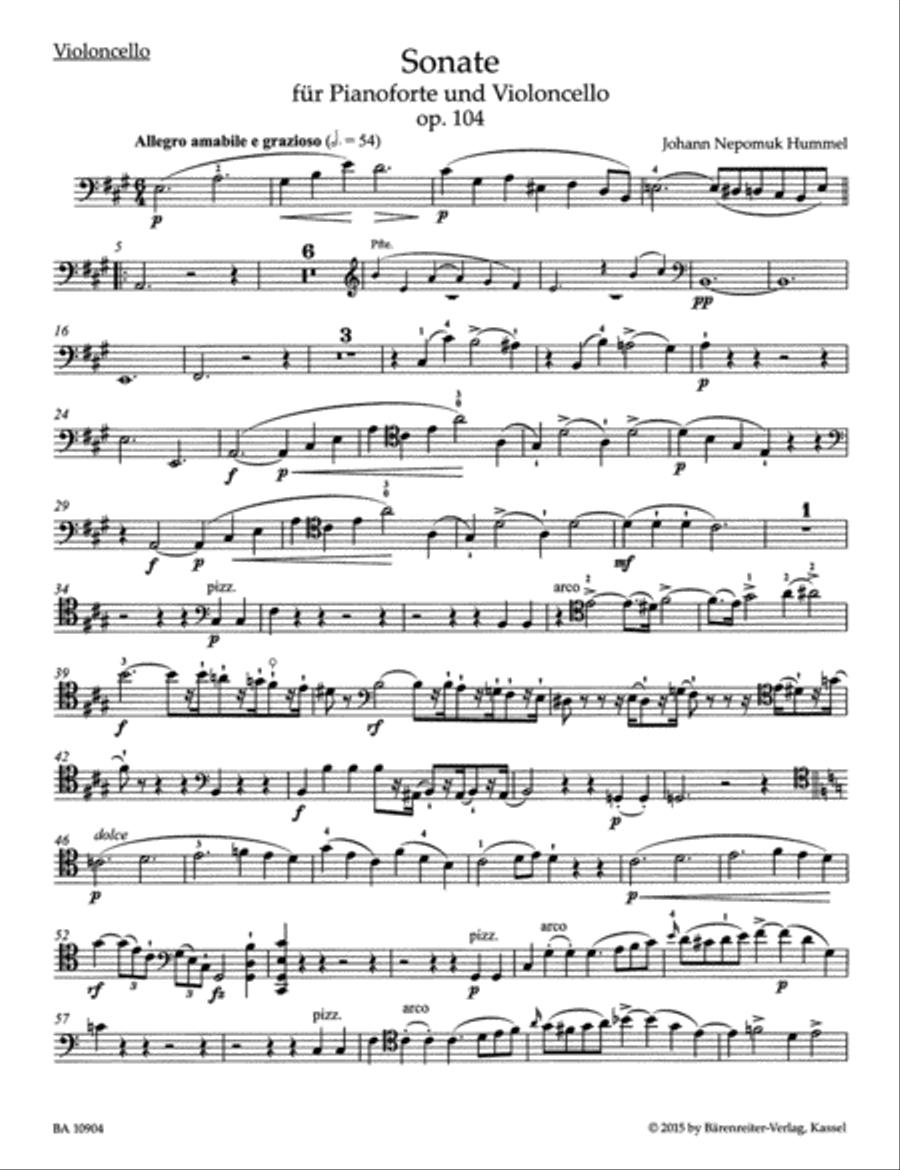
Composed by Johann Nepomuk Hummel. Edited by Mark Kroll. This edition: urtext edition. Stapled. Barenreiter Urtext. Performance score, Part. Opus 104. Baerenreiter Verlag #BA10904. Published by Baerenreiter Verlag (BA.BA10904).
ISBN 9790006558001. 12.2 x 9.57 inches. Preface: Mark Kroll.
Famous in his day, the Austrian composer and pianist Johann Nepomuk Hummel (1778–1837) studied with Mozart and befriended Beethoven. Among his many works is a relatively late sonata for violoncello and piano composed in 1824 and published in 1826 – a delightful early Romantic piece in three movements supported by a capricious piano part. The expressive cello cantilena in the “Romance” will capture the heart of every cellist.
Our edition, edited by Mark Kroll, is the first scholarly-critical publication of this sonata. It is based on the first edition of 1826 and the autograph manuscript, which served as a master copy for the engraving. A comparison of the sources brought to light a number of details overlooked in the first edition, especially with regard to dynamics.
About Barenreiter Urtext
What can I expect from a Barenreiter Urtext edition?
MUSICOLOGICALLY SOUND - A reliable musical text based on all available sources - A description of the sources - Information on the genesis and history of the work - Valuable notes on performance practice - Includes an introduction with critical commentary explaining source discrepancies and editorial decisions
... AND PRACTICAL - Page-turns, fold-out pages, and cues where you need them - A well-presented layout and a user-friendly format - Excellent print quality - Superior paper and binding
Composed by Johann Nepomuk Hummel. Edited by Mark Kroll. This edition: urtext edition. Stapled. Barenreiter Urtext. Performance score, Part. Opus 104. Baerenreiter Verlag #BA10904. Published by Baerenreiter Verlag (BA.BA10904).
ISBN 9790006558001. 12.2 x 9.57 inches. Preface: Mark Kroll.
Famous in his day, the Austrian composer and pianist Johann Nepomuk Hummel (1778–1837) studied with Mozart and befriended Beethoven. Among his many works is a relatively late sonata for violoncello and piano composed in 1824 and published in 1826 – a delightful early Romantic piece in three movements supported by a capricious piano part. The expressive cello cantilena in the “Romance” will capture the heart of every cellist.
Our edition, edited by Mark Kroll, is the first scholarly-critical publication of this sonata. It is based on the first edition of 1826 and the autograph manuscript, which served as a master copy for the engraving. A comparison of the sources brought to light a number of details overlooked in the first edition, especially with regard to dynamics.
About Barenreiter Urtext
What can I expect from a Barenreiter Urtext edition?
MUSICOLOGICALLY SOUND - A reliable musical text based on all available sources - A description of the sources - Information on the genesis and history of the work - Valuable notes on performance practice - Includes an introduction with critical commentary explaining source discrepancies and editorial decisions
... AND PRACTICAL - Page-turns, fold-out pages, and cues where you need them - A well-presented layout and a user-friendly format - Excellent print quality - Superior paper and binding
Preview: Sonata for Pianoforte and Violoncello op. 104
Tell A Friend
Tell a friend (or remind yourself) about this product. We'll instantly send an email containing product info and a link to it. You may also enter a personal message.
We do not use or store email addresses from this form for any other purpose than sending your share email.
After purchase, you can download your MP3 from your Sheet Music Plus Digital Library - no software installation is necessary! You can also listen to your MP3 at any time in your Digital Library.
Learn about Smart Music
After purchase, you can download your Smart Music from your Sheet Music Plus Digital Library - no software installation is necessary! You can also download at any time in your Digital Library.
Learn about Digital Video
After purchase you can download your video from your Digital Library. Your video is in XX format and is playable on most pre-installed video players.