

Details
- Instrument:
- Choir
- Ensembles:
- SSATB Orchestra Mixed Choir
- Genres:
- Christian Christmas Baroque Period
- Composers:
- Johann Sebastian Bach
- Publishers:
- Breitkopf and Haertel
- Series:
- Breitkopf Orchestral Library
- ISBN:
- 9790004349878
- Item types:
- Physical
- Artist:
- Johann Sebastian Bach
- Usages:
- Blessed Virgin Mary Psalms Magnificat
- Number of Pages:
- 8
- Size:
- 10 x 12.5 inches
- Shipping Weight:
- 0.45 pounds
SKU: BR.OB-5733-15
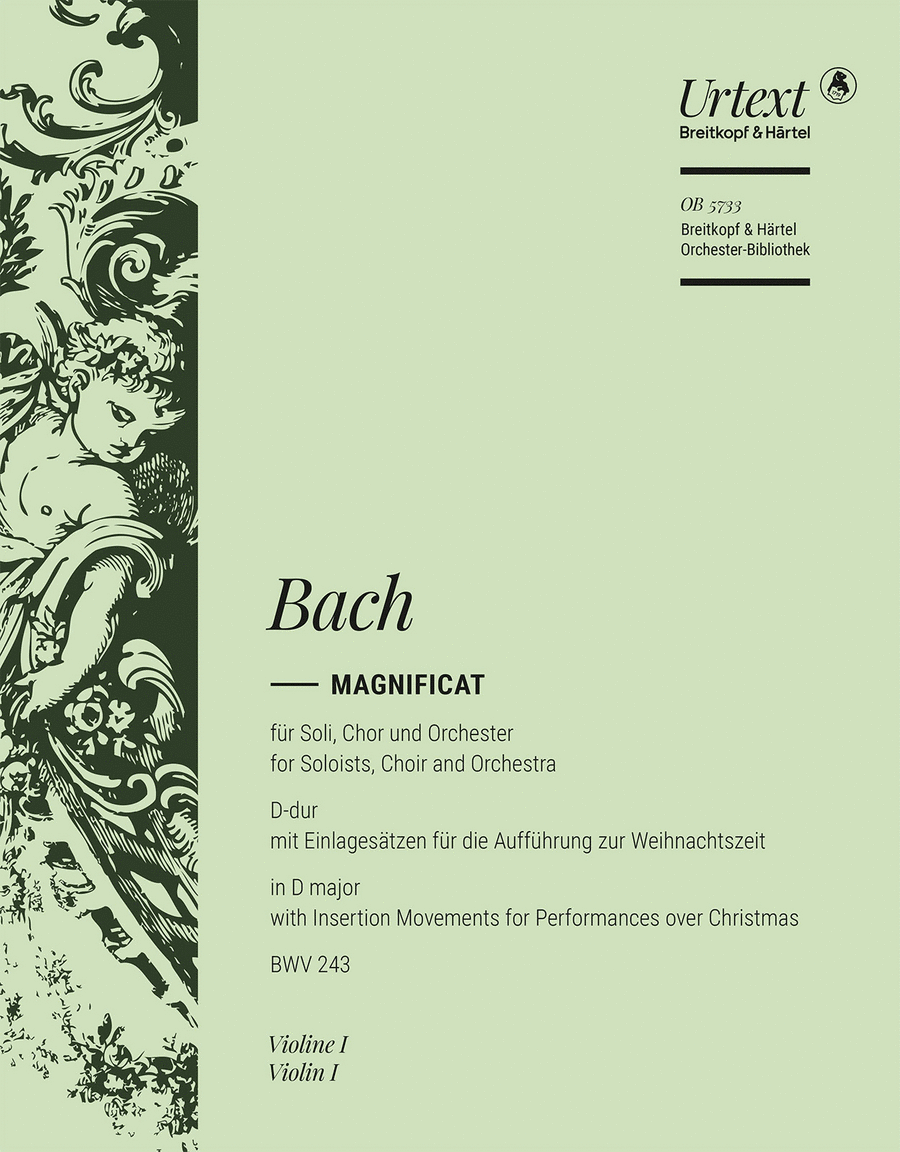
With the Insertion Movements of the Version in E flat major for Performances over Christmas – Urtext. Composed by Johann Sebastian Bach. Edited by David Erler. This edition: stapled. Choir; stapled. Orchester-Bibliothek (Orchestral Library). Psalm; Baroque. Indvidual part. 8 pages. Duration 40:00. Breitkopf and Haertel #OB 5733-15. Published by Breitkopf and Haertel (BR.OB-5733-15).ISBN 9790004349878. 10 x 12.5 inches.
Johann Sebastian Bach’s Magnificat BWV 243 is opulent festive music that in many respects represents a special feature in his œuvre. The first version (in E-flat major, BWV 243.1) was premiered only one month after Bach took up his post as Thomaskantor in Leipzig in 1723. In the same year, Bach adds the four Christmas interludes, so-called Lauds, and performs the expanded version again on Christmas Day. Eventually, between 1732 and 1735, he reworks the work in many places and changes the key to a more trumpet-friendly D major. It is in this version (BWV 243.2) that the work later becomes generally known.
The present edition adopts the interlude movements of the E-flat major version in a transposed form at the appropriate places in the score, parts, and piano vocal score. This allows a performance of the Magnificat in D major with interludes without time-consuming page-turning or the use of separate editions. In a performance without interlude movements, these can be paged over via a separate counting with Latin letters.
In addition, the editor undertakes a new reconstruction of the movement "Virga Jesse floruit," which survives only incompletely in the autograph. The preface and critical report provide detailed information on this and other editorial questions. After the edition of the Magnificat by Johann Kuhnau (PB 32108), David Erler now presents a standard-setting new edition of the Magnificat by J. S. Bach which places the work in the context of the Leipzig musical tradition.
- More by this Composer:
- Johann Sebastian Bach Johann Sebastian Bach Choir Johann Sebastian Bach Piano Johann Sebastian Bach Piano Accompaniment
- Series:
- Breitkopf Orchestral Library
- Artists:
- Johann Sebastian Bach
- Ensemble:
- SSATB Orchestra Mixed Choir
- Publisher:
- Breitkopf and Haertel