Order two or more copies of the same title and we'll automatically give you 5% off list price on that title.
To get 2+ Pricing , just add two or more copies of a title to your shopping cart. Your discount will be immediately applied to your order.
Sale titles, hymnals, and ShowKits (MTI's Broadway Junior Collection, Getting to Know... Collection (G2K) and MTI's Kids Collection) do not qualify for 2+ Pricing
If you have any questions or comments regarding 2+ Pricing , please visit our Help Center to find more information or chat with our support team
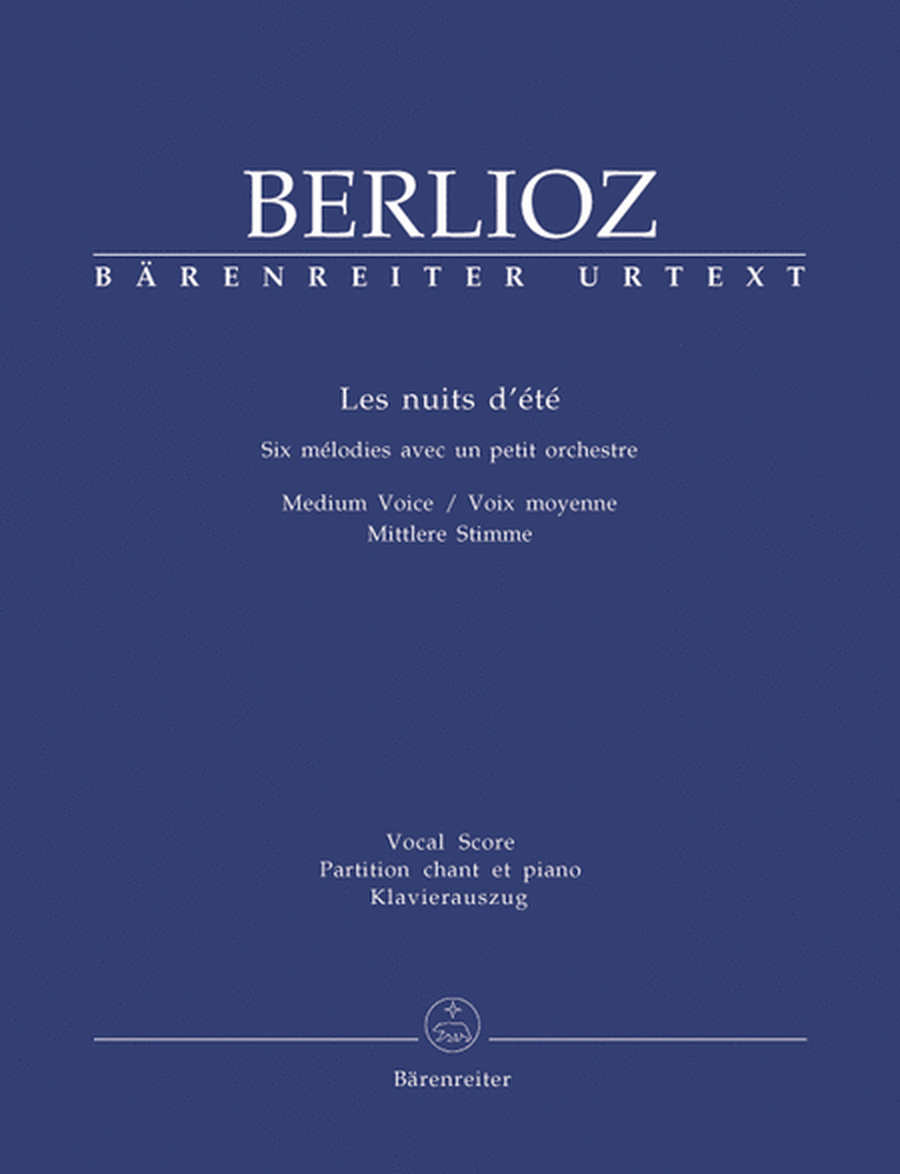
Six Songs. Composed by Hector Berlioz. Edited by Ian Kemp. Arranged by Douglas Woodfull-Harris. This edition: urtext edition. Paperback. Barenreiter Urtext. Vocal Score. Opus 7. Duration 25 minutes. Baerenreiter Verlag #BA05786-90. Published by Baerenreiter Verlag (BA.BA05786-90).
ISBN 9790006506033. 11.81 x 9.06 inches. Text: Theophile Gautier.
Berlioz composed these songs in 1840-41, between the composition of Romeo et Juliette and La damnation de Faust. The poems were taken from a collection entitled La comedie de la mort by Theophlie Gautier, published in 1838. The songs were for mezzo-soprano or tenor with piano accompaniment, and were published as a cycle under the title Les nuits d'ete in 1841. The second and fourth songs, Le spectre de la rose and Absence, were performed a few times at that period, and Absence was sung twice in February 1843 by Marie Recio on Berlioz's first tour of Germany. For Marie, who later became his second wife, Berlioz at once orchestrated the song for mezzo-soprano and small orchestra. A dozen years later Berlioz orchestrated the remaining five songs of the cycle, which appeared in its orchestral form in 1856. Two of these songs, Le spectre de la rose and Sur les lagunes, were now transposed to a lower key, so that the cycle was no longer within the compass of a single voice.
Six Songs. Composed by Hector Berlioz. Edited by Ian Kemp. Arranged by Douglas Woodfull-Harris. This edition: urtext edition. Paperback. Barenreiter Urtext. Vocal Score. Opus 7. Duration 25 minutes. Baerenreiter Verlag #BA05786-90. Published by Baerenreiter Verlag (BA.BA05786-90).
ISBN 9790006506033. 11.81 x 9.06 inches. Text: Theophile Gautier.
Berlioz composed these songs in 1840-41, between the composition of Romeo et Juliette and La damnation de Faust. The poems were taken from a collection entitled La comedie de la mort by Theophlie Gautier, published in 1838. The songs were for mezzo-soprano or tenor with piano accompaniment, and were published as a cycle under the title Les nuits d'ete in 1841. The second and fourth songs, Le spectre de la rose and Absence, were performed a few times at that period, and Absence was sung twice in February 1843 by Marie Recio on Berlioz's first tour of Germany. For Marie, who later became his second wife, Berlioz at once orchestrated the song for mezzo-soprano and small orchestra. A dozen years later Berlioz orchestrated the remaining five songs of the cycle, which appeared in its orchestral form in 1856. Two of these songs, Le spectre de la rose and Sur les lagunes, were now transposed to a lower key, so that the cycle was no longer within the compass of a single voice.
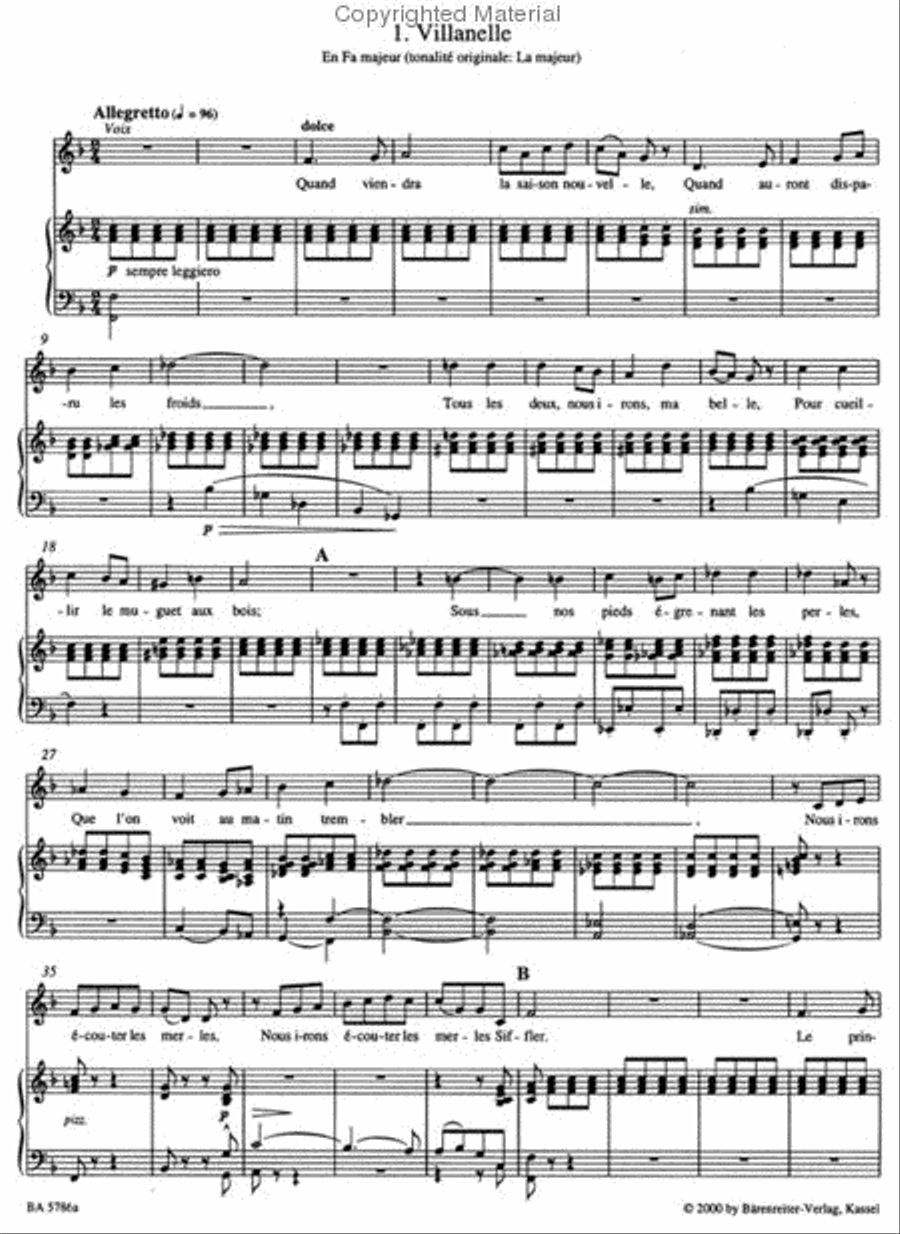
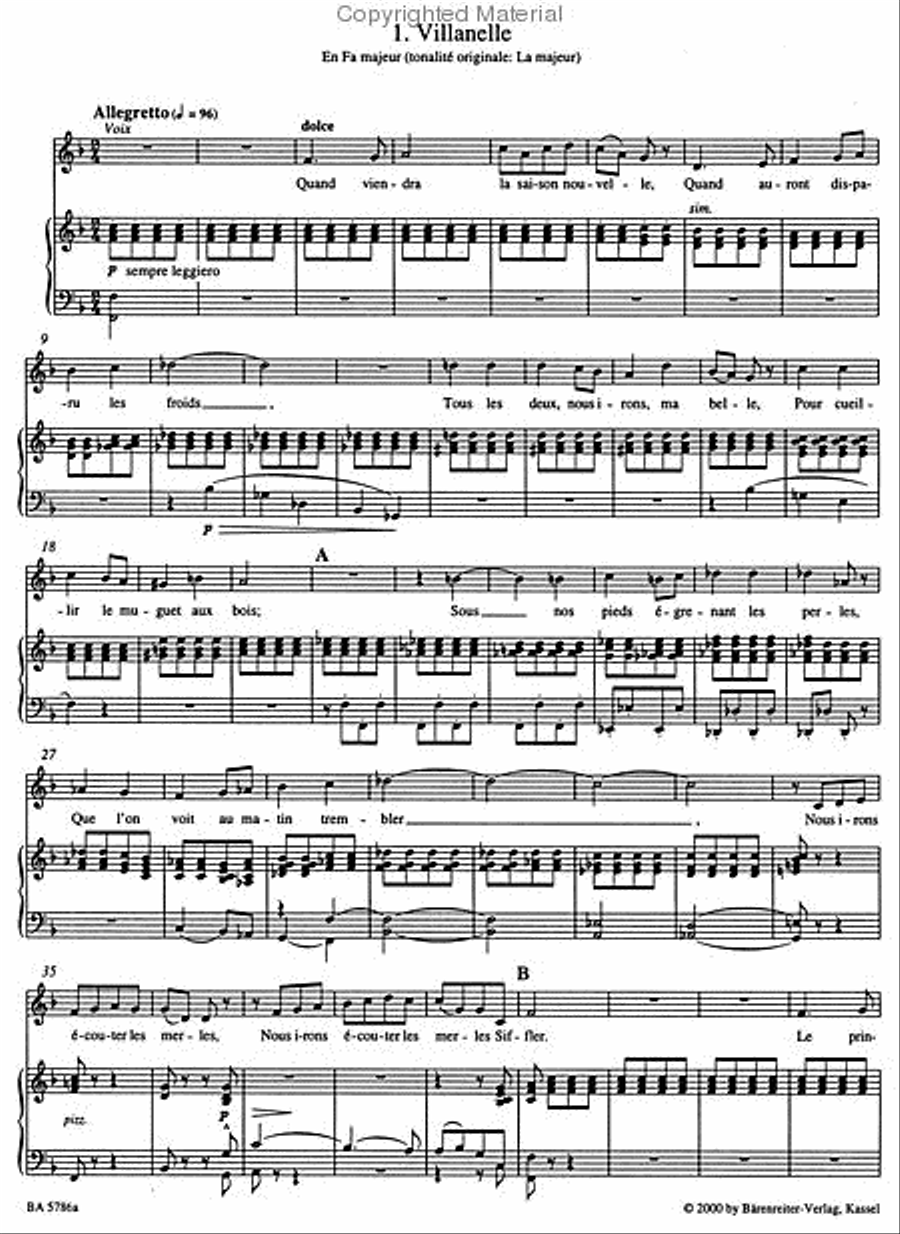
Villanelle
La Spectre de la rose
Sur les Lagunes
Absence
Au Cimetiere
L'Ile inconnue
Preview: Les nuits dete for Solo Voice and Orchestra op. 7 Hol. 81B
Tell A Friend
Tell a friend (or remind yourself) about this product. We'll instantly send an email containing product info and a link to it. You may also enter a personal message.
We do not use or store email addresses from this form for any other purpose than sending your share email.
After purchase, you can download your MP3 from your Sheet Music Plus Digital Library - no software installation is necessary! You can also listen to your MP3 at any time in your Digital Library.
Learn about Smart Music
After purchase, you can download your Smart Music from your Sheet Music Plus Digital Library - no software installation is necessary! You can also download at any time in your Digital Library.
Learn about Digital Video
After purchase you can download your video from your Digital Library. Your video is in XX format and is playable on most pre-installed video players.