Alexander Borodin Sheet Music

About Alexander Borodin

Alexander Borodin (1833-1887) was a distinguished Russian Romantic composer, celebrated for his vibrant orchestral works, operas, and chamber music that often blended Russian folk elements with exotic, "Oriental" influences. As a prominent member of "The Five" (also known as "The Mighty Handful"), a group of nationalist composers dedicated to forging a distinctly Russian classical music identity, Borodin left an indelible mark on music history through his rich harmonies, lyrical melodies, and vivid orchestration.

  • Despite his renown as a composer, Borodin's primary profession was that of a highly respected chemist and physician, contributing significantly to organic chemistry and advocating for women's education in science and medicine.
  • His most famous opera, "Prince Igor," which includes the popular "Polovtsian Dances," remained unfinished at his death and was subsequently completed by fellow composers Nikolai Rimsky-Korsakov and Alexander Glazunov.
  • The Broadway musical "Kismet" (1953) famously adapted many of Borodin's themes and melodies, particularly from "Prince Igor" and his Second Symphony, leading to a posthumous Tony Award for Borodin in 1954.

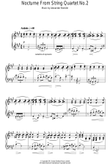
Borodin's sheet music offers a captivating journey into Russian Romanticism, suitable for intermediate to advanced instrumentalists and vocalists. Pianists can explore transcriptions of his famous orchestral pieces or his original, though less numerous, piano works, characterized by their lyrical and often nostalgic qualities. Chamber musicians, particularly string players, will find immense reward in his two String Quartets, especially the Second, with its beloved "Notturno" movement, showcasing elegant, romantic, and soulful melodies. Vocalists can delve into arias from "Prince Igor," while those who enjoy orchestral music can explore scores and parts for his symphonies and tone poems like "In the Steppes of Central Asia." Performing Borodin's music is a rewarding experience, offering rich melodic lines, dramatic scope, and a unique blend of accessible Romanticism with an exotic Russian flair.

Search all Alexander Borodin