Order two or more copies of the same title and we'll automatically give you 5% off list price on that title.
To get 2+ Pricing , just add two or more copies of a title to your shopping cart. Your discount will be immediately applied to your order.
Sale titles, hymnals, and ShowKits (MTI's Broadway Junior Collection, Getting to Know... Collection (G2K) and MTI's Kids Collection) do not qualify for 2+ Pricing
If you have any questions or comments regarding 2+ Pricing , please visit our Help Center to find more information or chat with our support team
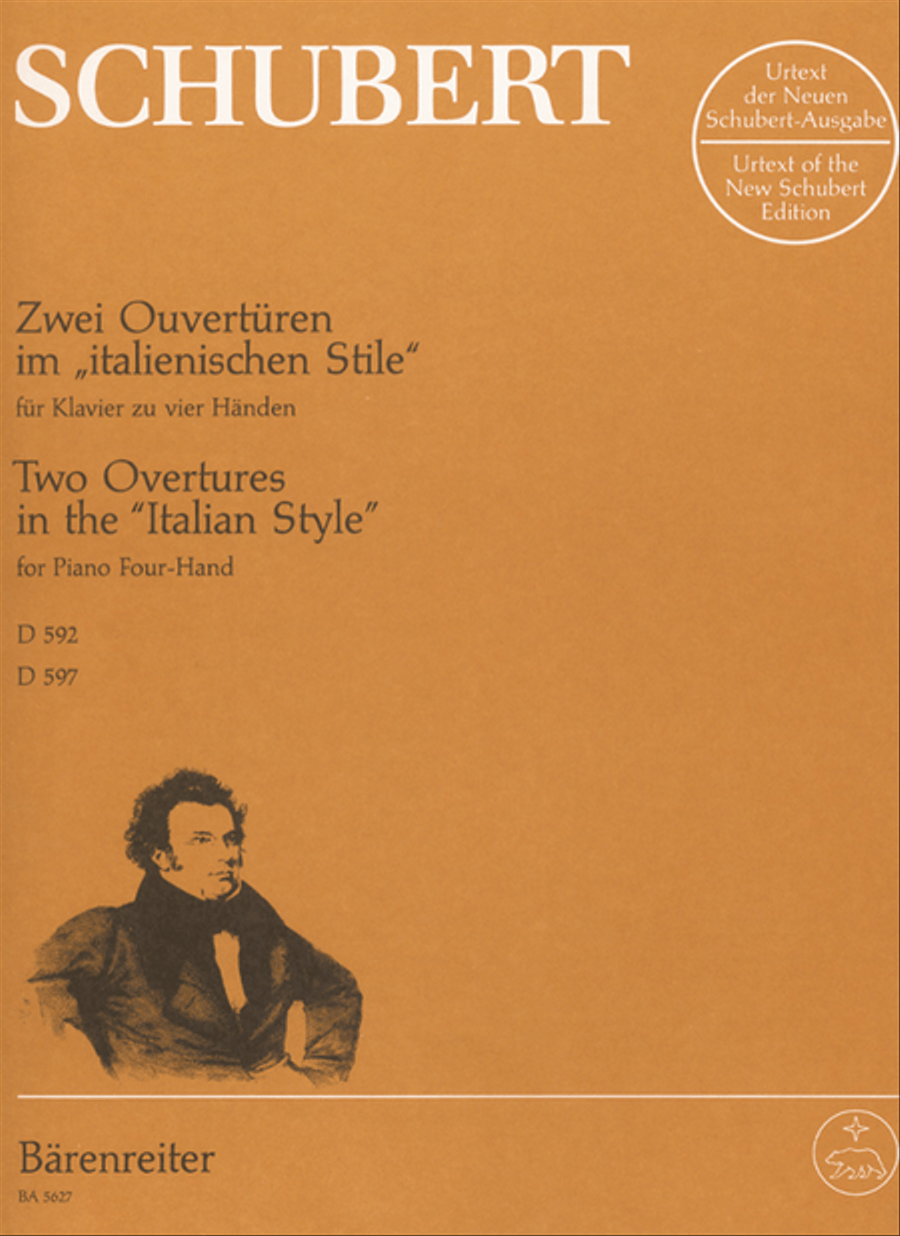
Arrangement by the composer of D 590 and D 591. Composed by Franz Schubert. Edited by Walburga Litschauer. This edition: urtext edition. Stapled. Barenreiter Urtext. Performance score, anthology. D 592, 597. 35 pages. Baerenreiter Verlag #BA05627. Published by Baerenreiter Verlag (BA.BA05627).
ISBN 9790006473175. 11.81 x 9.06 inches. Preface: Walburga Litschauer.
It was under the influence of Rossini, whose operas enjoyed great popularity in Vienna, that Schubert in November 1817 wrote two orchestral overtures “in the Italy style” (D 590 und D 591).
According to Schubert’s first biographer, Heinrich Kreissle, these pieces owe their existence to a musical wager. The composer had attended a performance of Rossini’s opera “Tancredi”, the overture of which was praised to the skies by his friends. “Doubtless finding these laudations excessive, Schubert was roused to a spirit of contradiction and declared that he would have no difficulty writing overtures of this sort in a similar style within the briefest span of time. His companions took him at his word and vowed, for their parts, to reward the deed with a glass of good wine. Schubert set to work immediately and composed an overture for orchestra, followed soon thereafter by a second. Both works came to be known by the name “Overtures in the Italian Style” and were roundly applauded in concerts during his lifetime”.
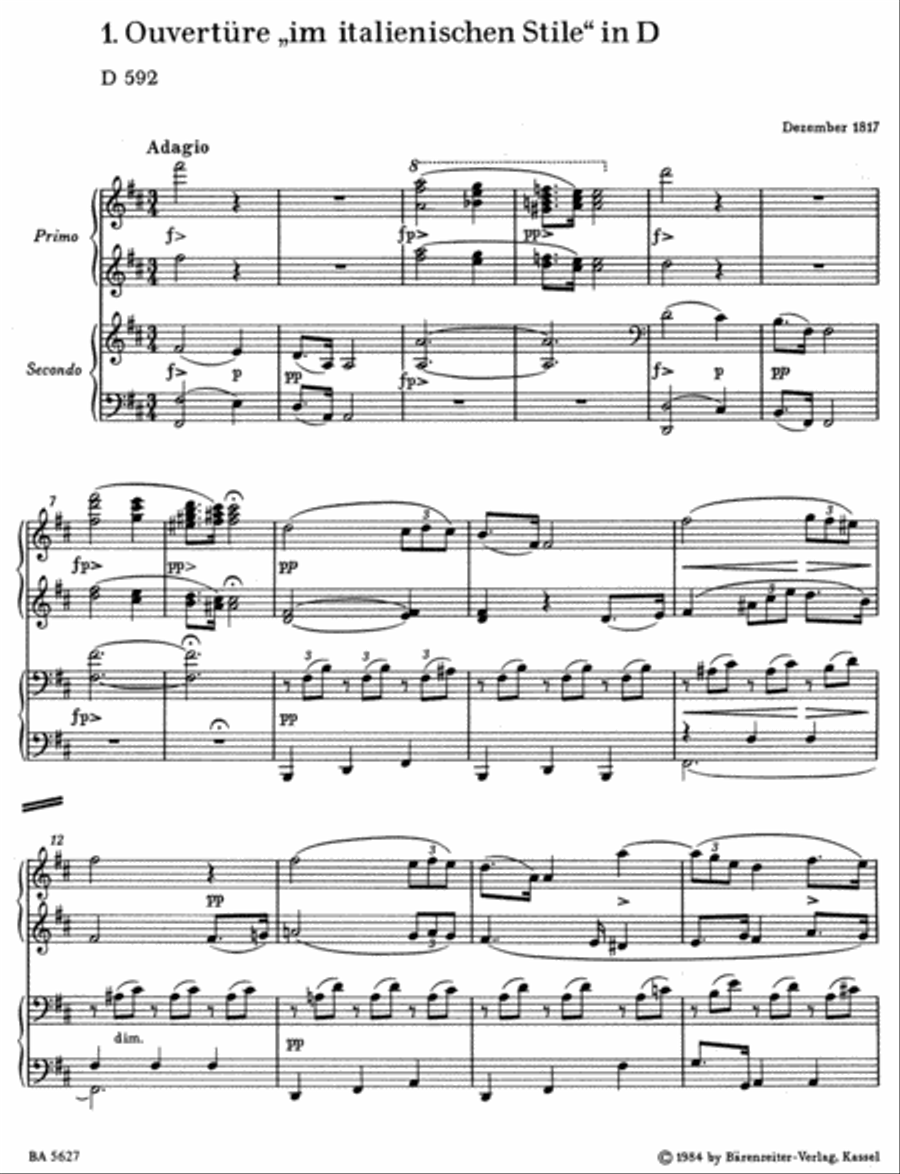
Shortly after finishing the orchestral versions Schubert arranged his two “Italian overtures” for piano four-hands.
The present edition adheres to the editorial principles set down for the “Neue Schubert-Ausgabe”.
About Barenreiter Urtext
What can I expect from a Barenreiter Urtext edition?
MUSICOLOGICALLY SOUND - A reliable musical text based on all available sources - A description of the sources - Information on the genesis and history of the work - Valuable notes on performance practice - Includes an introduction with critical commentary explaining source discrepancies and editorial decisions
... AND PRACTICAL - Page-turns, fold-out pages, and cues where you need them - A well-presented layout and a user-friendly format - Excellent print quality - Superior paper and binding
Arrangement by the composer of D 590 and D 591. Composed by Franz Schubert. Edited by Walburga Litschauer. This edition: urtext edition. Stapled. Barenreiter Urtext. Performance score, anthology. D 592, 597. 35 pages. Baerenreiter Verlag #BA05627. Published by Baerenreiter Verlag (BA.BA05627).
ISBN 9790006473175. 11.81 x 9.06 inches. Preface: Walburga Litschauer.
It was under the influence of Rossini, whose operas enjoyed great popularity in Vienna, that Schubert in November 1817 wrote two orchestral overtures “in the Italy style” (D 590 und D 591).
According to Schubert’s first biographer, Heinrich Kreissle, these pieces owe their existence to a musical wager. The composer had attended a performance of Rossini’s opera “Tancredi”, the overture of which was praised to the skies by his friends. “Doubtless finding these laudations excessive, Schubert was roused to a spirit of contradiction and declared that he would have no difficulty writing overtures of this sort in a similar style within the briefest span of time. His companions took him at his word and vowed, for their parts, to reward the deed with a glass of good wine. Schubert set to work immediately and composed an overture for orchestra, followed soon thereafter by a second. Both works came to be known by the name “Overtures in the Italian Style” and were roundly applauded in concerts during his lifetime”.
Shortly after finishing the orchestral versions Schubert arranged his two “Italian overtures” for piano four-hands.
The present edition adheres to the editorial principles set down for the “Neue Schubert-Ausgabe”.
About Barenreiter Urtext
What can I expect from a Barenreiter Urtext edition?
MUSICOLOGICALLY SOUND - A reliable musical text based on all available sources - A description of the sources - Information on the genesis and history of the work - Valuable notes on performance practice - Includes an introduction with critical commentary explaining source discrepancies and editorial decisions
... AND PRACTICAL - Page-turns, fold-out pages, and cues where you need them - A well-presented layout and a user-friendly format - Excellent print quality - Superior paper and binding
Preview: Zwei Ouverturen im "italienischen Stile" D 592 und D 597
Tell A Friend
Tell a friend (or remind yourself) about this product. We'll instantly send an email containing product info and a link to it. You may also enter a personal message.
We do not use or store email addresses from this form for any other purpose than sending your share email.
After purchase, you can download your MP3 from your Sheet Music Plus Digital Library - no software installation is necessary! You can also listen to your MP3 at any time in your Digital Library.
Learn about Smart Music
After purchase, you can download your Smart Music from your Sheet Music Plus Digital Library - no software installation is necessary! You can also download at any time in your Digital Library.
Learn about Digital Video
After purchase you can download your video from your Digital Library. Your video is in XX format and is playable on most pre-installed video players.