19551705
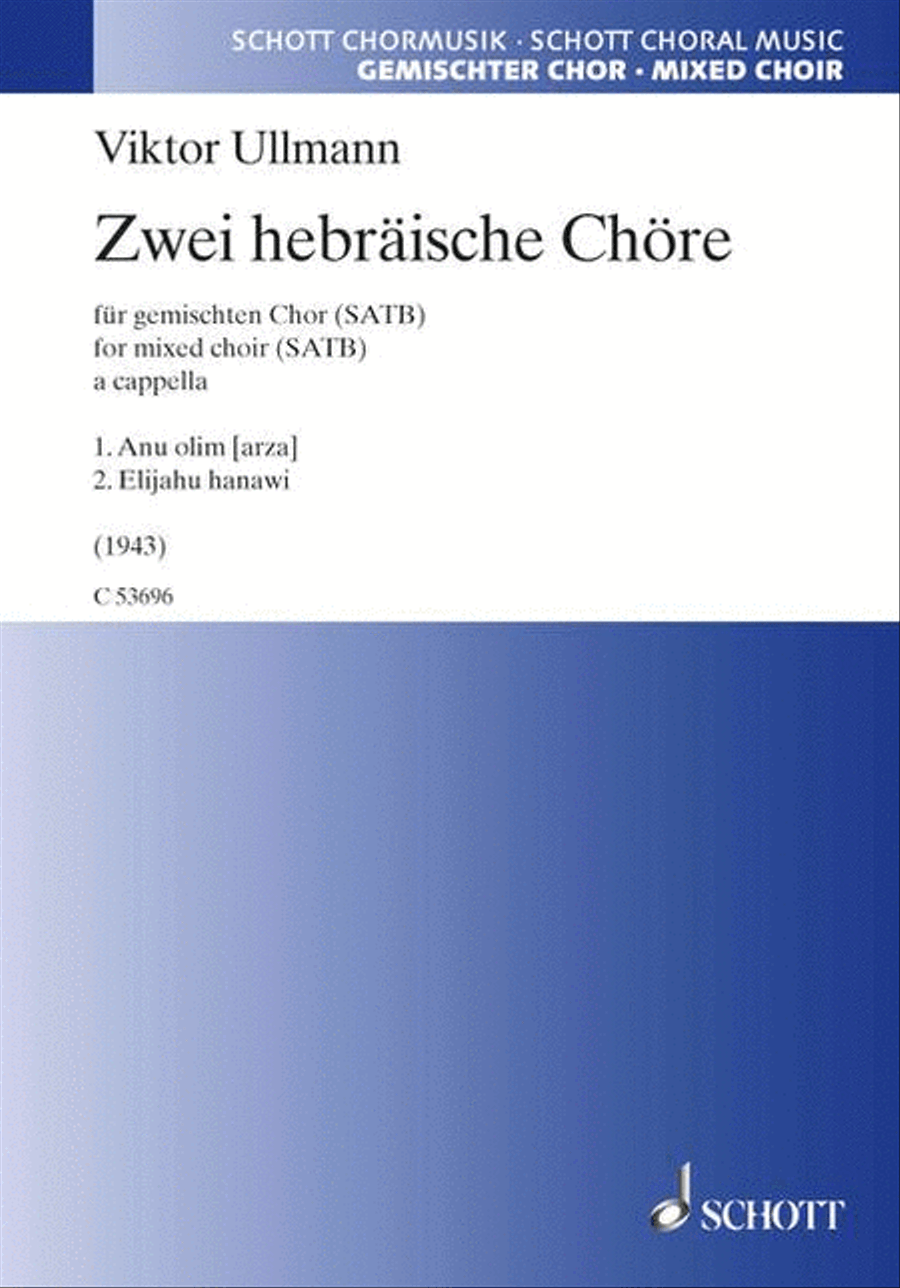
Zwei Hebraische Chore
19551705
19551705
19551705
Copyright Material for Preview Only - Sheet Music Plus
Choral; Mixed Choir (SATB a cappella)
SKU: HL.49018287
Composed by Viktor Ullmann. This edition: Saddle stitching. Sheet music. Choral. Classical. Softcover. Composed 1943. 7 pages. Duration 5'. Schott Music #C53696. Published by Schott Music (HL.49018287).
ISBN 9790001170826. UPC: 884088620752. 7.5x10.75x0.049 inches. Hebrew.
Viktor Ullmann composed his choral arrangements of Hebrew, Yiddish and Chassidic songs in the ghetto of Theresienstadt in 1943/1944. In the function of 'Head of the Studio for New Music', Ullmann made a significant contribution to the so-called 'leisure activities' in the ghetto. The works were evidently intended for the repertoire of the various choirs at Theresienstadt, including children's choirs such as the Karel Vrbas Youth Choir in which Ullmann's son Max also sang. There is no evidence to confirm that Ullmann's choral works were actually performed in Theresienstadt, for example in one of the frequent concerts given by Rafael Schachter's choir of up to a hundred voices (cf. Milan Kuna, Musik an der Grenze des Lebens, 21998. p.313). The German translations below first appeared in the song book Makkabi-Liederbuch published in Berlin in 1930 (2nd edition 1935) which was available to Viktor Ullmann as a source for the melodies and text orthography for his choral arrangements in Theresienstadt.
Choral; Mixed Choir (SATB a cappella)
SKU: HL.49018287
Composed by Viktor Ullmann. This edition: Saddle stitching. Sheet music. Choral. Classical. Softcover. Composed 1943. 7 pages. Duration 5'. Schott Music #C53696. Published by Schott Music (HL.49018287).
ISBN 9790001170826. UPC: 884088620752. 7.5x10.75x0.049 inches. Hebrew.
Viktor Ullmann composed his choral arrangements of Hebrew, Yiddish and Chassidic songs in the ghetto of Theresienstadt in 1943/1944. In the function of 'Head of the Studio for New Music', Ullmann made a significant contribution to the so-called 'leisure activities' in the ghetto. The works were evidently intended for the repertoire of the various choirs at Theresienstadt, including children's choirs such as the Karel Vrbas Youth Choir in which Ullmann's son Max also sang. There is no evidence to confirm that Ullmann's choral works were actually performed in Theresienstadt, for example in one of the frequent concerts given by Rafael Schachter's choir of up to a hundred voices (cf. Milan Kuna, Musik an der Grenze des Lebens, 21998. p.313). The German translations below first appeared in the song book Makkabi-Liederbuch published in Berlin in 1930 (2nd edition 1935) which was available to Viktor Ullmann as a source for the melodies and text orthography for his choral arrangements in Theresienstadt.
Tell a friend (or remind yourself) about this product. We'll instantly send an email containing product info and a link to it. You may also enter a personal message.
We do not use or store email addresses from this form for any other purpose than sending your share email.
Read our Privacy Policy.
After purchase, you can download your MP3 from your Sheet Music Plus Digital Library - no software installation is necessary! You can also listen to your MP3 at any time in your Digital Library.
After purchase, you can download your Smart Music from your Sheet Music Plus Digital Library - no software installation is necessary! You can also download at any time in your Digital Library.
After purchase you can download your video from your Digital Library. Your video is in XX format and is playable on most pre-installed video players.