21691759
3 sonate
21691759
21691759
21691759
Copyright Material for Preview Only - Sheet Music Plus
Flute & keyboard
SKU: HH.HH455-FSP
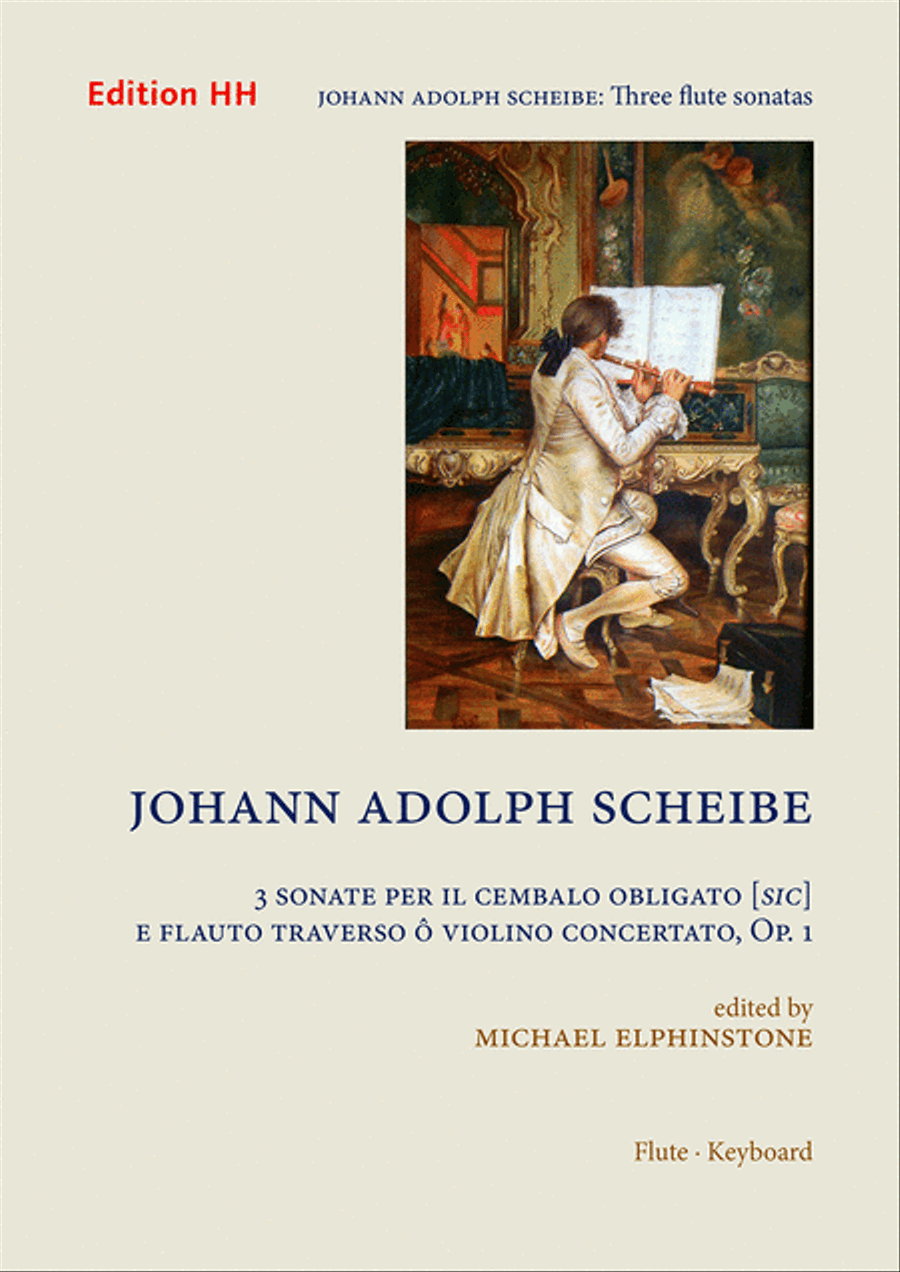
Composed by Johann Adolph Scheibe. Edited by Michael Elphinstone. Flute & Keyboard. Baroque. Full score and parts. Duration c.61:00. Edition HH Music Publishers #HH455-FSP. Published by Edition HH Music Publishers (HH.HH455-FSP).
ISBN 9790708146629. 8.27 x 11.69 inches.
Scheibe’s three sonatas for flute (or violin) and obbligato harpsichord were published by Haffner in the late 1750’s, but were probably composed much earlier; they contain a significant quantity of elaborate imitative writing that is out of character with Scheibe’s later music. Although rooted in the same tradition as the sonatas for flute and obbligato harpsichord by J.S. Bach, C.P.E Bach, and composers at Berlin court of Frederick the Great, these are more substantial works, each having four movements in the traditional slow-fast-slow-fast scheme. For the most part they are trio sonatas, the right hand of the harpsichord acting as the second treble voice, but several movements feature idiomatic writing for the keyboard. Also interesting is the large amount of ornamentation called for, particularly in the harpsichord part. While Scheibe disapproved of the excessive embellishments that Bach actually wrote into his melody lines, these sonatas are nonetheless heavily ornamented, albeit through the insertion of notational symbols; in addition to turns and mordents, Scheibe uses no less than three different trill symbols!
Flute & keyboard
SKU: HH.HH455-FSP
Composed by Johann Adolph Scheibe. Edited by Michael Elphinstone. Flute & Keyboard. Baroque. Full score and parts. Duration c.61:00. Edition HH Music Publishers #HH455-FSP. Published by Edition HH Music Publishers (HH.HH455-FSP).
ISBN 9790708146629. 8.27 x 11.69 inches.
Scheibe’s three sonatas for flute (or violin) and obbligato harpsichord were published by Haffner in the late 1750’s, but were probably composed much earlier; they contain a significant quantity of elaborate imitative writing that is out of character with Scheibe’s later music. Although rooted in the same tradition as the sonatas for flute and obbligato harpsichord by J.S. Bach, C.P.E Bach, and composers at Berlin court of Frederick the Great, these are more substantial works, each having four movements in the traditional slow-fast-slow-fast scheme. For the most part they are trio sonatas, the right hand of the harpsichord acting as the second treble voice, but several movements feature idiomatic writing for the keyboard. Also interesting is the large amount of ornamentation called for, particularly in the harpsichord part. While Scheibe disapproved of the excessive embellishments that Bach actually wrote into his melody lines, these sonatas are nonetheless heavily ornamented, albeit through the insertion of notational symbols; in addition to turns and mordents, Scheibe uses no less than three different trill symbols!
Tell a friend (or remind yourself) about this product. We'll instantly send an email containing product info and a link to it. You may also enter a personal message.
We do not use or store email addresses from this form for any other purpose than sending your share email.
Read our Privacy Policy.
After purchase, you can download your MP3 from your Sheet Music Plus Digital Library - no software installation is necessary! You can also listen to your MP3 at any time in your Digital Library.
After purchase, you can download your Smart Music from your Sheet Music Plus Digital Library - no software installation is necessary! You can also download at any time in your Digital Library.
After purchase you can download your video from your Digital Library. Your video is in XX format and is playable on most pre-installed video players.