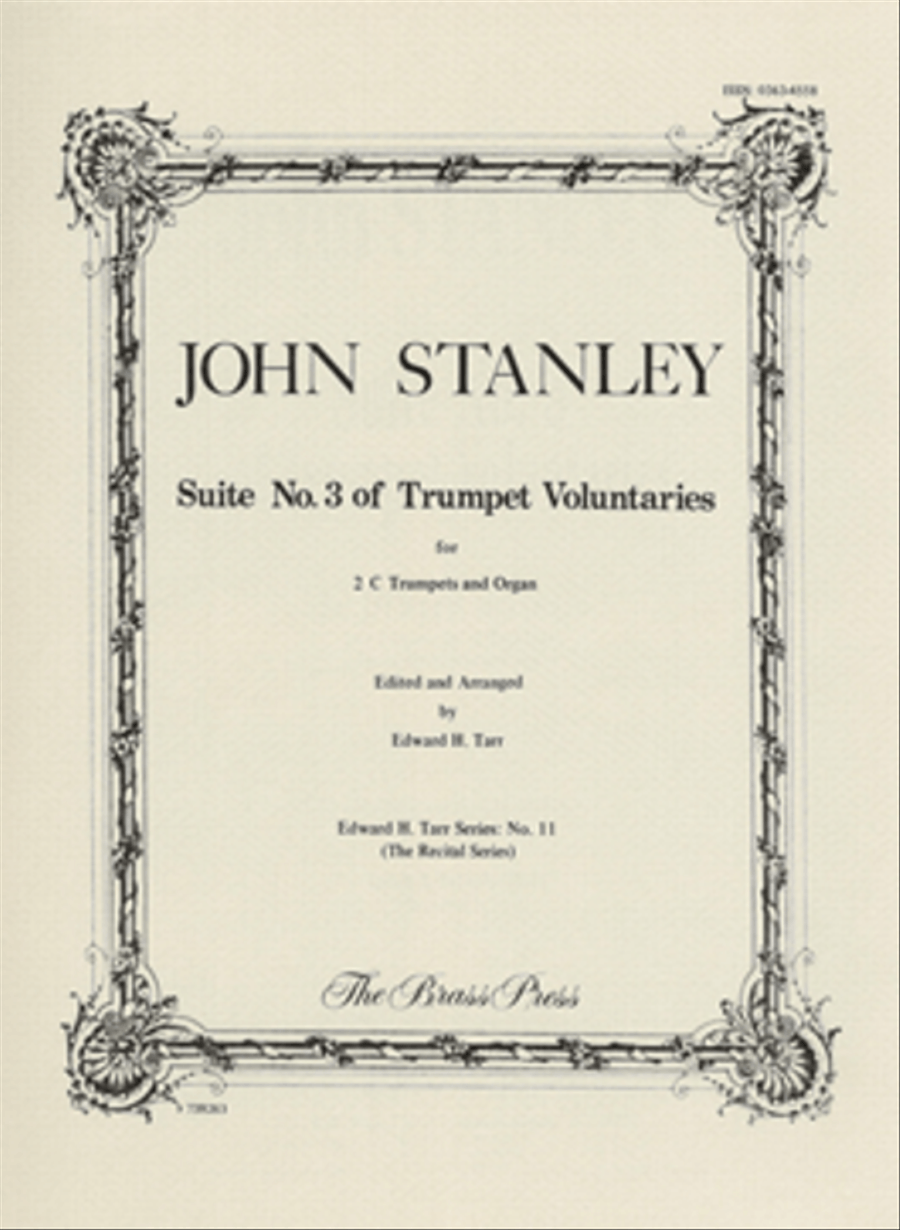
Composed by John Stanley. Arranged by Edward H. Tarr. Baroque.
ISBN 9790207019592.
John Stanley (1713-1786), blind from the age of three, was a pupil of Maurice Greene (1694-1775) and, like his teacher, became master of the King’s Band of Music (from 1779) all organist of the Chapel Royal (from 1782). He was also closely associated with Handel, conducting performances of his oratorios after Handel's death. Stanley’s six trumpet voluntaries, two each in his Opus 5, 6, and 7, are together with those of Boyce and Greene – among the latest examples of the genre and represent the culmination of virtuosity within it. (See Greene-Boyce, A Suite of Trumpet Voluntaries, published by The Brass Press.)
The first movement of the present suite No. 3 was taken from Stanley's Op. 7, No.2; the second and third movements come from Op. 5, No. 1. The trumpets are employed in the outer movements. The first movement consists of an opening ritornello featuring first the first trumpet then both trumpets; a long middle section with an organ solo, the musical material of which is an elaboration on the beginning of the ritornello, from which four bars are birefly quoted starting with measure 58; and the ritornello once again at the end. The second movement is a meditative bridge. In the final movement, trumpets and organ answer one another with the traditional form scheme of the trumpet voluntary: AABBCC, etc. In this movement, except for the first two bars, the two trumpets always sound together. Similar principles of form are also to be found in Stanley’s Suite No. 2 of Trumpet Voluntaries in D Major.
The Suite is published here in the original key of C.
Composed by John Stanley. Arranged by Edward H. Tarr. Baroque.
ISBN 9790207019592.
John Stanley (1713-1786), blind from the age of three, was a pupil of Maurice Greene (1694-1775) and, like his teacher, became master of the King’s Band of Music (from 1779) all organist of the Chapel Royal (from 1782). He was also closely associated with Handel, conducting performances of his oratorios after Handel's death. Stanley’s six trumpet voluntaries, two each in his Opus 5, 6, and 7, are together with those of Boyce and Greene – among the latest examples of the genre and represent the culmination of virtuosity within it. (See Greene-Boyce, A Suite of Trumpet Voluntaries, published by The Brass Press.)
The first movement of the present suite No. 3 was taken from Stanley's Op. 7, No.2; the second and third movements come from Op. 5, No. 1. The trumpets are employed in the outer movements. The first movement consists of an opening ritornello featuring first the first trumpet then both trumpets; a long middle section with an organ solo, the musical material of which is an elaboration on the beginning of the ritornello, from which four bars are birefly quoted starting with measure 58; and the ritornello once again at the end. The second movement is a meditative bridge. In the final movement, trumpets and organ answer one another with the traditional form scheme of the trumpet voluntary: AABBCC, etc. In this movement, except for the first two bars, the two trumpets always sound together. Similar principles of form are also to be found in Stanley’s Suite No. 2 of Trumpet Voluntaries in D Major.
The Suite is published here in the original key of C.
Preview: Suite N° 3 of Trumpet Voluntaries in C
Tell A Friend
Tell a friend (or remind yourself) about this product. We'll instantly send an email containing product info and a link to it. You may also enter a personal message.
We do not use or store email addresses from this form for any other purpose than sending your share email.
After purchase, you can download your MP3 from your Sheet Music Plus Digital Library - no software installation is necessary! You can also listen to your MP3 at any time in your Digital Library.
Learn about Smart Music
After purchase, you can download your Smart Music from your Sheet Music Plus Digital Library - no software installation is necessary! You can also download at any time in your Digital Library.
Learn about Digital Video
After purchase you can download your video from your Digital Library. Your video is in XX format and is playable on most pre-installed video players.