Copyright Material for Preview Only - Sheet Music Plus
Ships to you
Progressive Quartets for Strings
32 Quartets That Can Be Played by Any Combination of String Instruments by Jacques Offenbach String Orchestra - Sheet Music
Order two or more copies of the same title and we'll automatically give you 5% off list price on that title.
To get 2+ Pricing , just add two or more copies of a title to your shopping cart. Your discount will be immediately applied to your order.
Sale titles, hymnals, and ShowKits (MTI's Broadway Junior Collection, Getting to Know... Collection (G2K) and MTI's Kids Collection) do not qualify for 2+ Pricing
If you have any questions or comments regarding 2+ Pricing , please visit our Help Center to find more information or chat with our support team
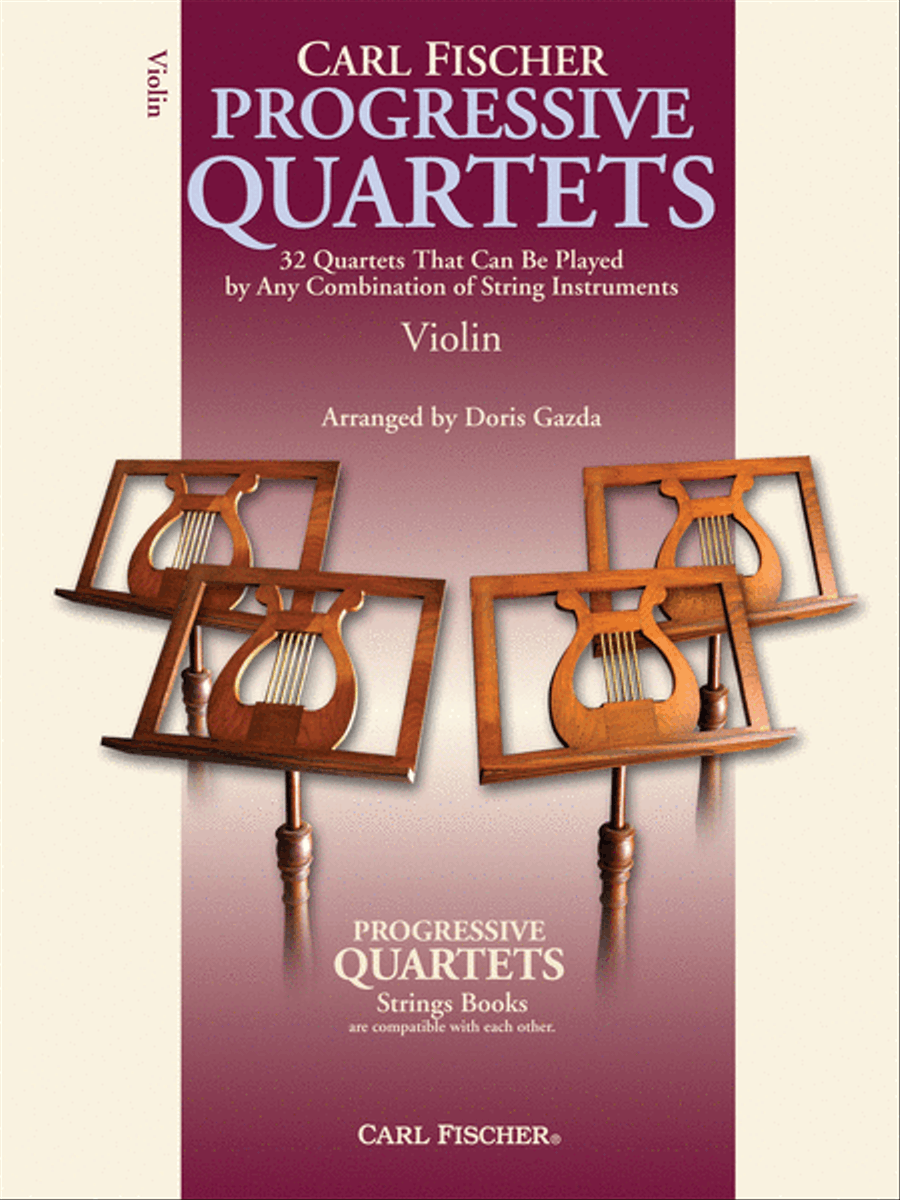
32 Quartets That Can Be Played by Any Combination of String Instruments. Composed by Catalonian Carol, Engelbert Humperdinck, Franz Schubert, French carol, Henry Carey, Jacques Offenbach, Peter Ilyich Tchaikovsky, Robert Schumann, Traditional French Carol, and Wolfgang Amadeus Mozart. Arranged by Doris Gazda. This edition: saddle-wire stitch. Sws. Back To School. Collection. With Standard notation. 48 pages. Carl Fischer Music #BF69. Published by Carl Fischer Music (CF.BF69).
ISBN 9780825889509. UPC: 798408089504. 9 x 12 inches.
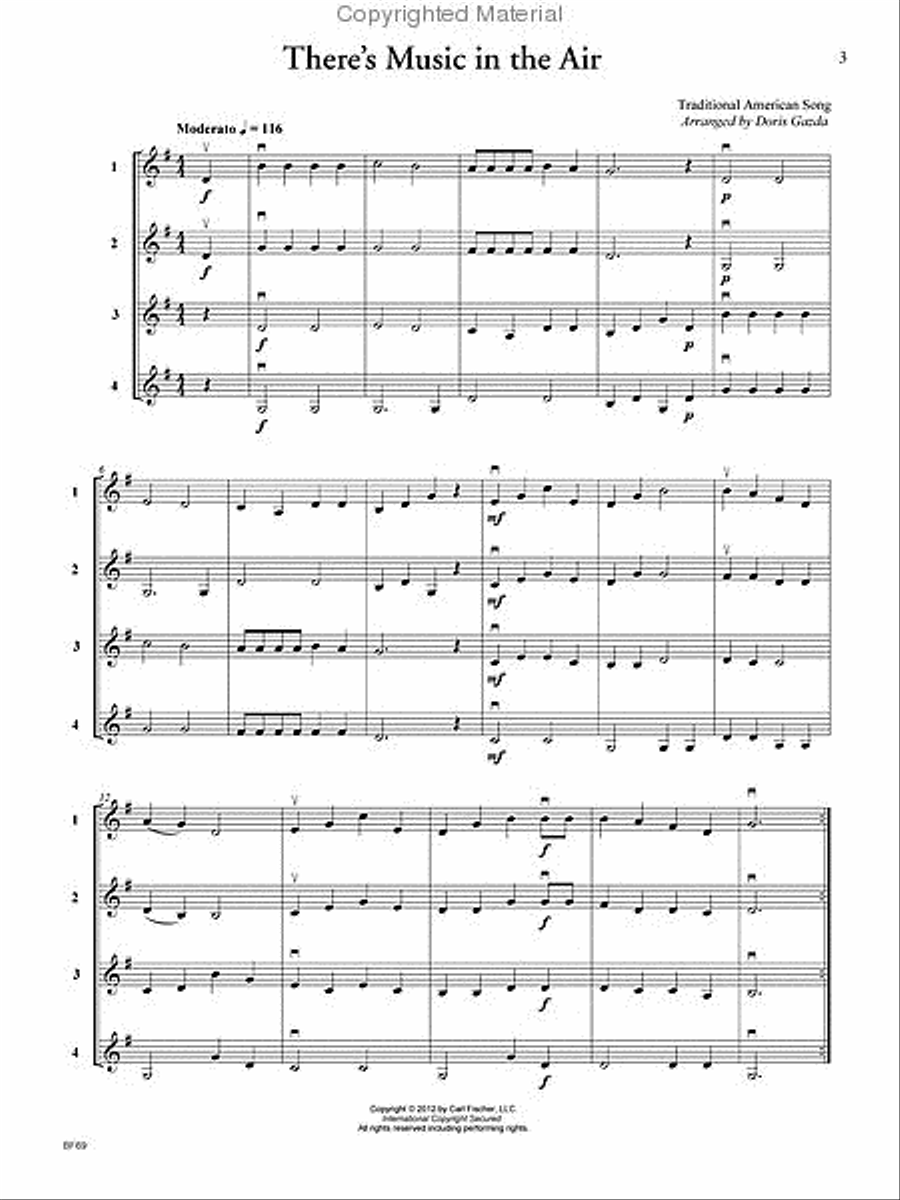
Chamber music is an essential part of learning to play an instrument.These versatile quartets are written so that they can be performed by anycombination of four string instruments. These arrangements by prominentstring pedagogue Doris Gazda will sound full and satisfying with only fourplayers all the way up to a full string orchestra. The selection of music inthis collection covers a wide variety of musical styles that will provide hoursof enjoyment and performance options. The quartets are progressivelyorganized by level of difficulty as the performers advance in their skills.This is a welcome addition to the repertoire for all string players. During the seventeenth and eighteenth centuries, music lovers gathered in theirhomes in the evenings to make music. The music they played was typically calledchamber music. Sometimes they formed small orchestras. The typical stringorchestra had four string parts which were Violin I, Violin II, Viola and BassoContinuo. The basso continuo provided both the bass line of the piece and theindication of the chord structure for each of the bass line notes. Usually the bassline was played by a cello or a bass viol. The chords were played by a harpsichord,lute, organ or harp. In the eighteenth century the small chamber orchestragrew into a more formal performance orchestra. Eventually, woodwind, brassand percussion instruments were added to the orchestral parts and became thesymphonic orchestra that we are familiar with today.When any four instruments play together, the sound approximates the soundof the full harmonic structure of an orchestra. It is very satisfying to be ableto perform music that can be played by four instrumentalists and yet gives thesound of a much larger group of performers.Progressive Quartets is a collection of new arrangements of favorite pieces fromthe classical repertoire. It is published for violin, viola, cello and string bass andis arranged so that it can be performed by any combination of four of theseinstruments. The quartets are placed in the book in order of difficulty andcover a wide range of musical styles.It was a pleasure to compile and arrange this collection. I hope that it willprovide you with literature that will be enjoyable to work on and perform withyour friends, and that it will add a new dimension to your musical repertoire.
32 Quartets That Can Be Played by Any Combination of String Instruments. Composed by Catalonian Carol, Engelbert Humperdinck, Franz Schubert, French carol, Henry Carey, Jacques Offenbach, Peter Ilyich Tchaikovsky, Robert Schumann, Traditional French Carol, and Wolfgang Amadeus Mozart. Arranged by Doris Gazda. This edition: saddle-wire stitch. Sws. Back To School. Collection. With Standard notation. 48 pages. Carl Fischer Music #BF69. Published by Carl Fischer Music (CF.BF69).
ISBN 9780825889509. UPC: 798408089504. 9 x 12 inches.
Chamber music is an essential part of learning to play an instrument.These versatile quartets are written so that they can be performed by anycombination of four string instruments. These arrangements by prominentstring pedagogue Doris Gazda will sound full and satisfying with only fourplayers all the way up to a full string orchestra. The selection of music inthis collection covers a wide variety of musical styles that will provide hoursof enjoyment and performance options. The quartets are progressivelyorganized by level of difficulty as the performers advance in their skills.This is a welcome addition to the repertoire for all string players. During the seventeenth and eighteenth centuries, music lovers gathered in theirhomes in the evenings to make music. The music they played was typically calledchamber music. Sometimes they formed small orchestras. The typical stringorchestra had four string parts which were Violin I, Violin II, Viola and BassoContinuo. The basso continuo provided both the bass line of the piece and theindication of the chord structure for each of the bass line notes. Usually the bassline was played by a cello or a bass viol. The chords were played by a harpsichord,lute, organ or harp. In the eighteenth century the small chamber orchestragrew into a more formal performance orchestra. Eventually, woodwind, brassand percussion instruments were added to the orchestral parts and became thesymphonic orchestra that we are familiar with today.When any four instruments play together, the sound approximates the soundof the full harmonic structure of an orchestra. It is very satisfying to be ableto perform music that can be played by four instrumentalists and yet gives thesound of a much larger group of performers.Progressive Quartets is a collection of new arrangements of favorite pieces fromthe classical repertoire. It is published for violin, viola, cello and string bass andis arranged so that it can be performed by any combination of four of theseinstruments. The quartets are placed in the book in order of difficulty andcover a wide range of musical styles.It was a pleasure to compile and arrange this collection. I hope that it willprovide you with literature that will be enjoyable to work on and perform withyour friends, and that it will add a new dimension to your musical repertoire.
Preview: Progressive Quartets for Strings
Tell A Friend
Tell a friend (or remind yourself) about this product. We'll instantly send an email containing product info and a link to it. You may also enter a personal message.
We do not use or store email addresses from this form for any other purpose than sending your share email.
After purchase, you can download your MP3 from your Sheet Music Plus Digital Library - no software installation is necessary! You can also listen to your MP3 at any time in your Digital Library.
Learn about Smart Music
After purchase, you can download your Smart Music from your Sheet Music Plus Digital Library - no software installation is necessary! You can also download at any time in your Digital Library.
Learn about Digital Video
After purchase you can download your video from your Digital Library. Your video is in XX format and is playable on most pre-installed video players.