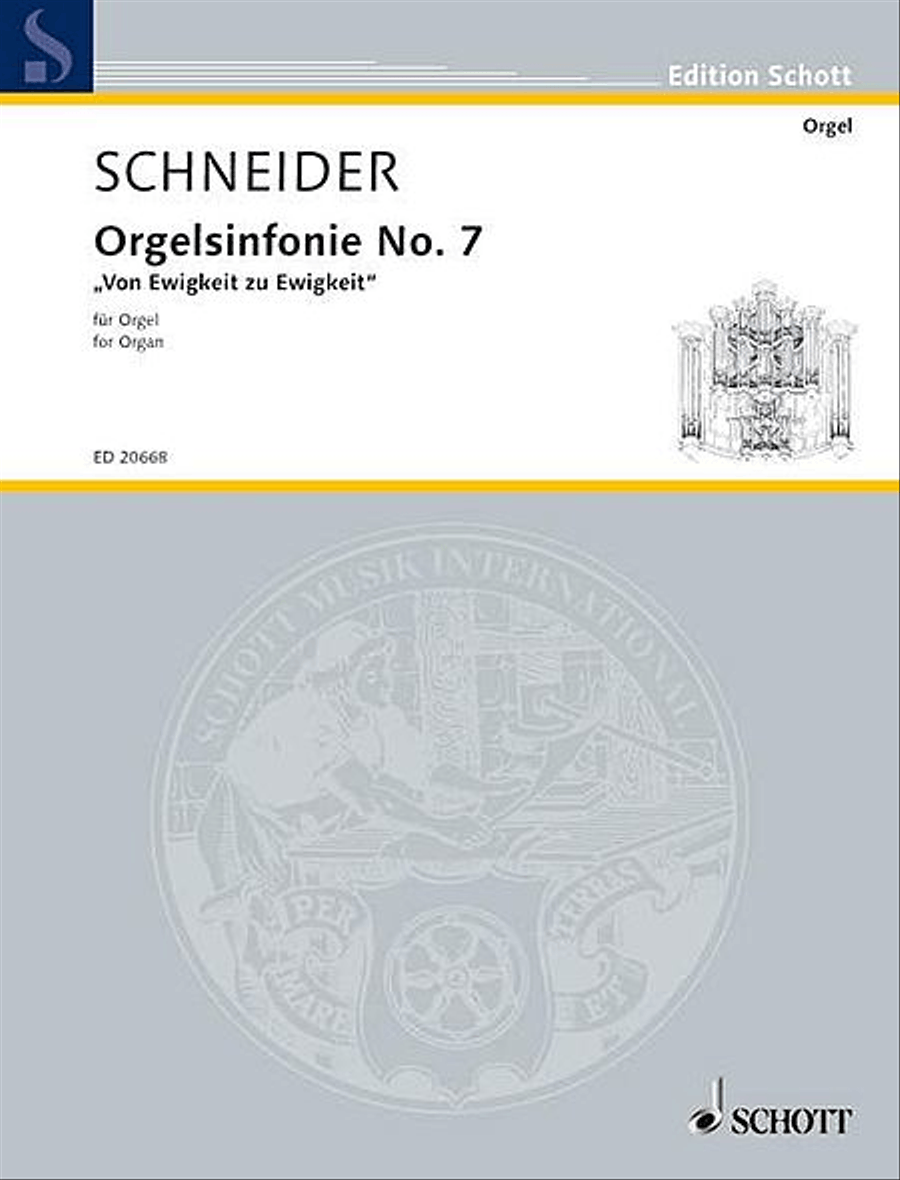
Von Ewigkeit zu Ewigkeit. Composed by Enjott Schneider. This edition: Saddle stitching. Sheet music. Organ Collection. Die Orgelsinfonie Nr. 7 'Von Ewigkeit zu Ewigkeit ist vom kompositorischen Rohstoff Zeit bestimmt. Stilistisch basiert die Komposition auf Elementen der Minimal Music, die Schneider mit der Tradition der europaischen Orgelkomposition verbindet. Composed 2009. 52 pages. Duration 24'. Schott Music #ED20668. Published by Schott Music (HL.49018082).
ISBN 9790001168809. UPC: 884088535094. 9.0x12.0x0.2 inches.
Each organ symphony by Enjott Schneider has its own colour and its own theme. Organ Symphony No. 7 'Von Ewigkeit zu Ewigkeit' is dominated by the theme of 'time': from the flowing rumbling of time in ancient beginnings ('In principio' - 1st movement) and periodic to the intellectually incomprehensible revolving ('Zeit der Sterne' - 2nd movement). After the third movement ('Zeit des Menschen'), a valse triste, infused by an almost humorous hectic atmosphere, the symphony ends with a kind of 'Amen!' in the fourth movement. Schneider sums it up: 'It is good as it is, we do not understand the course of time anyway.' With regard to style, his composition is based on elements of minimal music which he combines with the tradition of the European organ composition; it is at the same time a testimony to the composer's flexibility and versatility.
Von Ewigkeit zu Ewigkeit. Composed by Enjott Schneider. This edition: Saddle stitching. Sheet music. Organ Collection. Die Orgelsinfonie Nr. 7 'Von Ewigkeit zu Ewigkeit ist vom kompositorischen Rohstoff Zeit bestimmt. Stilistisch basiert die Komposition auf Elementen der Minimal Music, die Schneider mit der Tradition der europaischen Orgelkomposition verbindet. Composed 2009. 52 pages. Duration 24'. Schott Music #ED20668. Published by Schott Music (HL.49018082).
ISBN 9790001168809. UPC: 884088535094. 9.0x12.0x0.2 inches.
Each organ symphony by Enjott Schneider has its own colour and its own theme. Organ Symphony No. 7 'Von Ewigkeit zu Ewigkeit' is dominated by the theme of 'time': from the flowing rumbling of time in ancient beginnings ('In principio' - 1st movement) and periodic to the intellectually incomprehensible revolving ('Zeit der Sterne' - 2nd movement). After the third movement ('Zeit des Menschen'), a valse triste, infused by an almost humorous hectic atmosphere, the symphony ends with a kind of 'Amen!' in the fourth movement. Schneider sums it up: 'It is good as it is, we do not understand the course of time anyway.' With regard to style, his composition is based on elements of minimal music which he combines with the tradition of the European organ composition; it is at the same time a testimony to the composer's flexibility and versatility.
Preview: Orgelsinfonie No. 7 (organ Symphony) Organ Solo
Tell A Friend
Tell a friend (or remind yourself) about this product. We'll instantly send an email containing product info and a link to it. You may also enter a personal message.
We do not use or store email addresses from this form for any other purpose than sending your share email.
After purchase, you can download your MP3 from your Sheet Music Plus Digital Library - no software installation is necessary! You can also listen to your MP3 at any time in your Digital Library.
Learn about Smart Music
After purchase, you can download your Smart Music from your Sheet Music Plus Digital Library - no software installation is necessary! You can also download at any time in your Digital Library.
Learn about Digital Video
After purchase you can download your video from your Digital Library. Your video is in XX format and is playable on most pre-installed video players.