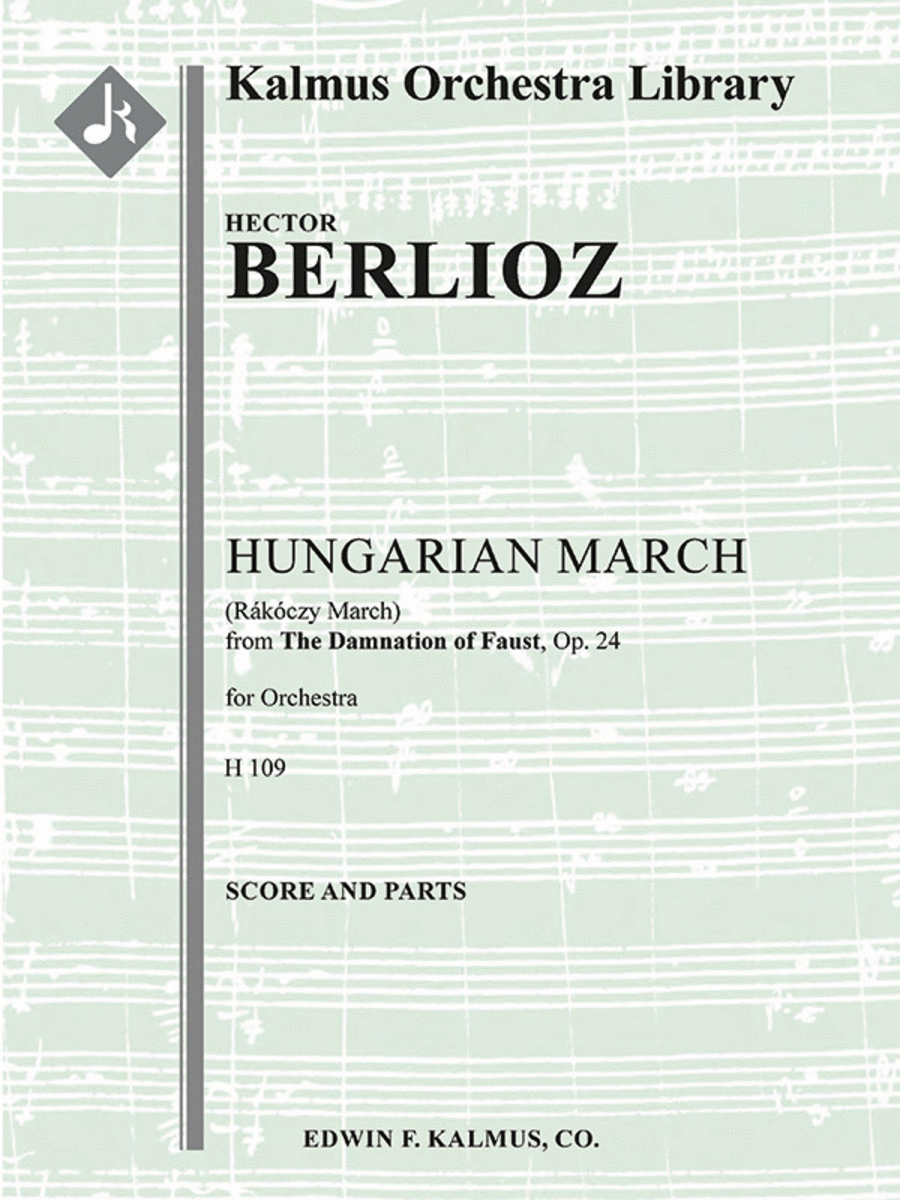
Concert Band; Orchestra 2+Picc.2.2.4: 4.2+Crnt(2).3.1: Timp.Perc(3-4): Str (9-8-7-6-5 in set)
SKU: AP.36-A130602
Composed by Hector Berlioz. Full Orchestra, Conductor Score & Parts. Kalmus Orchestra Library. Score and Part(s). LudwigMasters Publications #36-A130602. Published by LudwigMasters Publications (AP.36-A130602).
UPC: 659359750304. English.
Hector Berlioz (1803-1869) completed The Damnation of Faust, Op. 24 in 1846. A work for four solo voices, chorus, children's chorus, and orchestra, Berlioz originally intended the work, based on Goethe's dramatic poem, to be an opera, though most of the work's fame has come through concert performances given the difficulty staging it. The premiere at the Opéra-Comique in Paris on December 6, 1846, was met with indifference, perhaps because it exists between being an opera and a cantata, but it now sees frequent performances in concert halls, and it is occasionally staged as an opera. A few wholly instrumental works are included, and among them is Berlioz's version of the Rákóczi March, usually called the Hungarian March (H 109). Berlioz had actually written the march separately for a concert on February 15, 1846, in Pest, Hungary, and the success was so great that he decided to incorporate it into his larger project as the conclusion to Part I, with a few small tweaks. It is this version commonly heard today. Instrumentation: 2+Picc.2.2.4: 4.2+Crnt(2).3.1: Timp.Perc(3-4): Str (9-8-7-6-5 in set).
These products are currently being prepared by a new publisher. While many items are ready and will ship on time, some others may see delays of several months.
Concert Band; Orchestra 2+Picc.2.2.4: 4.2+Crnt(2).3.1: Timp.Perc(3-4): Str (9-8-7-6-5 in set)
SKU: AP.36-A130602
Composed by Hector Berlioz. Full Orchestra, Conductor Score & Parts. Kalmus Orchestra Library. Score and Part(s). LudwigMasters Publications #36-A130602. Published by LudwigMasters Publications (AP.36-A130602).
UPC: 659359750304. English.
Hector Berlioz (1803-1869) completed The Damnation of Faust, Op. 24 in 1846. A work for four solo voices, chorus, children's chorus, and orchestra, Berlioz originally intended the work, based on Goethe's dramatic poem, to be an opera, though most of the work's fame has come through concert performances given the difficulty staging it. The premiere at the Opéra-Comique in Paris on December 6, 1846, was met with indifference, perhaps because it exists between being an opera and a cantata, but it now sees frequent performances in concert halls, and it is occasionally staged as an opera. A few wholly instrumental works are included, and among them is Berlioz's version of the Rákóczi March, usually called the Hungarian March (H 109). Berlioz had actually written the march separately for a concert on February 15, 1846, in Pest, Hungary, and the success was so great that he decided to incorporate it into his larger project as the conclusion to Part I, with a few small tweaks. It is this version commonly heard today. Instrumentation: 2+Picc.2.2.4: 4.2+Crnt(2).3.1: Timp.Perc(3-4): Str (9-8-7-6-5 in set).
These products are currently being prepared by a new publisher. While many items are ready and will ship on time, some others may see delays of several months.
Preview: La Damnation de Faust, Op. 24: Hungarian (Rakoczy) March
Tell A Friend
Tell a friend (or remind yourself) about this product. We'll instantly send an email containing product info and a link to it. You may also enter a personal message.
We do not use or store email addresses from this form for any other purpose than sending your share email.
After purchase, you can download your MP3 from your Sheet Music Plus Digital Library - no software installation is necessary! You can also listen to your MP3 at any time in your Digital Library.
Learn about Smart Music
After purchase, you can download your Smart Music from your Sheet Music Plus Digital Library - no software installation is necessary! You can also download at any time in your Digital Library.
Learn about Digital Video
After purchase you can download your video from your Digital Library. Your video is in XX format and is playable on most pre-installed video players.