19859461
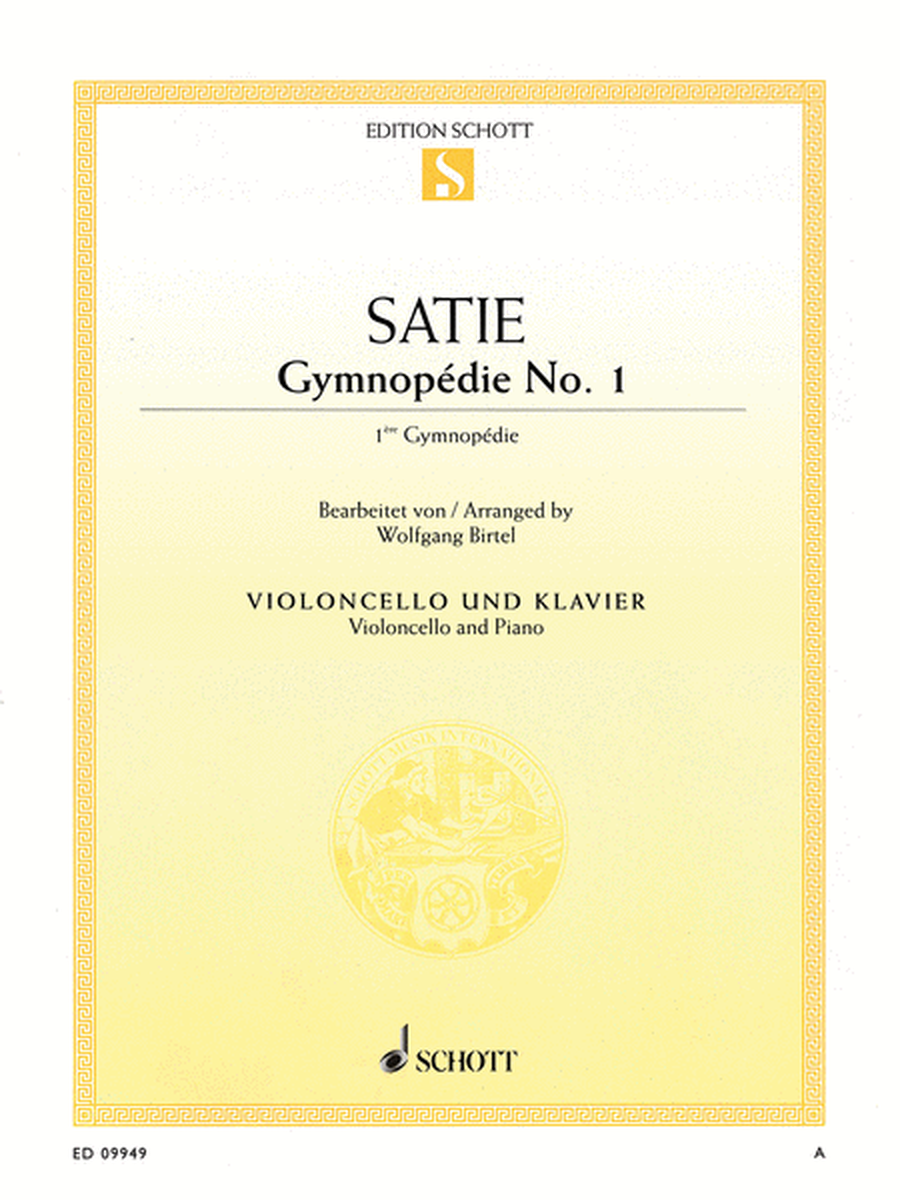
Gymnopédie No. 1
19859461
19859461
19859461
Copyright Material for Preview Only - Sheet Music Plus
Cello; Piano Accompaniment - easy to intermediate
SKU: HL.49019533
Cello and Piano. Composed by Erik Satie. Edited by Wolfgang Birtel. Arranged by Wolfgang Birtel. This edition: Saddle stitching. Sheet music. String. Classical. Softcover. Composed 1888. 6 pages. Schott Music #ED09949. Published by Schott Music (HL.49019533).
ISBN 9790001181631. UPC: 841886018419. 9.25x12.0x0.047 inches.
The music scene took notice of Erik Satie (1866-1925) all of a sudden: The world premiere of his ballet 'Parade' on 18 May 1917 [siehe dt. Text!] caused quite a scandal. The production which involved Sergey Diaghilev with his 'Ballets Russes', Pablo Picasso (scenery and costumes), Jean Cocteau (story) as well as Leonide Massine (choreography) divided the music scene of Paris, yet made the composer widely known. Satie who hardly had had any solid musical training and lived in Paris for almost all his life developed a new musical style, in deliberate rejection of the 'Wagnerisme' of his time. Classical form models, new harmonies, stylistic ease, meditative and clownish elements amalgamated in an original way, the perfect example being his '3 Gymnopedies' of 1888 the first of which was here arranged for a solo instrument with piano accompaniment: Thus, it is now possible, even for non-pianists, to play this famous miniature by Satie. Thanks to its easy playability, it can also be used for educational purposes.
Cello; Piano Accompaniment - easy to intermediate
SKU: HL.49019533
Cello and Piano. Composed by Erik Satie. Edited by Wolfgang Birtel. Arranged by Wolfgang Birtel. This edition: Saddle stitching. Sheet music. String. Classical. Softcover. Composed 1888. 6 pages. Schott Music #ED09949. Published by Schott Music (HL.49019533).
ISBN 9790001181631. UPC: 841886018419. 9.25x12.0x0.047 inches.
The music scene took notice of Erik Satie (1866-1925) all of a sudden: The world premiere of his ballet 'Parade' on 18 May 1917 [siehe dt. Text!] caused quite a scandal. The production which involved Sergey Diaghilev with his 'Ballets Russes', Pablo Picasso (scenery and costumes), Jean Cocteau (story) as well as Leonide Massine (choreography) divided the music scene of Paris, yet made the composer widely known. Satie who hardly had had any solid musical training and lived in Paris for almost all his life developed a new musical style, in deliberate rejection of the 'Wagnerisme' of his time. Classical form models, new harmonies, stylistic ease, meditative and clownish elements amalgamated in an original way, the perfect example being his '3 Gymnopedies' of 1888 the first of which was here arranged for a solo instrument with piano accompaniment: Thus, it is now possible, even for non-pianists, to play this famous miniature by Satie. Thanks to its easy playability, it can also be used for educational purposes.
Tell a friend (or remind yourself) about this product. We'll instantly send an email containing product info and a link to it. You may also enter a personal message.
We do not use or store email addresses from this form for any other purpose than sending your share email.
Read our Privacy Policy.
After purchase, you can download your MP3 from your Sheet Music Plus Digital Library - no software installation is necessary! You can also listen to your MP3 at any time in your Digital Library.
After purchase, you can download your Smart Music from your Sheet Music Plus Digital Library - no software installation is necessary! You can also download at any time in your Digital Library.
After purchase you can download your video from your Digital Library. Your video is in XX format and is playable on most pre-installed video players.