
Ships to you
Ships to you
SKU: PR.410412890
For Piano. Composed by Lowell Liebermann. This edition: saddle-wire stitch. Sws. Classical. Single piece. With Standard notation. Composed May 5 1989. Opus 29. 20 pages. Duration 13h. Theodore Presser Company #410-41289. Published by Theodore Presser Company (PR.410412890).ISBN 9781491108772. UPC: 680160086979. 9x12 inches.
A striking new work by this young composer, calling for the full dynamic range of the piano. First performed in 1989.
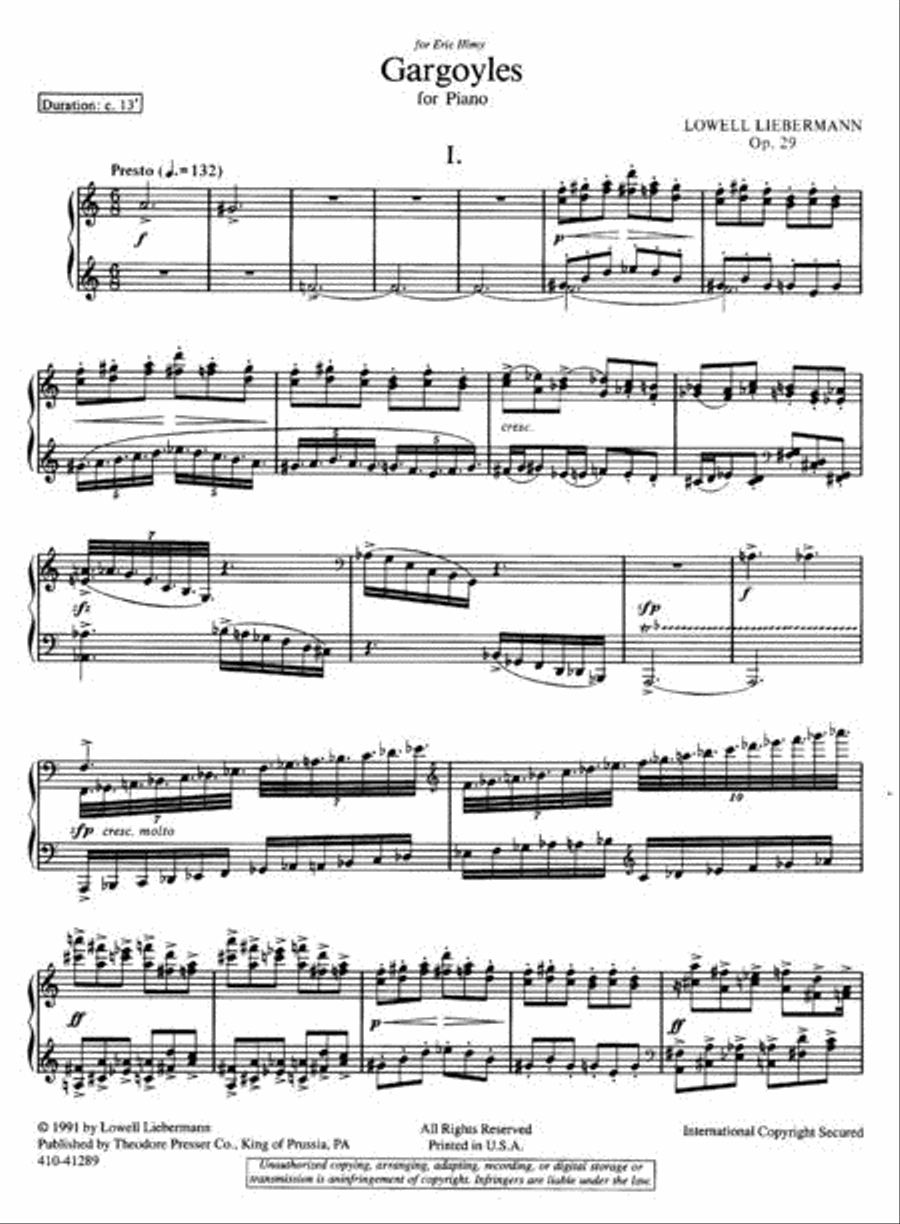
The set of four piano pieces entitled Gargoyles were commissioned by the Tcherepnin Society for pianist Eric Himy on the occasion of his 1989 Alice Tully Hall recital.I have long been fascinated by gargoyles and such ornamental grotesqueries.xa0 In this case the title Gargoyles is meant not in any programmatic way, but to indicate sharply drawn character sketches of a somewhat grotesque or morbid nature.xa0 The four pieces are actually highly contrasting etudes: the first, a devilishly difficult study in double-notes; the second, legato octaves above an ostinato; the third, legato melody with inner figuration divided between the two hands; and lastly, another fiendishly difficult study, an endurance test in double-notes, octaves and leaps.Gargoyles has been recorded by Stephen Hough for Virgin Classics, and by Michael Boriskin for New World Records.
About SMP Level 10 (Advanced)

Very advanced level, very difficult note reading, frequent time signature changes, virtuosic level technical facility needed.
|
Anonymous P.
August 08, 2016
Beautiful piece
This is an incredible piece of music, and it has already gained a well-deserved spot in the standard concert repertoire. The third movement is heart-stoppingly beautiful and could easily be used as an encore or programmed on its own. There are a lot of tricky passages, and this is certainly a virtuoso piece.
|
|
|
Anonymous
July 01, 2012
Contempary
Very interesting piece. Stephen Hough recorded this. That is How I got interested in the piece
|
|
|
James E.
December 08, 2011
Very traditional show pieces
This is one of Liebermann's most often performed pieces, and it's no wonder: of the four, three are brilliant virtuoso show pieces. But so traditional! No. 3 could have been written by Debussy. No. 4 owes nearly everything to Liszt. No. 1 is the kind of demonic march that Bartok made famous, but Liszt and Reger pioneered. Liebermann's music is showy and effective but diffuse: even when the energy level is so high, the pieces lose momentum because of lack of concision or an absence of sharp edges. Compare the first piece here to Bartok's Op. 14 or the Allegro Barbaro, or some of Liszt's late Csardas pieces -- or to Sebastian Currier's much more energetic Scarlatti Cadences. Given that the fourth piece, especially, requires technique on the order of the Transcendental Etudes, are they really the best choice for hours of practicing?
|
See Similar Sheet Music and Digital Downloads