Details
- Instrument:
- Piano Violin Solo
- Genres:
- Classical
- Composers:
- Miklos Rozsa
- Publishers:
- Breitkopf and Haertel
- ISBN:
- 9790004164457
- Format:
- Score
- Item types:
- Physical
- Artist:
- Miklos Rozsa
- Usages:
- School and Community
- Number of Pages:
- 40
- Size:
- 9 x 12 inches
- Shipping Weight:
- 0.49 pounds
SKU: BR.EB-5570
Composed by Miklos Rozsa. Solo instruments; stapled. Edition Breitkopf. Early modern; Music post-1945. Score. Composed 1931. 40 pages. Duration 20:00. Breitkopf and Haertel #EB 5570. Published by Breitkopf and Haertel (BR.EB-5570).ISBN 9790004164457. 9 x 12 inches.
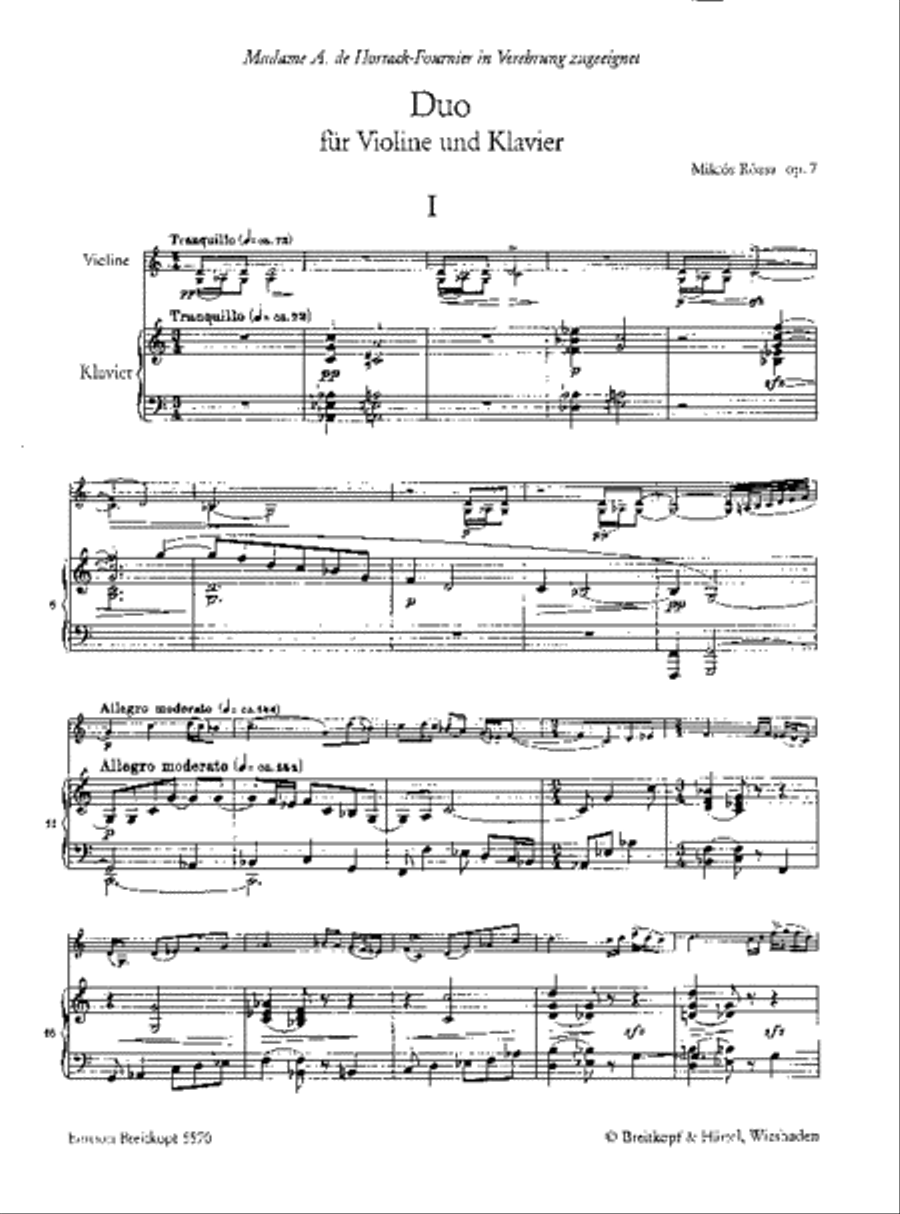
Miklos Rozsa's Duo for Violin and Piano op. 7 was written in 1931, during his last year of study in Leipzig. In view of the four movements, the title "Sonata" would also be appropriate. The outer movements each represent a middle way of sonata form and rondo. Rozsa's work with the contrasting thematic groups is more reminiscent of a variation movement, which is typical of the composer. The slow movement echoes the folk music of his native Hungary. He appreciated this kind of music, which is evident in many of his works. However, his compositions are merely based on the originals; direct quotations do not occur. Rozsa rather repaints the originals in a romantic, deeply expressive and powerful way.CD: Isabella Lippi (violin), John Novacek (piano)KOCH 3-7256-2Bibliography:Bally, Juliane: Miklos Rozsa. Ausbildung und kammermusikalisches Fruhwerk als Basis fur das filmmusikalische Schaffen am Beispiel Ben Hur, Saarbrucken: PFAU 2012, pp. 109-122.
- More by this Composer:
- Miklos Rozsa Miklos Rozsa Piano Miklos Rozsa Piano Solo Miklos Rozsa Violin Solo
- Instrument:
- Piano and Keyboard Piano Strings Violin Violin Solo
- Artists:
- Miklos Rozsa
- Publisher:
- Breitkopf and Haertel