18492072
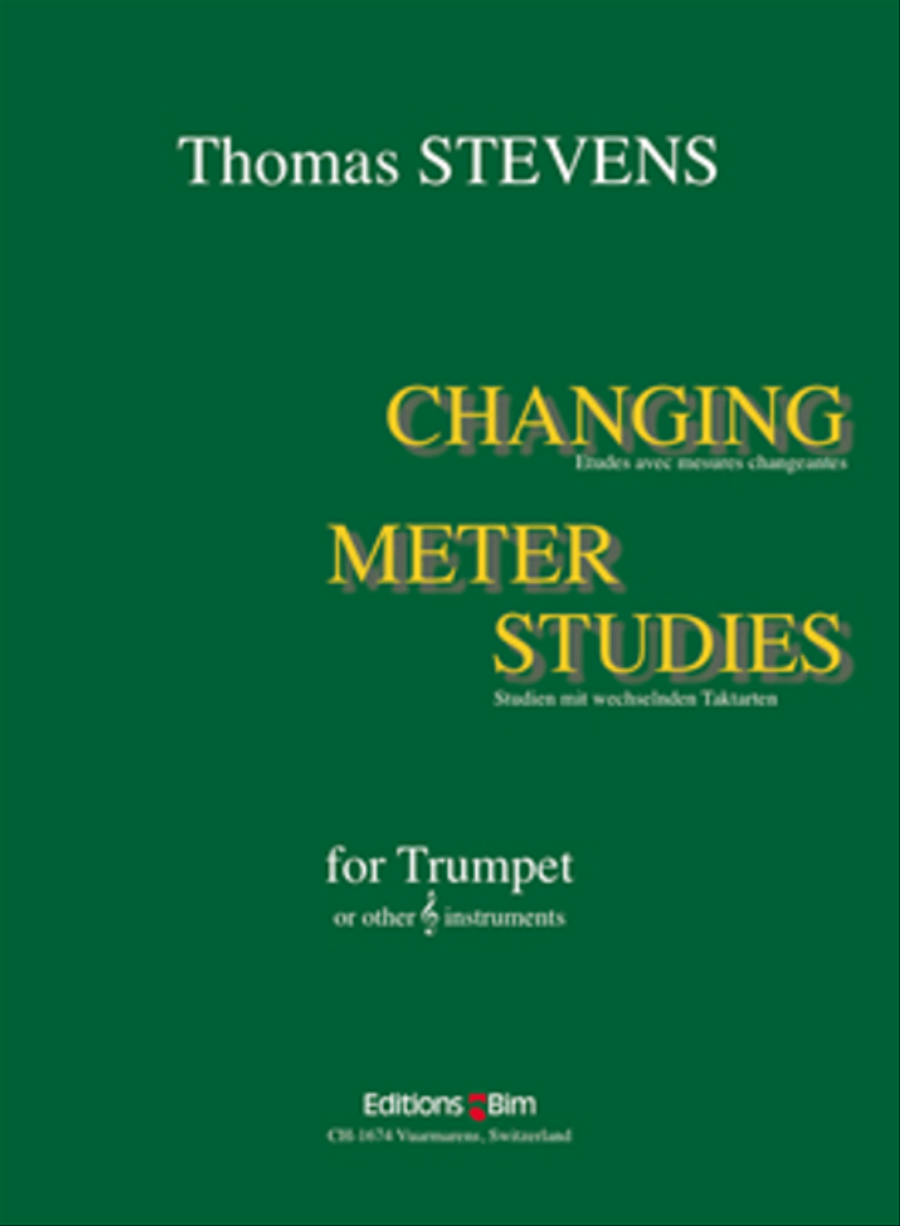
Changing Meter Studies
18492072
18492072
18492072
Copyright Material for Preview Only - Sheet Music Plus
Trumpet - Grade 3-5
SKU: ET.TP1
Composed by Thomas Stevens. Contemporary. Editions BIM #TP1. Published by Editions BIM (ET.TP1).
ISBN 9790207020529.
The Changing Meter Studies are intended to provide the student with practical exercises dealing with changing meters as they occur in much contemporary music.
The format for these studies is as follows: Studies I-XIV deal with regular shifting meter patterns. Studies XV-XXI present irregular shifting meter patterns. It should be noted that the meters used are 6 or less, since larger meters are generally nothing more than combinations of smaller ones.
Since the emphasis is on the problems presented by the meters themselves, I have attempted to use basic metric units, whenever possible, rather than complicated subdivisions within said meters. Furthermore, the units remain constant in all the studies.
The page of examples provides not only an illustration of these constant units, but also gives the student an idea of how to correctly connect the juxtaposed meters. In addition, examples I, III, and X have, placed above them, the conducting symbols, originally employed by Pierre Boulez in “Le Marteau sans Maître", to delineate duple and triple meters (I-III), and/or duple and triple subdivisions of intermediate meters (X).
The studies are not difficult from a technical point of view; the emphasis here being on the meter changes, which have been employed in such a way as to seem both “natural" and inevitable.
Thomas Stevens
(1978).
Trumpet - Grade 3-5
SKU: ET.TP1
Composed by Thomas Stevens. Contemporary. Editions BIM #TP1. Published by Editions BIM (ET.TP1).
ISBN 9790207020529.
The Changing Meter Studies are intended to provide the student with practical exercises dealing with changing meters as they occur in much contemporary music.
The format for these studies is as follows: Studies I-XIV deal with regular shifting meter patterns. Studies XV-XXI present irregular shifting meter patterns. It should be noted that the meters used are 6 or less, since larger meters are generally nothing more than combinations of smaller ones.
Since the emphasis is on the problems presented by the meters themselves, I have attempted to use basic metric units, whenever possible, rather than complicated subdivisions within said meters. Furthermore, the units remain constant in all the studies.
The page of examples provides not only an illustration of these constant units, but also gives the student an idea of how to correctly connect the juxtaposed meters. In addition, examples I, III, and X have, placed above them, the conducting symbols, originally employed by Pierre Boulez in “Le Marteau sans Maître", to delineate duple and triple meters (I-III), and/or duple and triple subdivisions of intermediate meters (X).
The studies are not difficult from a technical point of view; the emphasis here being on the meter changes, which have been employed in such a way as to seem both “natural" and inevitable.
Thomas Stevens
(1978).
Tell a friend (or remind yourself) about this product. We'll instantly send an email containing product info and a link to it. You may also enter a personal message.
We do not use or store email addresses from this form for any other purpose than sending your share email.
Read our Privacy Policy.
After purchase, you can download your MP3 from your Sheet Music Plus Digital Library - no software installation is necessary! You can also listen to your MP3 at any time in your Digital Library.
After purchase, you can download your Smart Music from your Sheet Music Plus Digital Library - no software installation is necessary! You can also download at any time in your Digital Library.
After purchase you can download your video from your Digital Library. Your video is in XX format and is playable on most pre-installed video players.