Order two or more copies of the same title and we'll automatically give you 5% off list price on that title.
To get 2+ Pricing , just add two or more copies of a title to your shopping cart. Your discount will be immediately applied to your order.
Sale titles, hymnals, and ShowKits (MTI's Broadway Junior Collection, Getting to Know... Collection (G2K) and MTI's Kids Collection) do not qualify for 2+ Pricing
If you have any questions or comments regarding 2+ Pricing , please visit our Help Center to find more information or chat with our support team
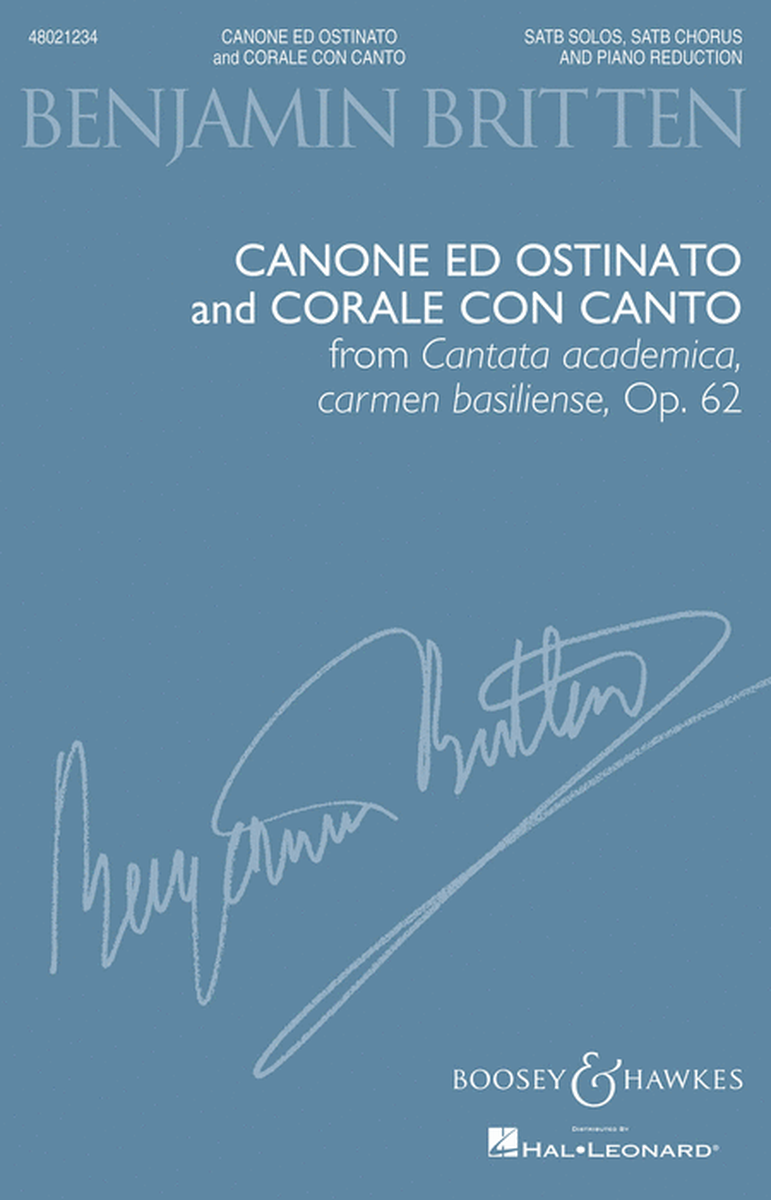
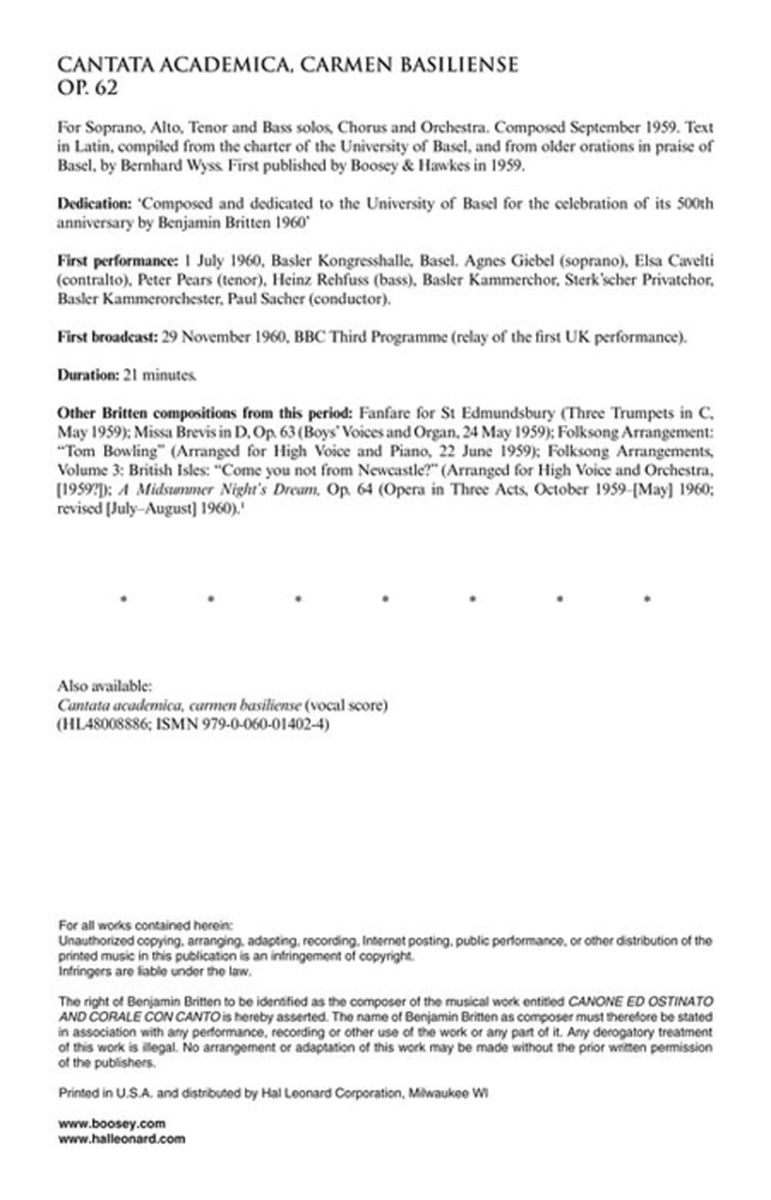
From Cantata academica, Carmen basiliense. Composed by Benjamin Britten. Boosey & Hawkes Sacred Choral. Classical. Octavo. 16 pages. Boosey & Hawkes #M051482474. Published by Boosey & Hawkes (HL.48021234).
ISBN 9781458423542. UPC: 884088642037. 6.75x10.5x0.037 inches.
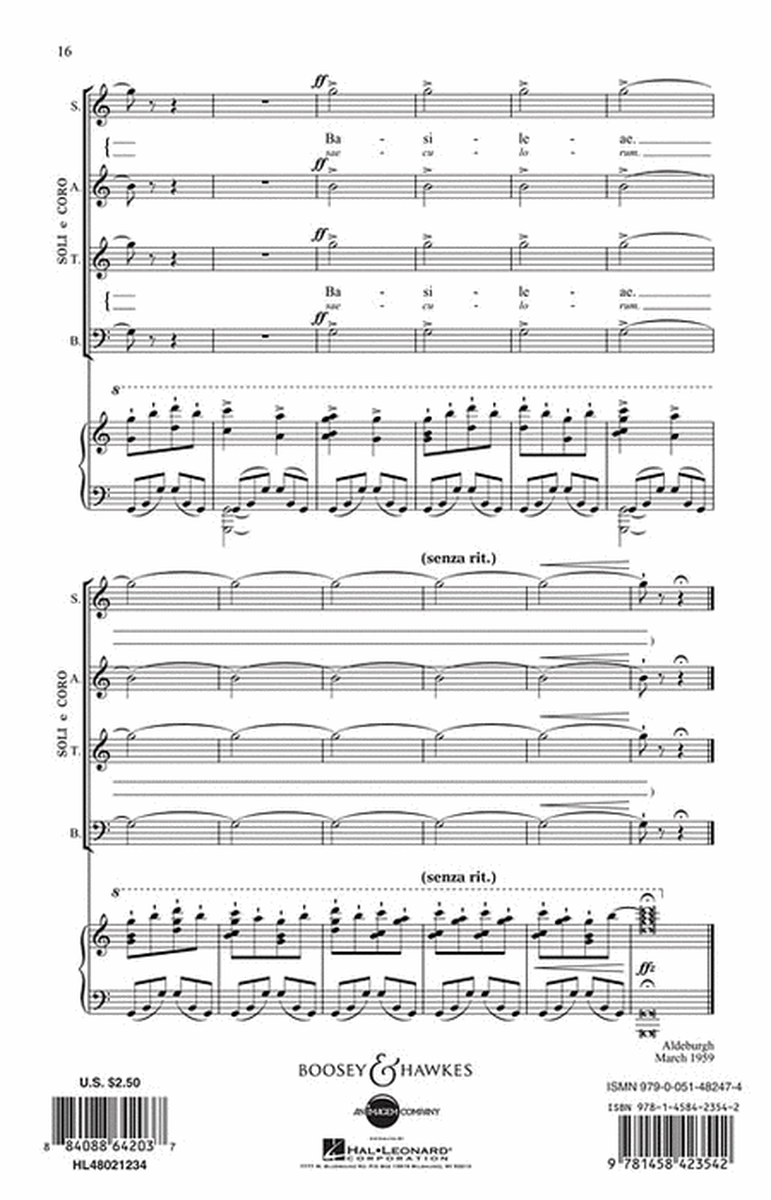
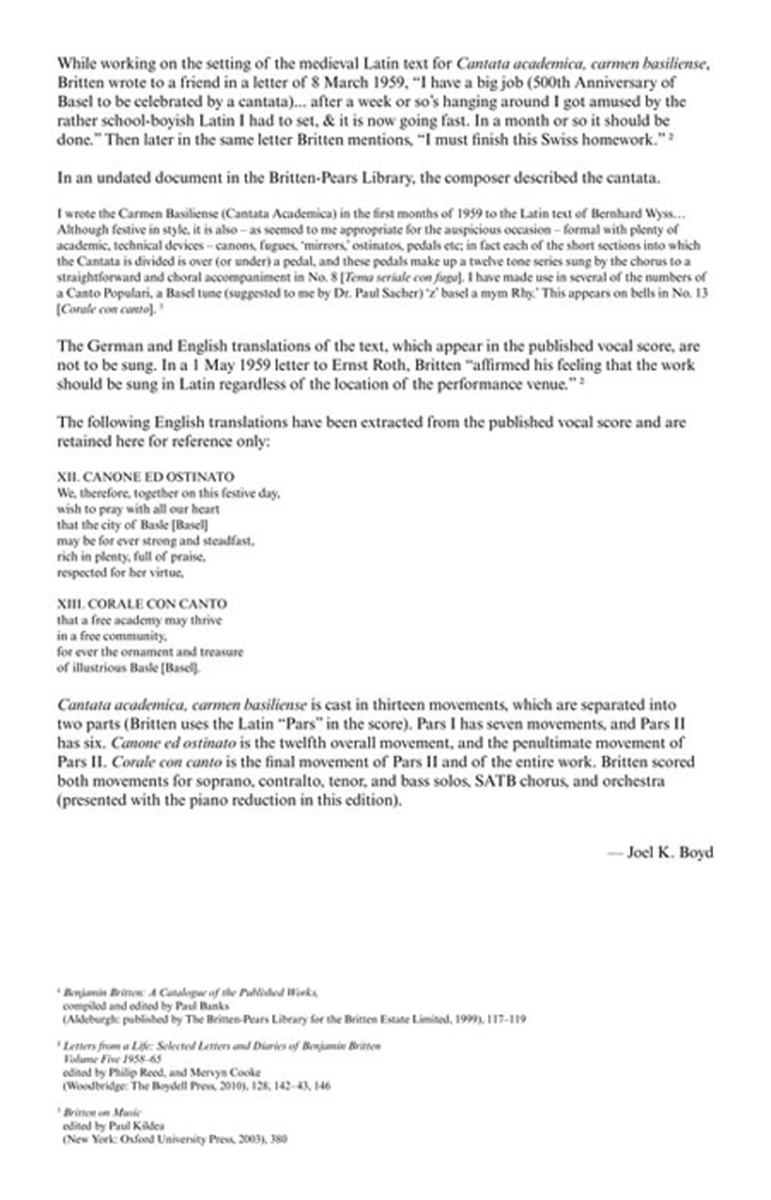
Text: in Latin compiled from the charter of the University, and from older orations in praise of Basle by Bernhard Wyss. Publisher: Boosey & Hawkes Difficulty level: 4 (for chorus) Britten's genius lifts this work above being just a worthy celebration of the 500th anniversary of the foundation of Basle University. It is tongue-in-cheek and mockingly non-academic while referring all the time to academic musical forms and formulae. It is written in two parts (everything is in the statutory Latin including the titles of the parts - Pars I and Pars II). The titles of the movements show Britten's intention to show off a wide variety of techniques. Here are some examples: Chorale/Alla Rovescio (the theme is given and responded to with the same melody upside down)/Recitativo/Tema seriale con fuga/Canone ed ostinato. There is a good deal of humour here. There are seven movements in Pars I and six in Pars II. The tenor soloist is given three florid recitatives, accompanied only by a piano, which act as bridges between other orchestrally accompanied movements. Of these the most noteworthy are the Arioso con canto popolare for soprano solo with tenors and basses who hum a student song; another terrific Britten scherzo; and a wonderfully raucous final pair of movements (Canon ed ostinato and Corale con canto) where Britten seems to be aping the Vivat Regina! cries in Parry's I was glad or encouraging the kind of noisy 'I'm from the best university' kind of student touchline shout. This has outrageously high notes for the tenors (top B) which further endorse this feeling. There are real echoes of the Spring Symphony (see separate entry) final movement here which are further underlined by the last section of the Cantata which brings in the bells, piano, huge percussion and the inevitable chorale in which the choir sings 'that a free academy may thrive in a free community, for ever the ornament and treasure of illustrious Basle'. This may not be Britten at his most soul-searching but, as always, there is plenty here to enjoy, especially if the work is not taken too seriously. It is a celebratory, occasional piece and it could be well taken up by other academic establishments celebrating big anniversaries. The chorus parts are not very difficult, though they do present challenges for the choir - not least in having tenors capable of those very high notes at the end. The Tema seriale con fuga is sinewy and needs careful tuning. It also has the subject regularly given upside down after its initial sounding by the basses. All good fun. Duration: 21 minutes Paul Spicer, Lichfield, 2011.
From Cantata academica, Carmen basiliense. Composed by Benjamin Britten. Boosey & Hawkes Sacred Choral. Classical. Octavo. 16 pages. Boosey & Hawkes #M051482474. Published by Boosey & Hawkes (HL.48021234).
ISBN 9781458423542. UPC: 884088642037. 6.75x10.5x0.037 inches.
Text: in Latin compiled from the charter of the University, and from older orations in praise of Basle by Bernhard Wyss. Publisher: Boosey & Hawkes Difficulty level: 4 (for chorus) Britten's genius lifts this work above being just a worthy celebration of the 500th anniversary of the foundation of Basle University. It is tongue-in-cheek and mockingly non-academic while referring all the time to academic musical forms and formulae. It is written in two parts (everything is in the statutory Latin including the titles of the parts - Pars I and Pars II). The titles of the movements show Britten's intention to show off a wide variety of techniques. Here are some examples: Chorale/Alla Rovescio (the theme is given and responded to with the same melody upside down)/Recitativo/Tema seriale con fuga/Canone ed ostinato. There is a good deal of humour here. There are seven movements in Pars I and six in Pars II. The tenor soloist is given three florid recitatives, accompanied only by a piano, which act as bridges between other orchestrally accompanied movements. Of these the most noteworthy are the Arioso con canto popolare for soprano solo with tenors and basses who hum a student song; another terrific Britten scherzo; and a wonderfully raucous final pair of movements (Canon ed ostinato and Corale con canto) where Britten seems to be aping the Vivat Regina! cries in Parry's I was glad or encouraging the kind of noisy 'I'm from the best university' kind of student touchline shout. This has outrageously high notes for the tenors (top B) which further endorse this feeling. There are real echoes of the Spring Symphony (see separate entry) final movement here which are further underlined by the last section of the Cantata which brings in the bells, piano, huge percussion and the inevitable chorale in which the choir sings 'that a free academy may thrive in a free community, for ever the ornament and treasure of illustrious Basle'. This may not be Britten at his most soul-searching but, as always, there is plenty here to enjoy, especially if the work is not taken too seriously. It is a celebratory, occasional piece and it could be well taken up by other academic establishments celebrating big anniversaries. The chorus parts are not very difficult, though they do present challenges for the choir - not least in having tenors capable of those very high notes at the end. The Tema seriale con fuga is sinewy and needs careful tuning. It also has the subject regularly given upside down after its initial sounding by the basses. All good fun. Duration: 21 minutes Paul Spicer, Lichfield, 2011.
Preview: Canone ed Ostinato and Corale con Canto
Tell A Friend
Tell a friend (or remind yourself) about this product. We'll instantly send an email containing product info and a link to it. You may also enter a personal message.
We do not use or store email addresses from this form for any other purpose than sending your share email.
After purchase, you can download your MP3 from your Sheet Music Plus Digital Library - no software installation is necessary! You can also listen to your MP3 at any time in your Digital Library.
Learn about Smart Music
After purchase, you can download your Smart Music from your Sheet Music Plus Digital Library - no software installation is necessary! You can also download at any time in your Digital Library.
Learn about Digital Video
After purchase you can download your video from your Digital Library. Your video is in XX format and is playable on most pre-installed video players.