Composed by David Stout. Arranged by Louis Setzer. 20th Century American. Score and Trombone part. Cherry Classics #CC3090. Published by Cherry Classics (CY.CC3090).
ISBN 9790530110676. 8.5 x 11 in inches.
Al Circo (To the Circus) was written in 1968 by David Stout, dedicated to Emory Remington and was premiered by Trombonist Fred Boyd on a recital at the Eastman School of Music with Carolyn Kuban performing on the Harp. The work is in two movements, both in a lighter nature and humorous. Mute colors are an important part of the mood of the work.
David Stout writes about his work:
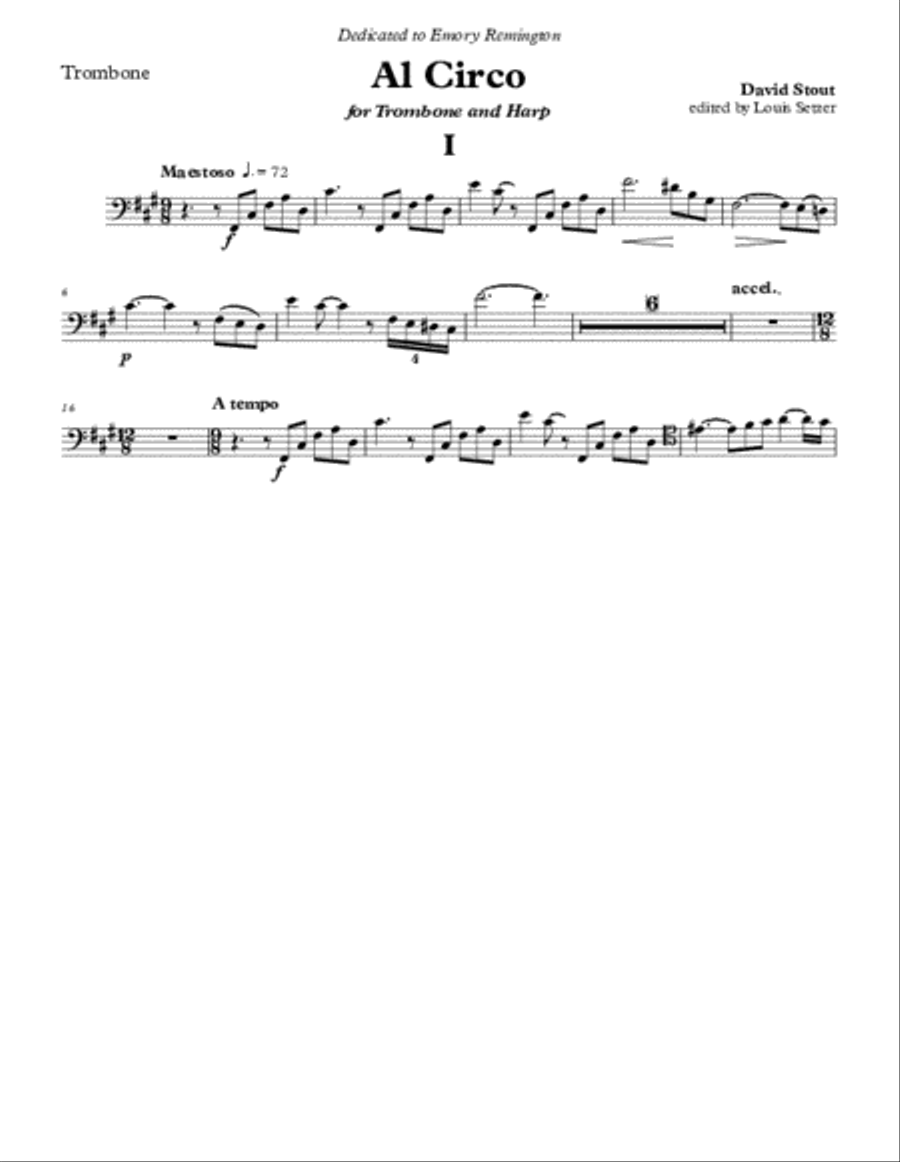
I wrote this when I was a junior at the Eastman School of Music. Fred Boyd, a bass trombonist, wanted to play it. At the bottom of page 4, on the trombone part, where it says hand in bell he had a problem. With a bass trombone he couldn’t reach around far enough to put his hand in deep enough to distort the tone enough. So, he calls me into his practice room one day and tells me to turn around so I can’t see him. He then plays that passage. ‘Is that the sound you want?’ he asks. ‘Yeah that’s it. Perfect!’ I reply. I turn around. He shows me a large plastic fish that he had used to shove in the bell. So on his part, we mark those notes, ‘con sardino.’
Dr. Louis Setzer, the author of Solo Literature for Trombone and Harp - An Annotated Bibliography, rediscovered the work and received permission from the composer to edit the composition from the original pencil manuscript. He believes this work is the oldest known original composition for Trombone and Harp
This fine work is appropriate for advanced performers and is about 7 minutes in length.
Composed by David Stout. Arranged by Louis Setzer. 20th Century American. Score and Trombone part. Cherry Classics #CC3090. Published by Cherry Classics (CY.CC3090).
ISBN 9790530110676. 8.5 x 11 in inches.
Al Circo (To the Circus) was written in 1968 by David Stout, dedicated to Emory Remington and was premiered by Trombonist Fred Boyd on a recital at the Eastman School of Music with Carolyn Kuban performing on the Harp. The work is in two movements, both in a lighter nature and humorous. Mute colors are an important part of the mood of the work.
David Stout writes about his work:
I wrote this when I was a junior at the Eastman School of Music. Fred Boyd, a bass trombonist, wanted to play it. At the bottom of page 4, on the trombone part, where it says hand in bell he had a problem. With a bass trombone he couldn’t reach around far enough to put his hand in deep enough to distort the tone enough. So, he calls me into his practice room one day and tells me to turn around so I can’t see him. He then plays that passage. ‘Is that the sound you want?’ he asks. ‘Yeah that’s it. Perfect!’ I reply. I turn around. He shows me a large plastic fish that he had used to shove in the bell. So on his part, we mark those notes, ‘con sardino.’
Dr. Louis Setzer, the author of Solo Literature for Trombone and Harp - An Annotated Bibliography, rediscovered the work and received permission from the composer to edit the composition from the original pencil manuscript. He believes this work is the oldest known original composition for Trombone and Harp
This fine work is appropriate for advanced performers and is about 7 minutes in length.
Preview: Al Circo for Trombone and Harp
Tell A Friend
Tell a friend (or remind yourself) about this product. We'll instantly send an email containing product info and a link to it. You may also enter a personal message.
We do not use or store email addresses from this form for any other purpose than sending your share email.
After purchase, you can download your MP3 from your Sheet Music Plus Digital Library - no software installation is necessary! You can also listen to your MP3 at any time in your Digital Library.
Learn about Smart Music
After purchase, you can download your Smart Music from your Sheet Music Plus Digital Library - no software installation is necessary! You can also download at any time in your Digital Library.
Learn about Digital Video
After purchase you can download your video from your Digital Library. Your video is in XX format and is playable on most pre-installed video players.