Order two or more copies of the same title and we'll automatically give you 5% off list price on that title.
To get 2+ Pricing , just add two or more copies of a title to your shopping cart. Your discount will be immediately applied to your order.
Sale titles, hymnals, and ShowKits (MTI's Broadway Junior Collection, Getting to Know... Collection (G2K) and MTI's Kids Collection) do not qualify for 2+ Pricing
If you have any questions or comments regarding 2+ Pricing , please visit our Help Center to find more information or chat with our support team
High voice solo and piano accompaniment (high voice) - Difficulty: difficult
SKU: IM.1695
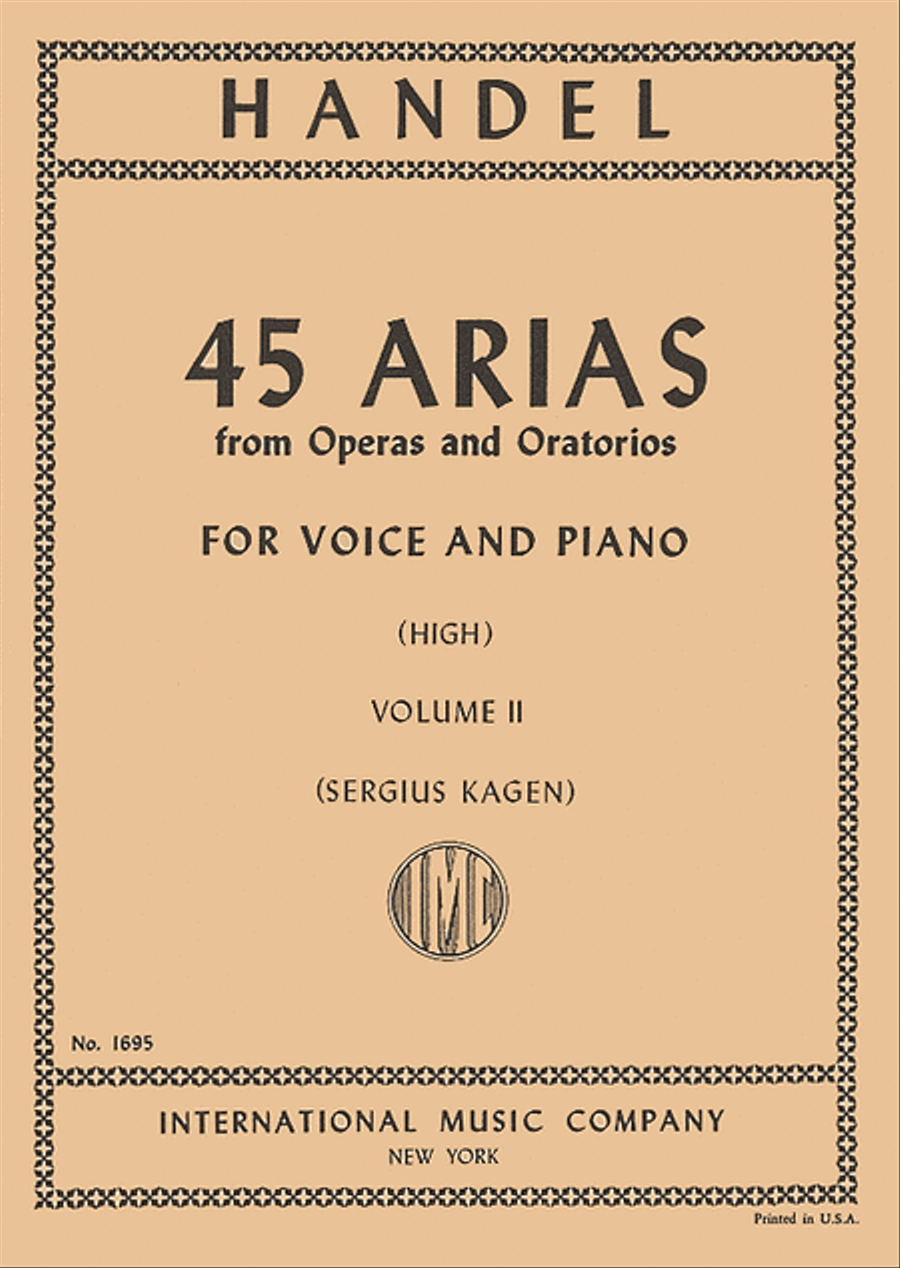
Volume II. Composed by George Frideric Handel. Edited by Sergius Kagen. Baroque. Collection. With vocal melody, piano accompaniment, lyrics, translations and introductory text. 64 pages. International Music Co. #1695. Published by International Music Co. (IM.1695).
High voice solo and piano accompaniment (high voice) - Difficulty: difficult
SKU: IM.1695
Volume II. Composed by George Frideric Handel. Edited by Sergius Kagen. Baroque. Collection. With vocal melody, piano accompaniment, lyrics, translations and introductory text. 64 pages. International Music Co. #1695. Published by International Music Co. (IM.1695).
7.5x10.5 inches.
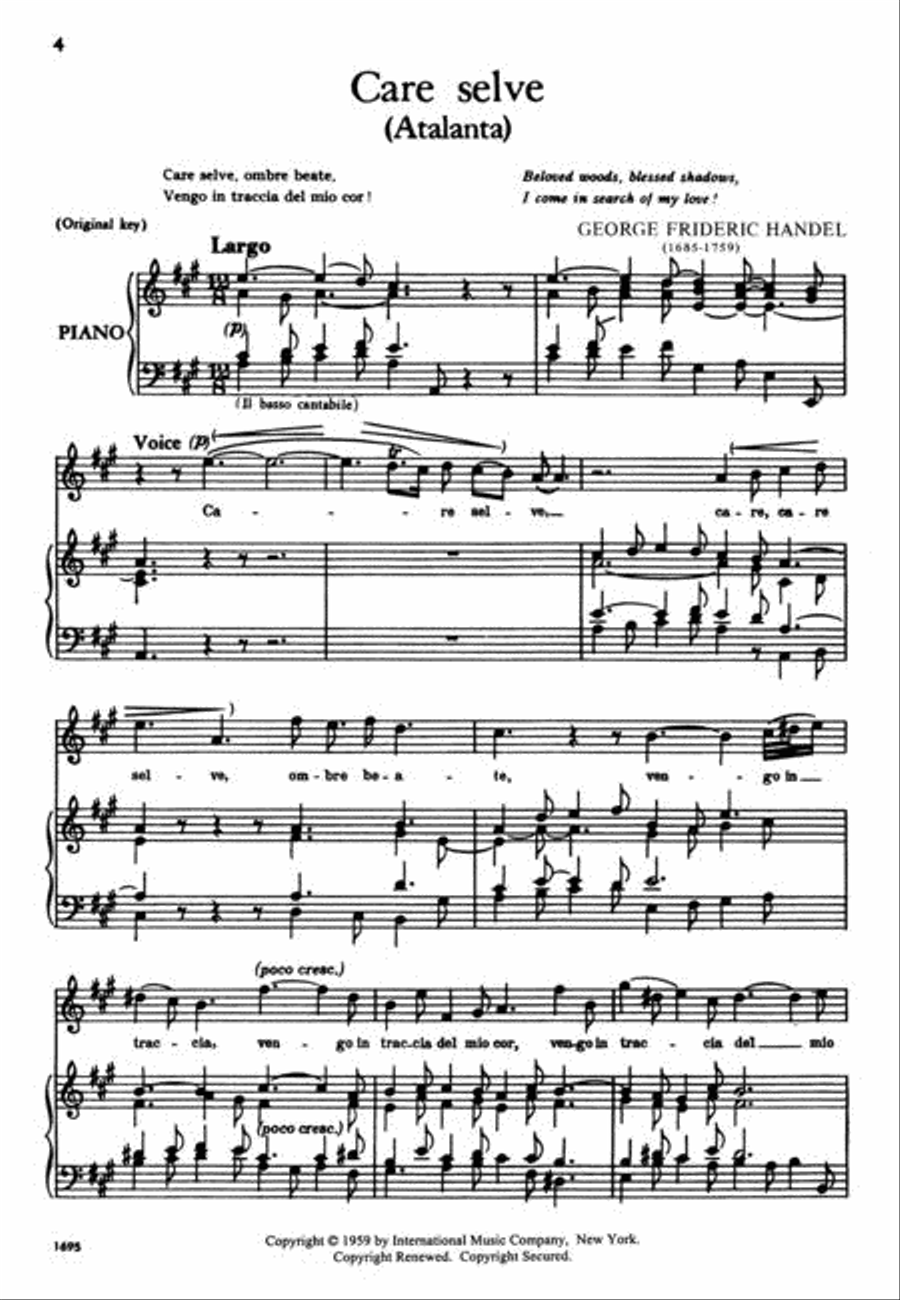
Care selve
Mirth admit me
Non lo diro
Recit: O didst thou
Aria: As when the dove
Recit: Frondi tenere
Aria: Ombra mai fu
Aria: Angels ever bright
O had I Jubal's Lyre
O Sleep
Rendi il serno
Sommi Dei
Sweet Bird
Sound An Alarm!
There the brisk sparkling Necktor
Verdi Prati
So shall the Lute and Harp
Recit: O worse than Death
Ratings + Reviews
★Based on 1 Reviews
★
Anonymous
May 13, 2011
Handel 45 Arias, Vol. 2 (International)
If one allows that some of the arias in this anthology are only proper for soprano or tenor, not both, there remain some good things to say about it. First, the selection consists of basic arias with which no performer should be unfamiliar. The editing, too, is modest enough, with editorial dynamics clearly set off in parentheses. In addition, the piano reductions of the orchestral accompaniments are not difficult and provide useful study material for student accompanists. While it is true that some of the continuo realizations will seem conservative by present-day standards, they work well enough on the piano, are of an appropriate level of complexity for student accompanists, and could be easily dressed up by the pianist if necessary.
Preview: 45 ARIAS from Operas and Oratorios for Voice and Piano (High Voice)
Tell A Friend
Tell a friend (or remind yourself) about this product. We'll instantly send an email containing product info and a link to it. You may also enter a personal message.
We do not use or store email addresses from this form for any other purpose than sending your share email.
After purchase, you can download your MP3 from your Sheet Music Plus Digital Library - no software installation is necessary! You can also listen to your MP3 at any time in your Digital Library.
Learn about Smart Music
After purchase, you can download your Smart Music from your Sheet Music Plus Digital Library - no software installation is necessary! You can also download at any time in your Digital Library.
Learn about Digital Video
After purchase you can download your video from your Digital Library. Your video is in XX format and is playable on most pre-installed video players.