Details
- Instrument:
- Piano Tenor Saxophone Saxophone Solo
- Ensembles:
- Chamber Music
- Composers:
- Stacy Garrop
- Publishers:
- Theodore Presser Company
- Series:
- Women Composers and Arrangers
- UPC:
- 680160675906
- ISBN:
- 9781491130506
- Format:
- Score Set of Parts Score and Parts
- Item types:
- Physical
- Artist:
- Stacy Garrop
- Usages:
- School and Community
- Number of Pages:
- 44
- Size:
- 9 x 12 inches
- Shipping Weight:
- 1.56 pounds
SKU: PR.114419450
Composed by Stacy Garrop. This edition: saddle-wire stitch. Sws. Score and parts. 44 pages. Duration 0:14:15. Theodore Presser Company #114-41945. Published by Theodore Presser Company (PR.114419450).ISBN 9781491130506. UPC: 680160675906. 9 x 12 inches.
Garrop’s intense-yet-droll program note refers back to her earlier Tantrum for Alto Saxophone and Piano (2000), noting that WRATH is a new work revisiting Tantrum’s voice while “re-imagining it as a leaner, meaner, ferocious teenager who has moved on from an infant’s temper tantrum into an all-out vengeful fury.” Bearing the movement titles I. Menace, II. Shock, and III. Amok, WRATH is a rare major work in the tenor sax repertoire, with occasional explosions of wailing freedom, generous amounts of altissimo, and long patches of dark, traditional beauty. For advanced players.
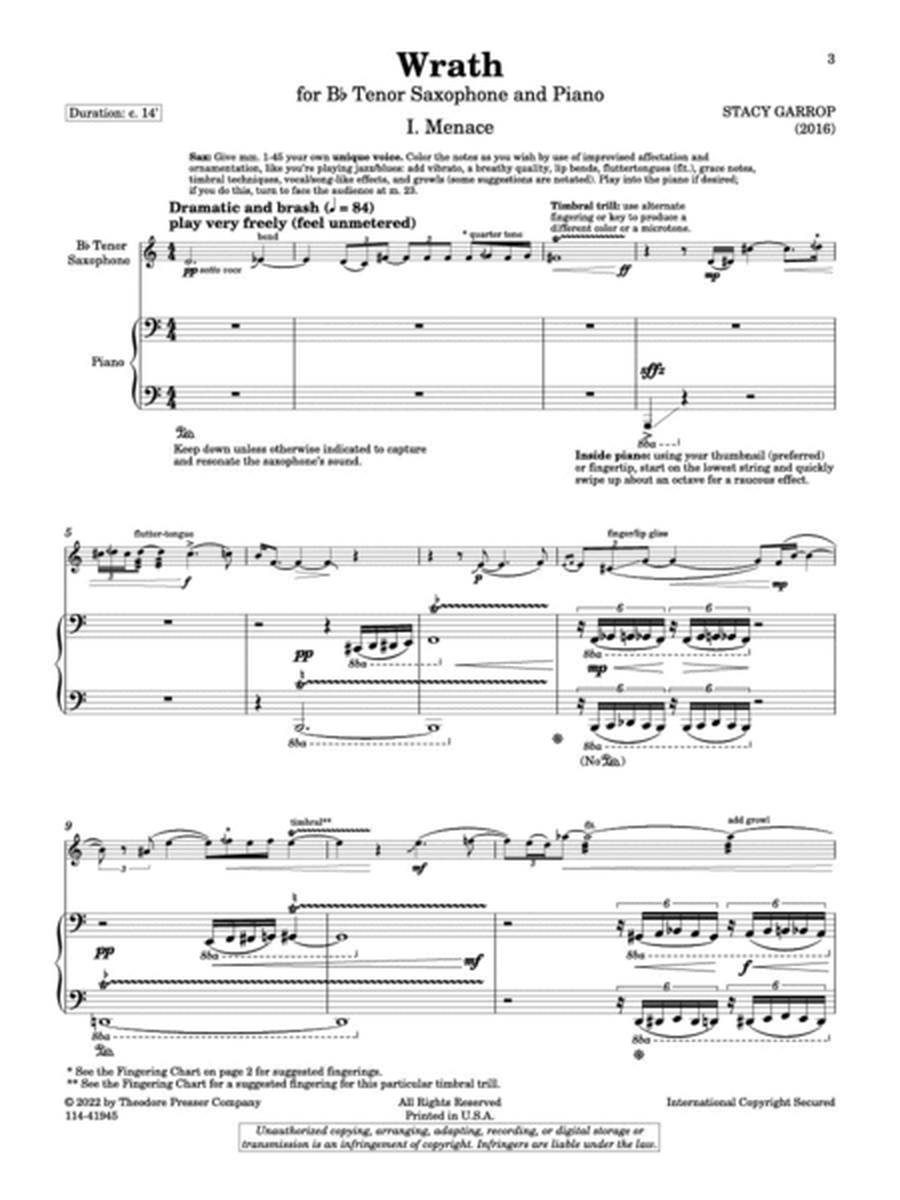
In 2000, I wrote a feisty piece called Tantrum for alto saxophone and piano. Sixteen years later, Idecided to revisit Tantrum and re-imagine it as a leaner, meaner, ferocious teenager who hasmoved on from an infant’s temper tantrum into an all-out vengeful fury. Wrath shares a fewstructural similarities with Tantrum: both have three movements that follow a fast – slow – superfast pattern; both works also open with a declamatory statement issued by the saxophone; andboth are high in energy and very dramatic. Musically, the works are independent.One of the intriguing features of Wrath was inspired by the manner in which the piece wascommissioned. Saxophonist David Stambler and I built a consortium of fifteen saxophonists whoall took part in commissioning the piece. I wanted each saxophonist to have multipleopportunities to personalize the music by bringing his or her own interpretation to the notes. So Iincorporated several spots in the first movement in which the saxophonists are encouraged toexperiment and tinker with the way they perform the written material (you’ll hear a primeexample of this in the opening material of the first movement). Additionally, near the end of thefirst movement, there is a spot in which the saxophonists are asked to improvise.
- More by this Composer:
- Stacy Garrop Stacy Garrop Cello Stacy Garrop B-Flat Clarinet Stacy Garrop Piano
- Series:
- Women Composers and Arrangers
- Instrument:
- Piano and Keyboard Piano Woodwinds Saxophone Tenor Saxophone Woodwinds Saxophone Saxophone Solo
- Artists:
- Stacy Garrop
- Ensemble:
- Chamber Music
- Publisher:
- Theodore Presser Company