
Ships to you
Ships to you
SKU: LM.27488
Composed by Tristan Murail. Ensemble music. Contemporary. Score. 54 pages. Duration 13'. Editions Henry Lemoine #27488. Published by Editions Henry Lemoine (LM.27488).ISBN 9790230974882.
Where does the title Winter Fragments come from?
As a rule I don't like naming a piece before I've finished writing it, like counting your chickens before they're hatched. The completed piece may well differ considerably from the initial project, which is a concept, ideas, sounds and images, while the finished product is sound, organised within time. There's a gulf between the two. So this title has to be taken for what it's worth. It is at one and the same time an acknowledgement of the festival where the piece is to be created ("Sounds of winter and today"), and the experience of a genuine winter last year, particularly where we now live, to the north of New York, a region of lakes and small mountains. The lake in front of our house was frozen over, and there were sixty centimetres of snow all round. For the most part the sun shone brightly and its intense light bathed the house, which is open to nature all round. Sometimes a violent storm would arise, followed by silence, and the blinding light would come back. Perhaps the "fragments of winter" are there.
Has the instrumentation any symbolic meaning?
No! And anyway what counts is not so much the instruments themselves as the way you use them. Using exactly the same grouping (flute, clarinet, violin, cello and piano) I've written pieces which sound quite different. Winter Fragments uses the same instruments, not for symbolic reasons but for practical ones, and will sound quite different again. There are also the electronic sounds which melt into the ensemble. I am trying therefore to renew the experience of Bois Flotté for small ensemble and synthetic sounds, but in a fairly different style, with different musical and sound vocabulary. I also hope to put in more detailed work on spatialisation, with the aid of the studio at Annecy.
Could you define a successful work?
For me, a "successful" work does not necessarily mean one which is the most popular with the audience - and vice versa. Some works that I think are successful, at least in one sense, might leave a number of listeners quite puzzled. Above all, I look for evidence of a certain quality in the musical flow (and others might say this quality is "necessary", but I don't think anything should be really necessary in art). I know intuitively when I get to that stage of evidence, even though I'd find it hard to explain all the ins and outs. It is concerned with the intrinsic quality between the musical objects (such as timbre, harmony and figuration), and their position in time. There is no clear rule here, because what is at stake here is perception, the emotions aroused by these objects, the psychological effect produced by their succession, and the distortion in the perception of time created by the quality of the chosen objects as well as their immediate relationship - and so on. It is all very complex, and cannot be boiled down to some set of objective rules or pigeonholing of abstract characteristics, which would in any way be far too reduced. Finally, my ultimate aim would be to create and master an entirely personal "language" - which is not a very precise term but I use it because there's nothing better - which I could use to communicate, a language which would be as flexible and versatile as, for example, the musical idioms of the end of the tonal period, a language that would rediscover certain universal and permanent categories of musical expression, without wading through some sort of nostalgia, or taking one of the "post-modern" paths with which we are bombarded today.
Tristan Murail
In many regards, Winter Fragments (2000) is fairly close in spirit and means to Le Lac. One will hardly be surprised to already find, in addition to this oftmentioned Nature (here, a mineral, glacial Nature, bathed in a particularly bright luminosity), a discourse based on a limited number of objects of nearly iconic value which are subjjected to multiple transformations. Thre piece is organised primarily on the evolution of a "wery simple melodic cell that is repeated and transformed". A flute motif will, in fact, be reformulated several times and extended, then become an oscillating motif. It is "thickened" in an interesting way in section l, m in a sort of heterophony. The strong stylistic traits that link the two works originate in a turning point taken by Murail in the early 1990s, evident in the singular Serendib but more patent in L'Esprit des dunes (1994), in which the crystallisation of essential aspects of the composer's music seems to begin. Written for an ensemble modelled after that of Treize couleurs du soleil couchant, these Fragments only partially belong to the domain of chamber music, the electronic element sometimes contributing an orchestral depth to the whole, even more so given the manifest desire to favour fused textures and to blur the possible differentiation between instrumental and electronic timbres. Again, the overall structure is closely tied to the deployment of these object-figures with easily identifiable contours, which one might schematically reduce to the following topology: flute melody (rising in its first formulations); descending figure (with equal rhythmic values, in a measured rallentando or in accelerando; in arpeggios or broken arpeggios); a pointillist polyphony (violin and cello pizzicati, to which the piano is most often added). One observes that the "descending rallentando" gesture corresponds to an inverse gesture, "rising accelerando", but which is practically unused, as if the descending formula corresponded to a more natural, more universal gesture. In addition, one might note at the end of the piece a short quotation from Prologue, for viola, the first part of Gerard Grisey's Espaces acoustiques, an homage rendered in a discreet but moving way to the departed composer. This quotation from Prologue is present throughout the piece in distorted fashion, stemming from the initial flute melody; it progressively gets closer to the original form which, in fact, is not heard until the very end of the piece. As for the elecronic part, Jérôme Chadel, author of a thesis in progress on Tristan Murail's music, distinguishes four classes of sounds: 1) inharmonic percussive: 2) noisy ftute; 3) bruitist surface; 4) crystalline sounds, isolated or in cascade. The 225 sounds elaborated by the composer according to a process of analysis, treatment and re-synthesis using the Diphone, Audiosculpt, Patchwork, Csound and Max software are used in the form of samples triggered by a MIDI master keyboard. Their traditional notation on the score, which has a prescriptive value for the performer but no real musical significance (the written notes corresponding only to a key on the keyboard and a sample assigned to it), is relayed by a notation evoking those of mediaeval neumes, graphically taking into account the envelope of sound in its broad lines.
Pierre Rigaudière
Translated by John Tyler Tuttle
CD aeon Winter Fragments
1 CD aeon, AE0746
Winter Fragments - Unanswered Questions - Ethers - Feuilles à travers les cloches - Le Lac
Argento Chamber Ensemble, Erin Lesser (flute), Michel Galante (conductor)
1 DVD Accord / Una Corda / Universal music, AC4725109
Treize Couleurs du Soleil Couchant - Bois Flotté - Winter Fragments
Ensemble Les Temps Modernes, Fabrice Pierre (conductor)
1 CD Accord, AC4725112
Treize Couleurs du soleil couchant - Winter fragments - Bois flotté
Ensemble Les Temps Modernes, Fabrice Pierre (conductor)
Hervé Bailly-Basin (video artist)
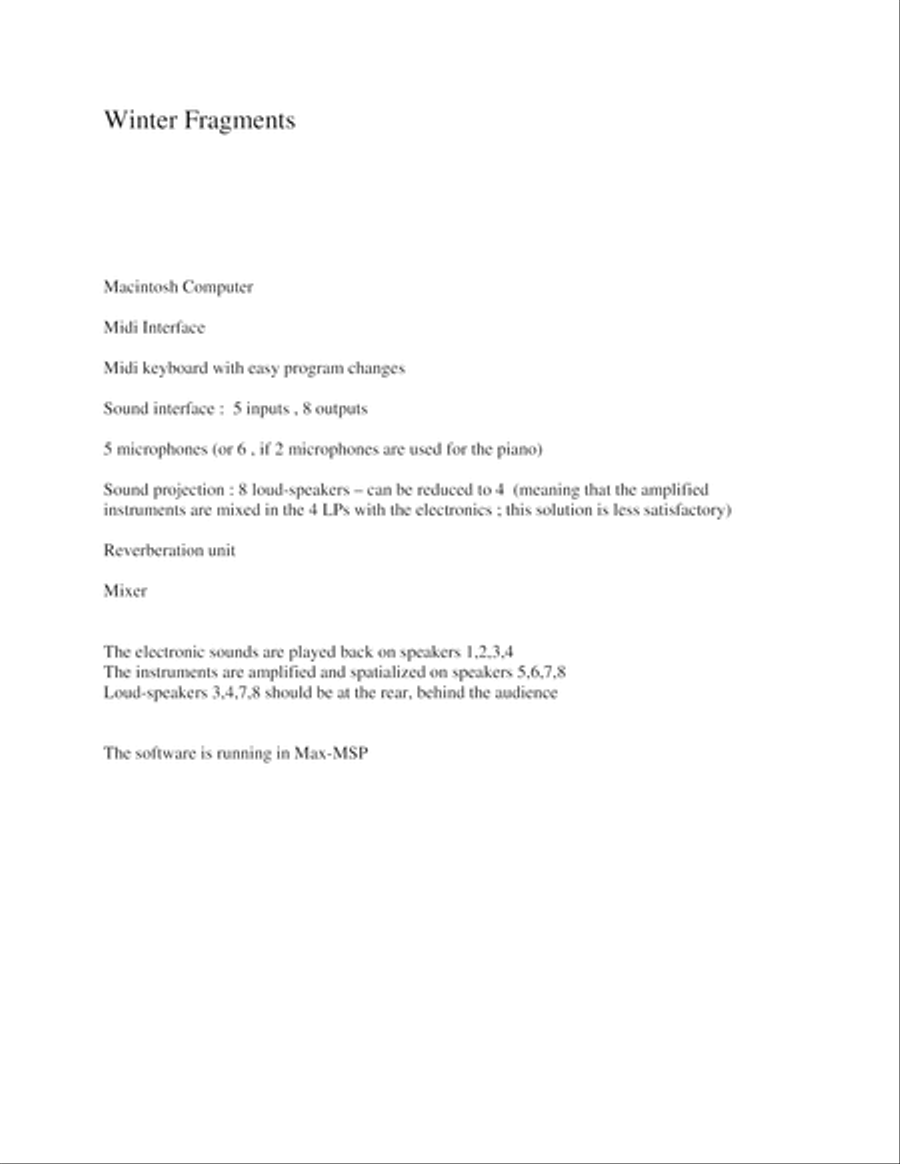
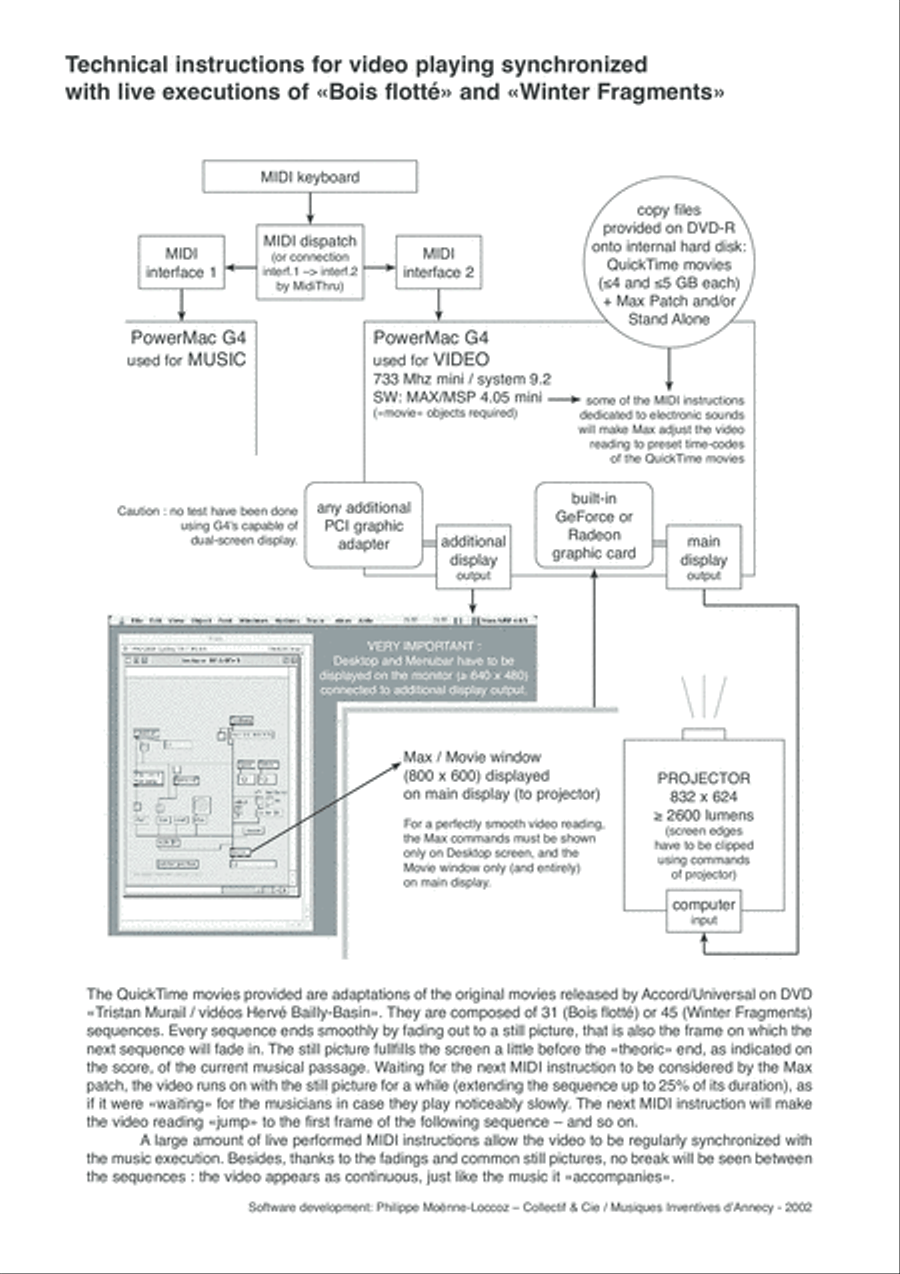
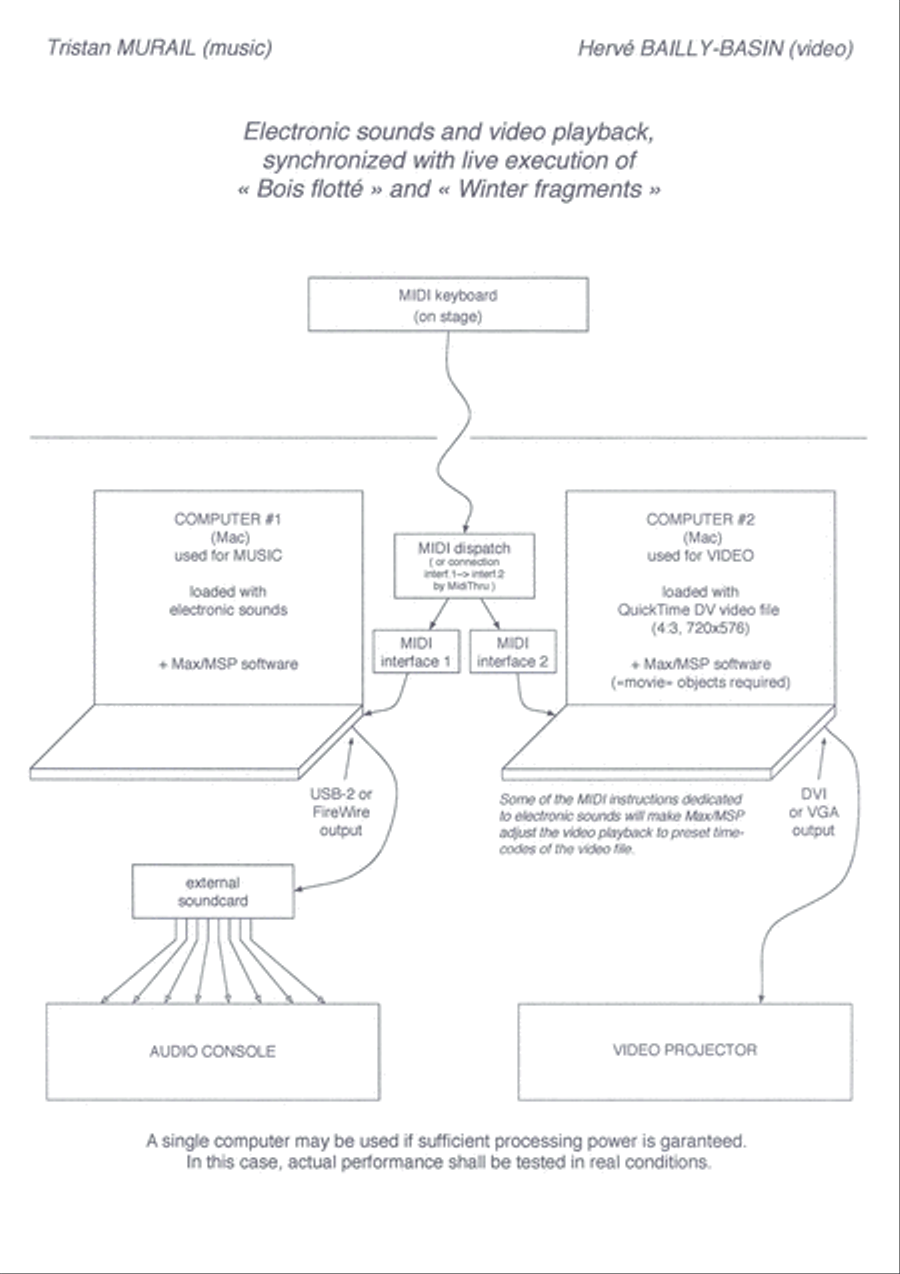
This work uses electronics sounds (obligatory) and images (optional) which are projected behind the musicians.
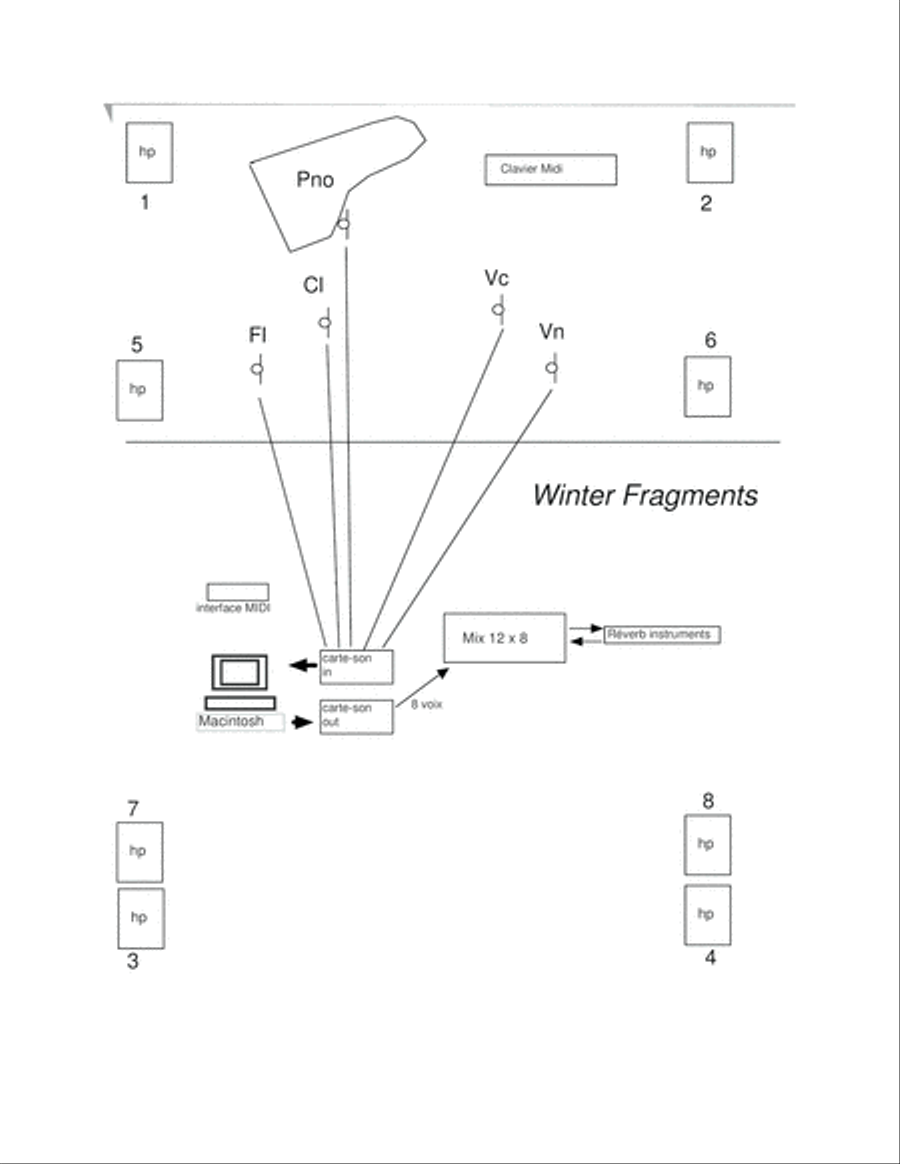
Electronic sounds are synchronised with live performing of the music by a Midi keyboard.
The keyboard is connected to a portable computer reading a Max6 (Max MSP/Jitter) software. Same process is to be used to project the video, with a second computer.
The downloading addresses for audio and video softwares and datas will be given to you once the hire contract has been signed.
See Similar Sheet Music and Digital Downloads