Order two or more copies of the same title and we'll automatically give you 5% off list price on that title.
To get 2+ Pricing , just add two or more copies of a title to your shopping cart. Your discount will be immediately applied to your order.
Sale titles, hymnals, and ShowKits (MTI's Broadway Junior Collection, Getting to Know... Collection (G2K) and MTI's Kids Collection) do not qualify for 2+ Pricing
If you have any questions or comments regarding 2+ Pricing , please visit our Help Center to find more information or chat with our support team
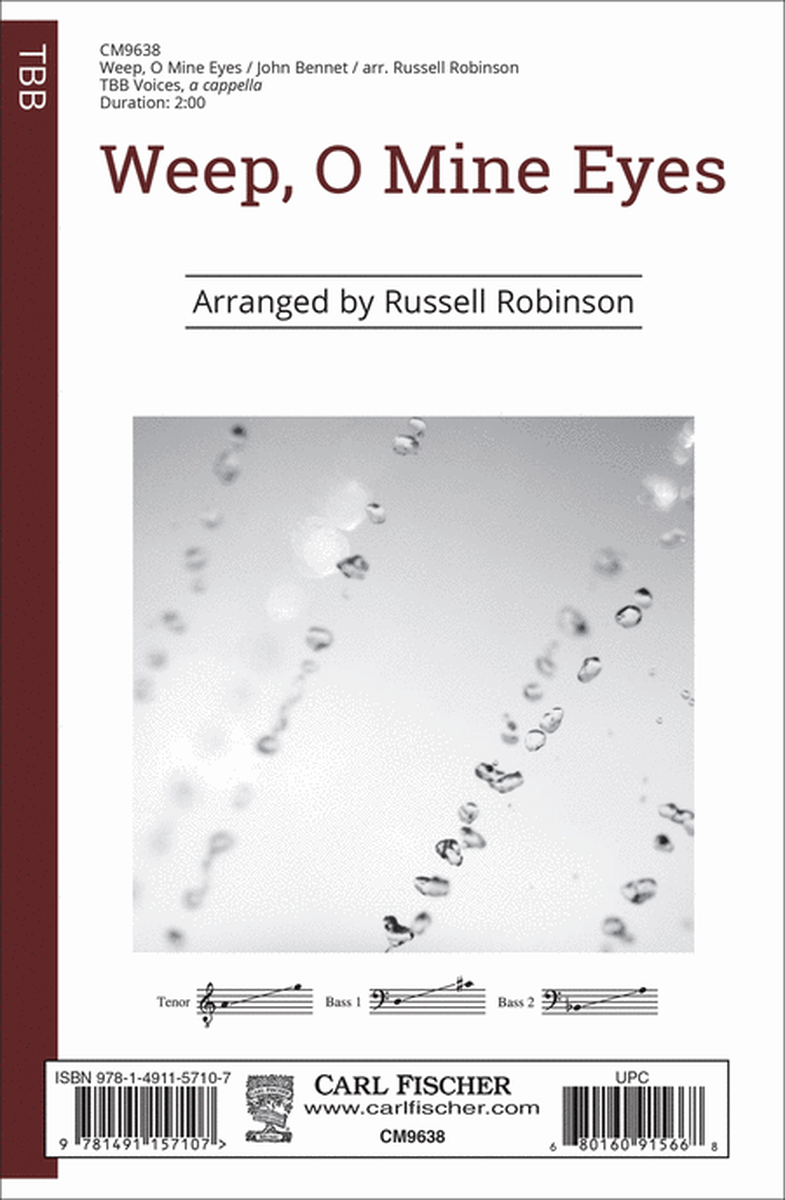
Composed by John Bennet. Arranged by Russell L. Robinson. Octavo. Performance Score. 4 pages. Duration 0:02:00. Carl Fischer Music #CM9638. Published by Carl Fischer Music (CF.CM9638).
ISBN 9781491157107. UPC: 680160915668. 6.875 x 10.5 inches. Key: A minor. English. Original.
Robinson's TBB arrangement of this beloved Bennett madrigal, originally published for four voices in 1599, has been changed from the original key of A minor to the key of D minor, making the ranges and texture more characteristic for TBB voices. A wonderful concert or festival staple piece!. Weep, O Mine Eyes is a classic madrigal from the Renaissance period (circa 1400-1650). Although John Bennet's exact birth and death dates are unknown, we know that he was English and composed madrigals (non-sacred a cappella pieces) in the late 16th - early 17th centuries. Although, Bennet was not as prolific as other madrigal writers of the time, such as Thomas Morley, Weep, O Mine Eyes has certainly stood the test of time. Originally published in a book of 17 madrigals for four voices in 1599, this arrangement for TBB voices has been changed from the original key of A minor to the key of D minor, making the ranges and texture more characteristic for TBB voices. The original flavor of Bennet's four-part setting has been preserved, including the counterpoint (independent voices) where each voice is of equal importance. In Renaissance style no parts should over sing; the beauty of the melodic lines and text should come through and over singing will take away from the beauty. The EE vowel is sometimes problematic in the word "weep." I suggest that you produce the EE vowel with OO on the lips and EE inside the mouth for better blend and to avoid a horizontal spreading of the vowel. Enjoy this wonderful madrigal!. Weep, O Mine Eyes is a classic madrigal from the Renaissance period (circa 1400-1650). Although John Bennet's exact birth and death dates are unknown, we know that he was English and composed madrigals (non-sacred a cappella pieces) in the late 16th - early 17th centuries. Although, Bennet was not as prolific as other madrigal writers of the time, such as Thomas Morley, Weep, O Mine Eyes has certainly stood the test of time.Originally published in a book of 17 madrigals for four voices in 1599, this arrangement for TBB voices has been changed from the original key of A minor to the key of D minor, making the ranges and texture more characteristic for TBB voices.The original flavor of Bennet's four-part setting has been preserved, including the counterpoint (independent voices) where each voice is of equal importance. In Renaissance style no parts should over sing; the beauty of the melodic lines and text should come through and over singing will take away from the beauty.The EE vowel is sometimes problematic in the word "weep." I suggest that you produce the EE vowel with OO on the lips and EE inside the mouth for better blend and to avoid a horizontal spreading of the vowel.Enjoy this wonderful madrigal!
Composed by John Bennet. Arranged by Russell L. Robinson. Octavo. Performance Score. 4 pages. Duration 0:02:00. Carl Fischer Music #CM9638. Published by Carl Fischer Music (CF.CM9638).
ISBN 9781491157107. UPC: 680160915668. 6.875 x 10.5 inches. Key: A minor. English. Original.
Robinson's TBB arrangement of this beloved Bennett madrigal, originally published for four voices in 1599, has been changed from the original key of A minor to the key of D minor, making the ranges and texture more characteristic for TBB voices. A wonderful concert or festival staple piece!. Weep, O Mine Eyes is a classic madrigal from the Renaissance period (circa 1400-1650). Although John Bennet's exact birth and death dates are unknown, we know that he was English and composed madrigals (non-sacred a cappella pieces) in the late 16th - early 17th centuries. Although, Bennet was not as prolific as other madrigal writers of the time, such as Thomas Morley, Weep, O Mine Eyes has certainly stood the test of time. Originally published in a book of 17 madrigals for four voices in 1599, this arrangement for TBB voices has been changed from the original key of A minor to the key of D minor, making the ranges and texture more characteristic for TBB voices. The original flavor of Bennet's four-part setting has been preserved, including the counterpoint (independent voices) where each voice is of equal importance. In Renaissance style no parts should over sing; the beauty of the melodic lines and text should come through and over singing will take away from the beauty. The EE vowel is sometimes problematic in the word "weep." I suggest that you produce the EE vowel with OO on the lips and EE inside the mouth for better blend and to avoid a horizontal spreading of the vowel. Enjoy this wonderful madrigal!. Weep, O Mine Eyes is a classic madrigal from the Renaissance period (circa 1400-1650). Although John Bennet's exact birth and death dates are unknown, we know that he was English and composed madrigals (non-sacred a cappella pieces) in the late 16th - early 17th centuries. Although, Bennet was not as prolific as other madrigal writers of the time, such as Thomas Morley, Weep, O Mine Eyes has certainly stood the test of time.Originally published in a book of 17 madrigals for four voices in 1599, this arrangement for TBB voices has been changed from the original key of A minor to the key of D minor, making the ranges and texture more characteristic for TBB voices.The original flavor of Bennet's four-part setting has been preserved, including the counterpoint (independent voices) where each voice is of equal importance. In Renaissance style no parts should over sing; the beauty of the melodic lines and text should come through and over singing will take away from the beauty.The EE vowel is sometimes problematic in the word "weep." I suggest that you produce the EE vowel with OO on the lips and EE inside the mouth for better blend and to avoid a horizontal spreading of the vowel.Enjoy this wonderful madrigal!
Tell a friend (or remind yourself) about this product. We'll instantly send an email containing product info and a link to it. You may also enter a personal message.
We do not use or store email addresses from this form for any other purpose than sending your share email.
After purchase, you can download your MP3 from your Sheet Music Plus Digital Library - no software installation is necessary! You can also listen to your MP3 at any time in your Digital Library.
Learn about Smart Music
After purchase, you can download your Smart Music from your Sheet Music Plus Digital Library - no software installation is necessary! You can also download at any time in your Digital Library.
Learn about Digital Video
After purchase you can download your video from your Digital Library. Your video is in XX format and is playable on most pre-installed video players.