6361299
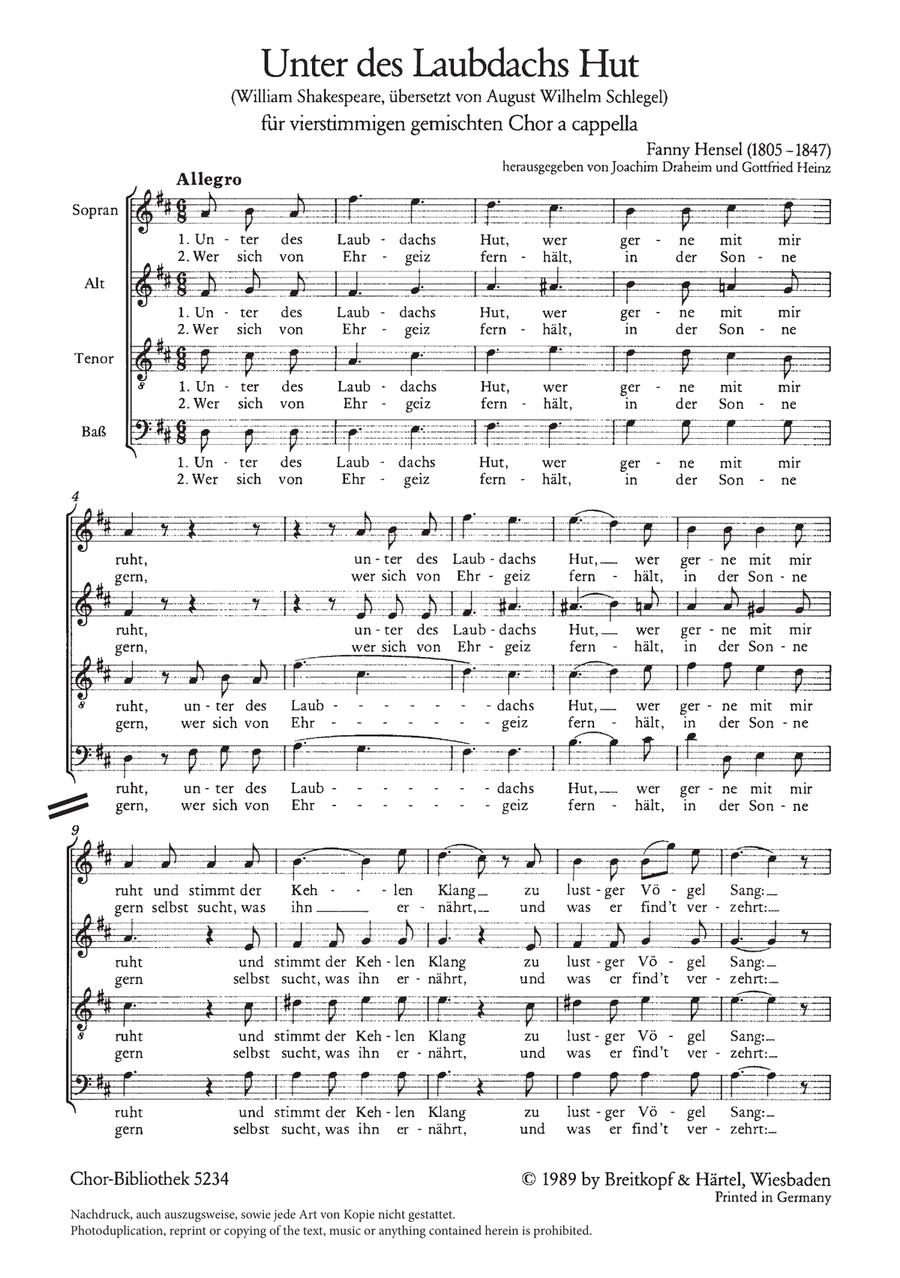
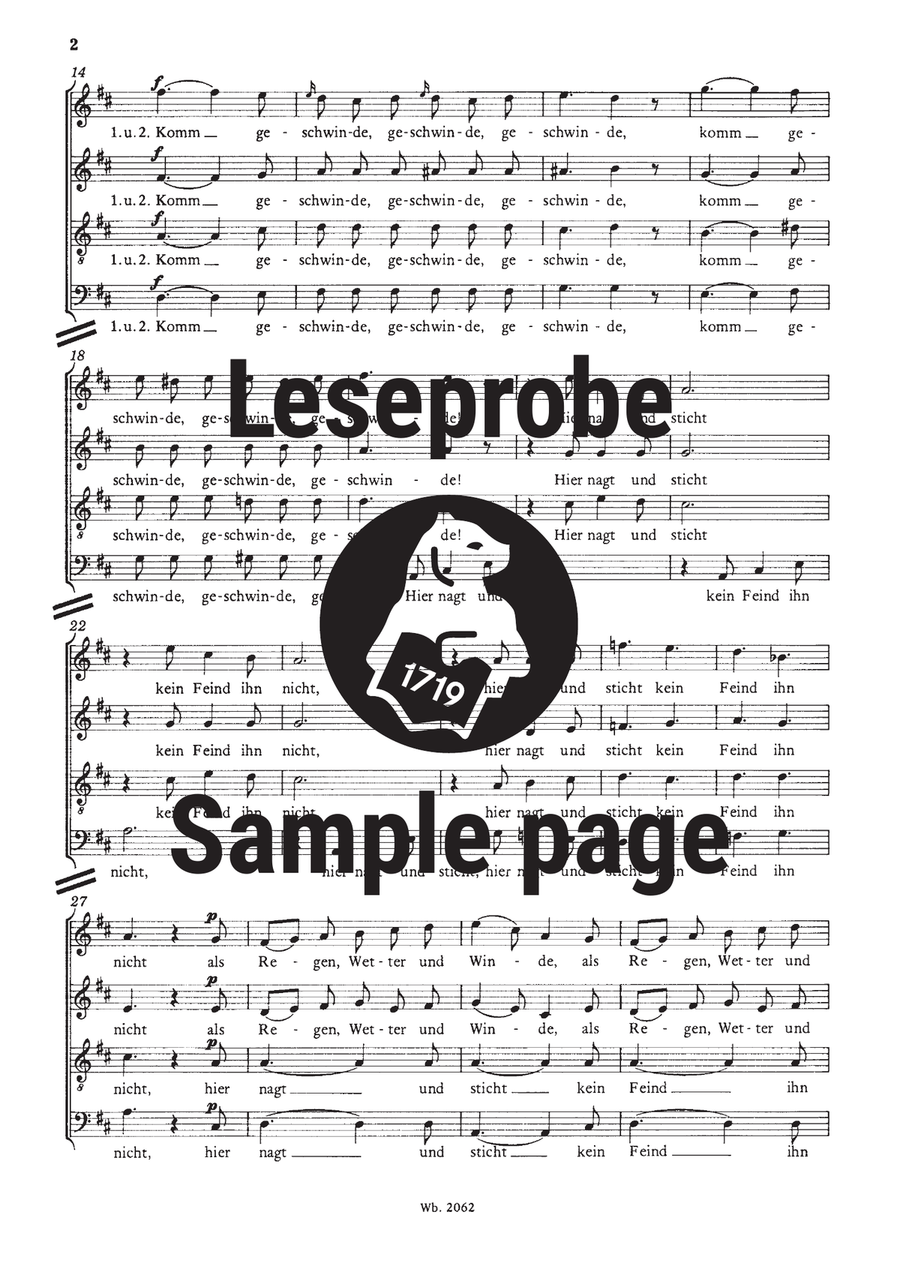
Unter des Laubdachs Hut
6361299
6361299
6361299
Copyright Material for Preview Only - Sheet Music Plus
Chorus a cappella
SKU: BR.CHB-5234
Choral score. Composed by Fanny Hensel. Edited by J. Draheim; Gottfried Heinz. Choir; stapled. Chor-Bibliothek (Choral Library). Song; Romantic. Choral score. 4 pages. Breitkopf and Haertel #ChB 5234. Published by Breitkopf and Haertel (BR.CHB-5234).
ISBN 9790004411537. 7.5 x 10.5 inches. German.
Madame Hensel, Mendelssohn's sister, whose eyes speak intelligence and profundity''. This diary entry made by Robert Schumann in June 1843 succinctly but fittingly characterizes Fanny Hensel, without a doubt the most significant woman composer of the 19th century. Born in Hamburg on 14 November 1805, she was the eldest sister of Felix Mendelssohn Bartholdy and the granddaughter of the philosopher Moses Mendelssohn. In 1829 she married the Prussian court painter and occasional poet Wilhelm Hensel (1794-1861). After her sudden death in Berlin on 14 May 1847 as a result of a stroke, the music journalist Ludwig Rellstab poignantly wrote that she shared the brotherhood ef talent with her famous sibling.Fanny Hensel was given the same excellent and comprehensive musical training as her precocious brother, including composition lessons with Goethe's friend Carl Friedrich Zelter. Felix and Fanny not only loved each other tenderly, but they also maintained an intensive, life-long exchange of ideas which proved musically profitable to both of them. However, it was only in 1846 that Mendelssohn gave up his resistance to Fanny's publication plans. And so, just shortly before her death, she was able to publish a carefully selected sample of her songs and piano pieces.Not only these pieces, but also a few orchestral and chamber-music works (e.g. the String Quartet in E flat major, KM 2255) and, in particular, choral music occupy an important position in her oeuvre. Most of her choral works were written in 1846, and she was able to rehearse them with the chorus she conducted at the famous Sunday Concerts in the Mendelssohn home. She had six of these choral songs published in a revised version under the title Gartenlieder Op. 3 by the Berlin music publisher Bote & Bock. The title of the Gartenlieder brings to mind Mendelssohn's well-known Lieder im Freien zu singen (Opera 41, 48, 59; CHB 4763-4780), published before 1846. But, as far as the quality of their melodic writing, the compositional technique, and the choice of texts are concerned, as well as the perfect balance between folk-like simplicity and polished design, they are as outstanding as the works of her brother.
"Fanny Hensel's choral works not only stand up to comparison with any of the rich and varied choral works of the Romantic era - they also rank among the best. Very likely to become hits!" (Musica).
Chorus a cappella
SKU: BR.CHB-5234
Choral score. Composed by Fanny Hensel. Edited by J. Draheim; Gottfried Heinz. Choir; stapled. Chor-Bibliothek (Choral Library). Song; Romantic. Choral score. 4 pages. Breitkopf and Haertel #ChB 5234. Published by Breitkopf and Haertel (BR.CHB-5234).
ISBN 9790004411537. 7.5 x 10.5 inches. German.
Madame Hensel, Mendelssohn's sister, whose eyes speak intelligence and profundity''. This diary entry made by Robert Schumann in June 1843 succinctly but fittingly characterizes Fanny Hensel, without a doubt the most significant woman composer of the 19th century. Born in Hamburg on 14 November 1805, she was the eldest sister of Felix Mendelssohn Bartholdy and the granddaughter of the philosopher Moses Mendelssohn. In 1829 she married the Prussian court painter and occasional poet Wilhelm Hensel (1794-1861). After her sudden death in Berlin on 14 May 1847 as a result of a stroke, the music journalist Ludwig Rellstab poignantly wrote that she shared the brotherhood ef talent with her famous sibling.Fanny Hensel was given the same excellent and comprehensive musical training as her precocious brother, including composition lessons with Goethe's friend Carl Friedrich Zelter. Felix and Fanny not only loved each other tenderly, but they also maintained an intensive, life-long exchange of ideas which proved musically profitable to both of them. However, it was only in 1846 that Mendelssohn gave up his resistance to Fanny's publication plans. And so, just shortly before her death, she was able to publish a carefully selected sample of her songs and piano pieces.Not only these pieces, but also a few orchestral and chamber-music works (e.g. the String Quartet in E flat major, KM 2255) and, in particular, choral music occupy an important position in her oeuvre. Most of her choral works were written in 1846, and she was able to rehearse them with the chorus she conducted at the famous Sunday Concerts in the Mendelssohn home. She had six of these choral songs published in a revised version under the title Gartenlieder Op. 3 by the Berlin music publisher Bote & Bock. The title of the Gartenlieder brings to mind Mendelssohn's well-known Lieder im Freien zu singen (Opera 41, 48, 59; CHB 4763-4780), published before 1846. But, as far as the quality of their melodic writing, the compositional technique, and the choice of texts are concerned, as well as the perfect balance between folk-like simplicity and polished design, they are as outstanding as the works of her brother.
"Fanny Hensel's choral works not only stand up to comparison with any of the rich and varied choral works of the Romantic era - they also rank among the best. Very likely to become hits!" (Musica).
Tell a friend (or remind yourself) about this product. We'll instantly send an email containing product info and a link to it. You may also enter a personal message.
We do not use or store email addresses from this form for any other purpose than sending your share email.
Read our Privacy Policy.
After purchase, you can download your MP3 from your Sheet Music Plus Digital Library - no software installation is necessary! You can also listen to your MP3 at any time in your Digital Library.
After purchase, you can download your Smart Music from your Sheet Music Plus Digital Library - no software installation is necessary! You can also download at any time in your Digital Library.
After purchase you can download your video from your Digital Library. Your video is in XX format and is playable on most pre-installed video players.