19390733
Um Mitternacht
19390733
19390733
19390733
Copyright Material for Preview Only - Sheet Music Plus
Choral SSAATTBBB choir
SKU: PR.UE034684
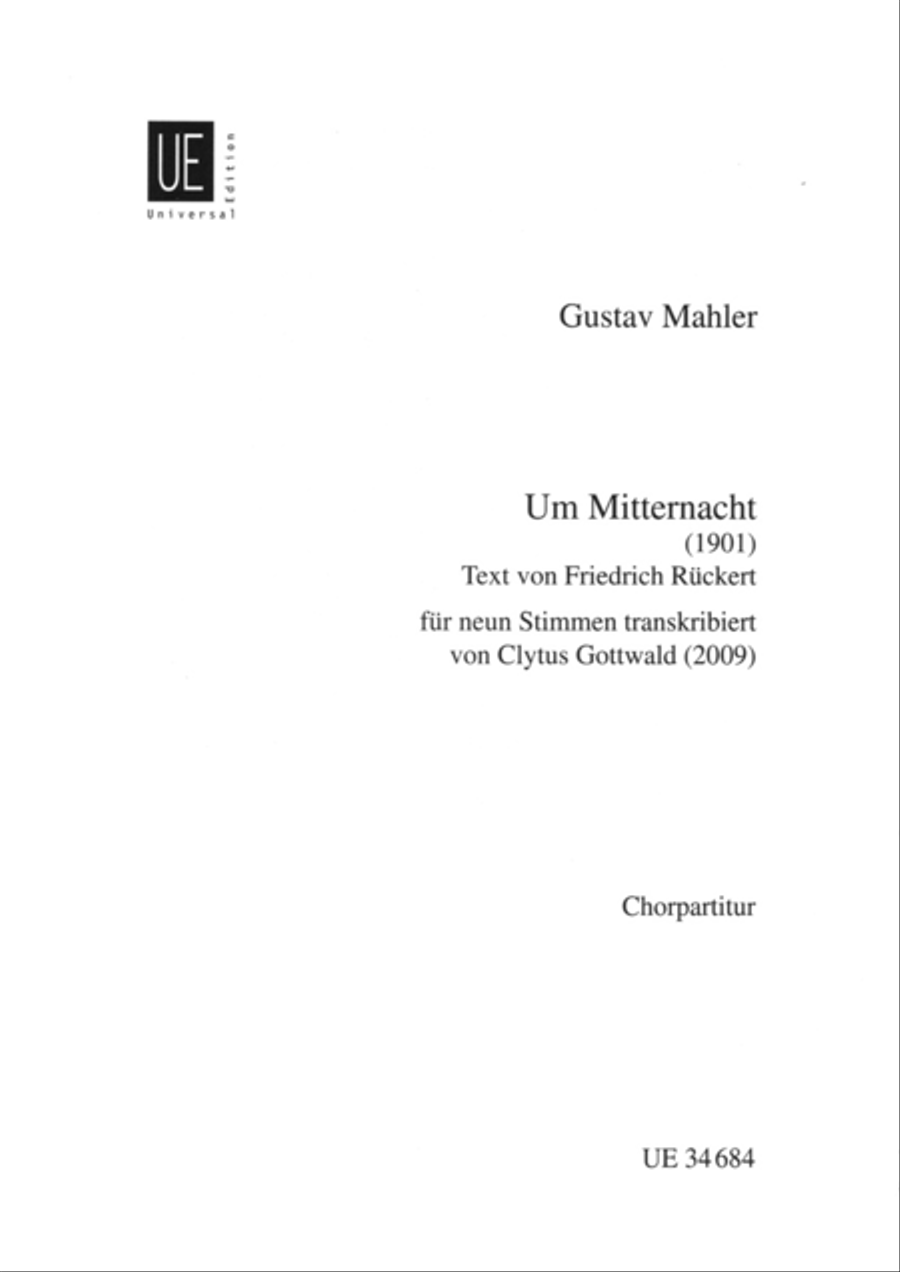
Text von Friedrich Ruckert. Composed by Gustav Mahler. Edited by Clytus Gottwald (transcriber). Part. With Standard notation. Universal Edition #UE034684. Published by Universal Edition (PR.UE034684).
ISBN 9783702467234. UPC: 803452064428. Text: Franz Ruckert / Transcribed by Clytus Gottwald. Franz Ruckert.
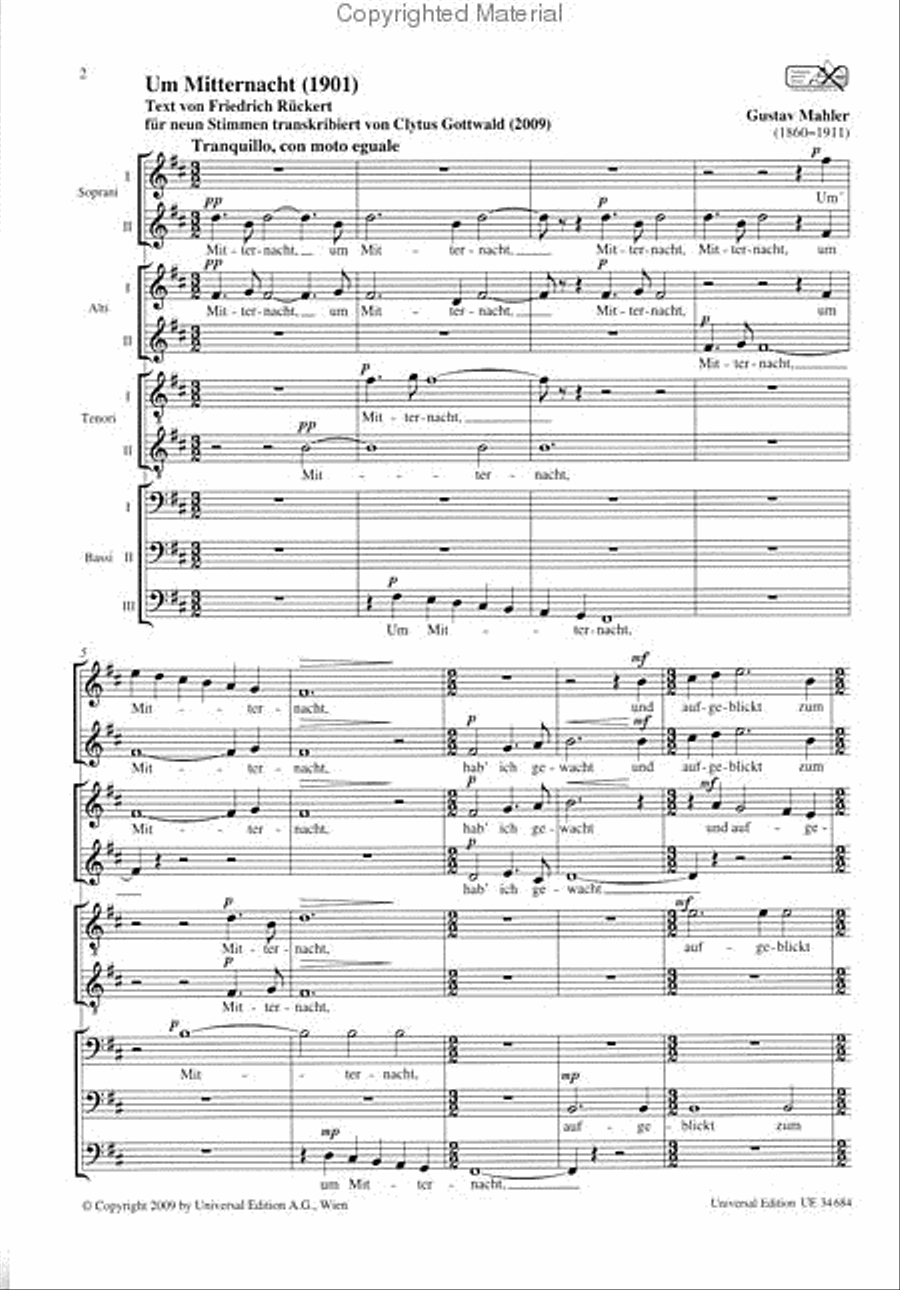
Translated as "at midnight," this song was written in the summer of 1901 in Maiernigg am Worthersee, Austria, where Mahler spent his vacations while working as director of the Vienna Court Opera. According to the foreword: "As with almost all of his songs, Um Mitternacht is also actively connected with the composition of his symphonies. This song may not have originated as part of a symphony as many others did, but Mahler added the orchestration a little later, more or less transcribing it with symphonic standards in mind... It is musically obvious that Mahler aimed for a certain amount of reduction in this song. Just a few themes are joined together to make a certain frame, without padding this out with sound. This..is what makes this piece so appealing. Transcription and interpretation are called upon to express this bleakness without suppressing the impulse to reduce it musically." For advanced ensembles.
Choral SSAATTBBB choir
SKU: PR.UE034684
Text von Friedrich Ruckert. Composed by Gustav Mahler. Edited by Clytus Gottwald (transcriber). Part. With Standard notation. Universal Edition #UE034684. Published by Universal Edition (PR.UE034684).
ISBN 9783702467234. UPC: 803452064428. Text: Franz Ruckert / Transcribed by Clytus Gottwald. Franz Ruckert.
Translated as "at midnight," this song was written in the summer of 1901 in Maiernigg am Worthersee, Austria, where Mahler spent his vacations while working as director of the Vienna Court Opera. According to the foreword: "As with almost all of his songs, Um Mitternacht is also actively connected with the composition of his symphonies. This song may not have originated as part of a symphony as many others did, but Mahler added the orchestration a little later, more or less transcribing it with symphonic standards in mind... It is musically obvious that Mahler aimed for a certain amount of reduction in this song. Just a few themes are joined together to make a certain frame, without padding this out with sound. This..is what makes this piece so appealing. Transcription and interpretation are called upon to express this bleakness without suppressing the impulse to reduce it musically." For advanced ensembles.
Tell a friend (or remind yourself) about this product. We'll instantly send an email containing product info and a link to it. You may also enter a personal message.
We do not use or store email addresses from this form for any other purpose than sending your share email.
Read our Privacy Policy.
After purchase, you can download your MP3 from your Sheet Music Plus Digital Library - no software installation is necessary! You can also listen to your MP3 at any time in your Digital Library.
After purchase, you can download your Smart Music from your Sheet Music Plus Digital Library - no software installation is necessary! You can also download at any time in your Digital Library.
After purchase you can download your video from your Digital Library. Your video is in XX format and is playable on most pre-installed video players.