

Digital Download
Digital Download
SKU: A0.1346342
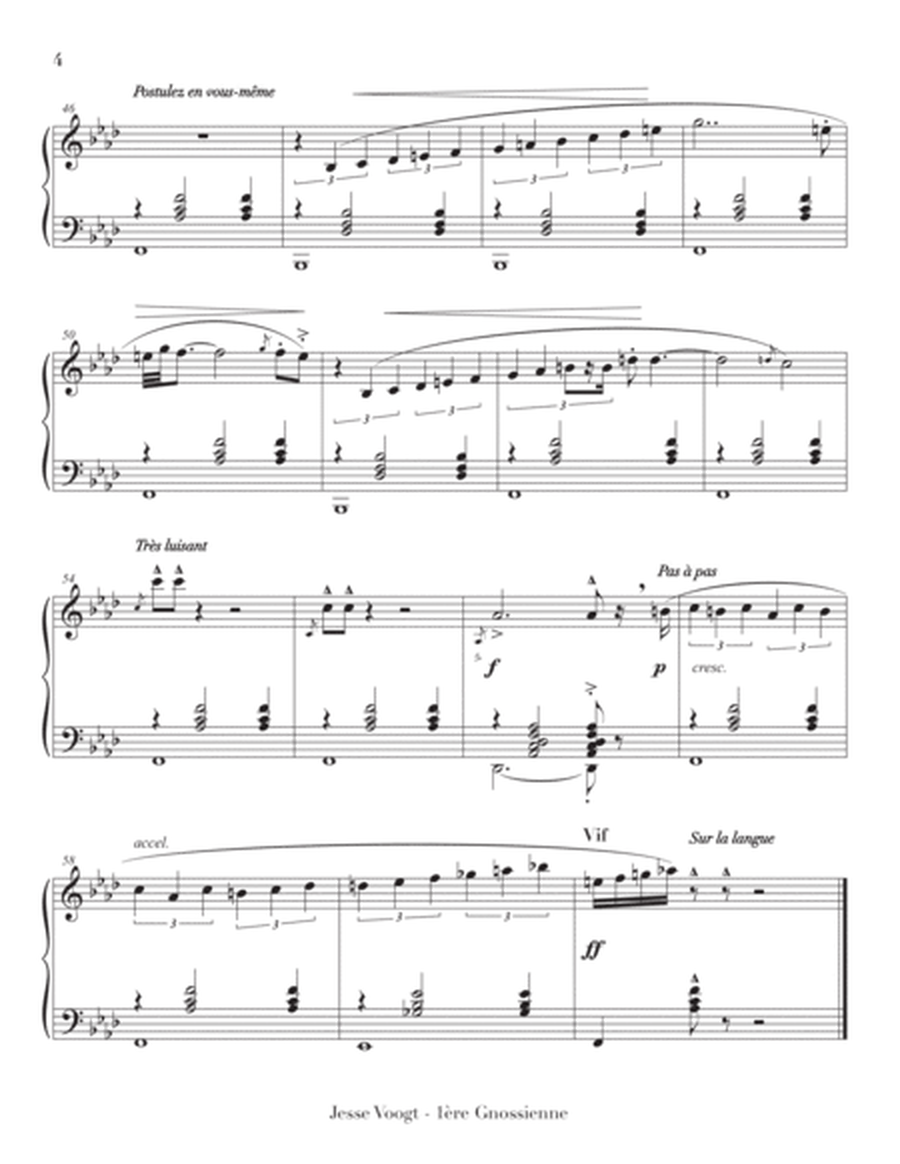
Composed by Jesse Voogt. Arranged by Jesse Voogt. This edition: pdf, streaming. 21st Century, Classical, Contemporary, Early Music. Score. 12 pages. Jesse Voogt #931164. Published by Jesse Voogt (A0.1346342).The following commentaries are presented in order to contextualize the three published Gnossiennes of Jesse Voogt (1979-2067), a composer who lived an almost hermit-like, ascetic existence before the glow of a computer screen. Although he achieved a brief and genuine success during his lifetime, his reputation quickly diminished as the meme-obsessed public of the 2020s shifted its attentions elsewhere. Scholars today continue to puzzle over his notational experiments and idiosyncratic instructions, which stand as rare survivals of a moment in cultural history that appears, from our vantage point, both strangely intimate and utterly foreign. Of particular interest is the recurring symbol ⧝,(see note 1) attested in the composer’s holograph manuscripts though omitted from the published editions, whose meaning and origin remain uncertain.
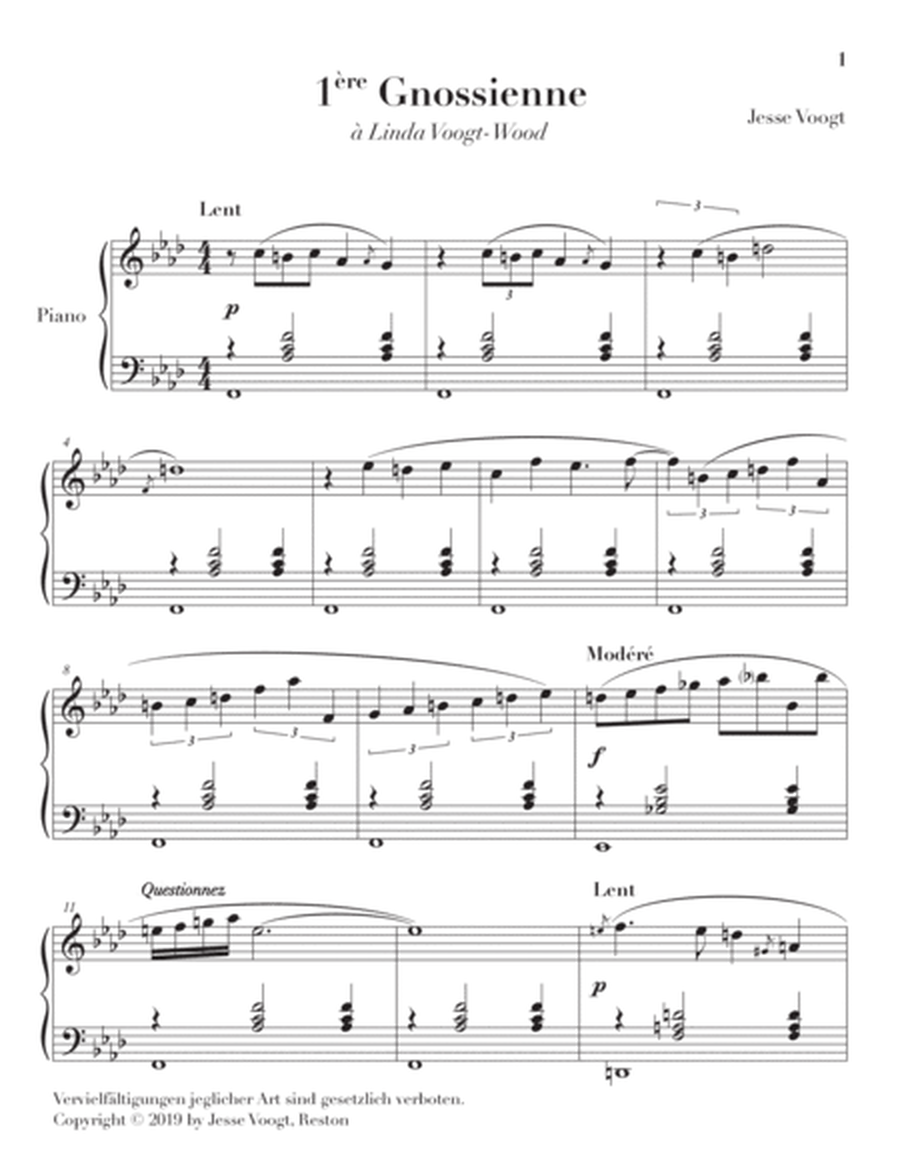
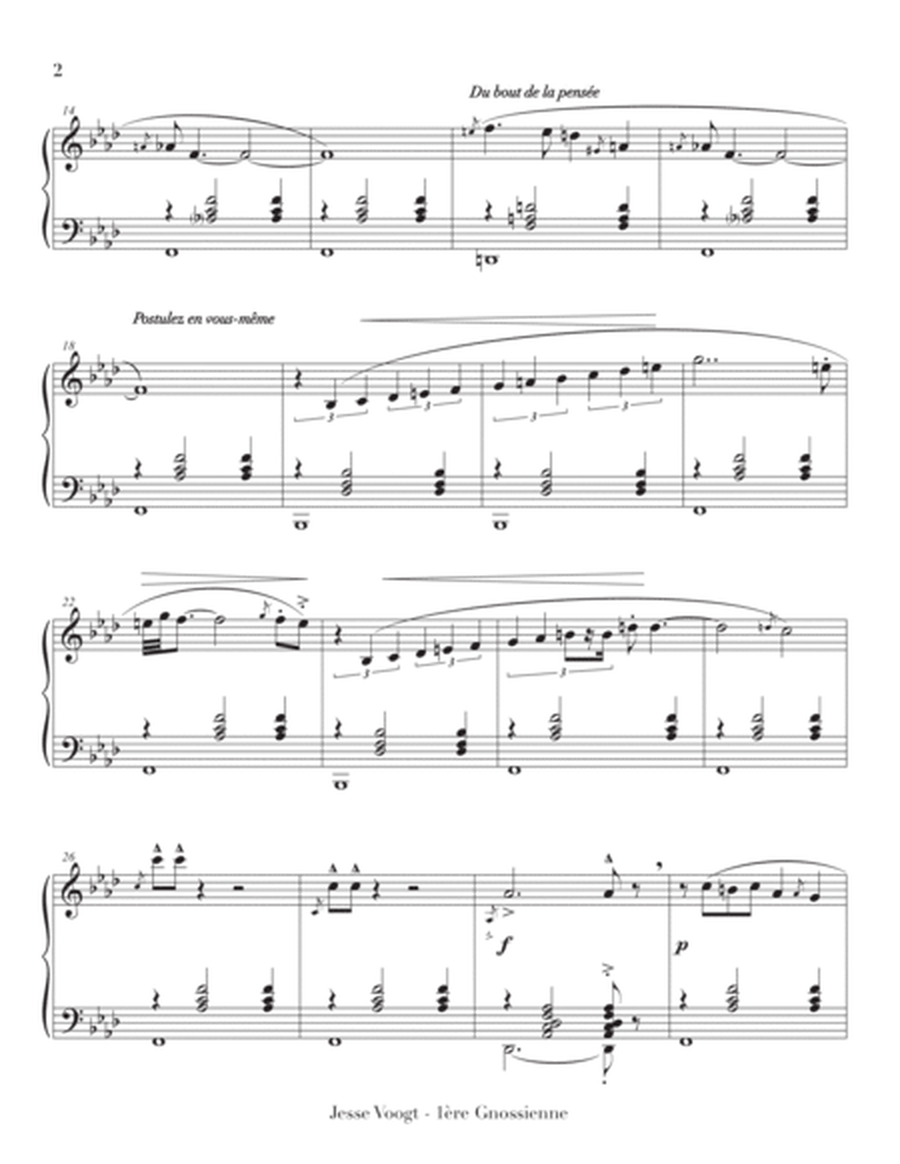
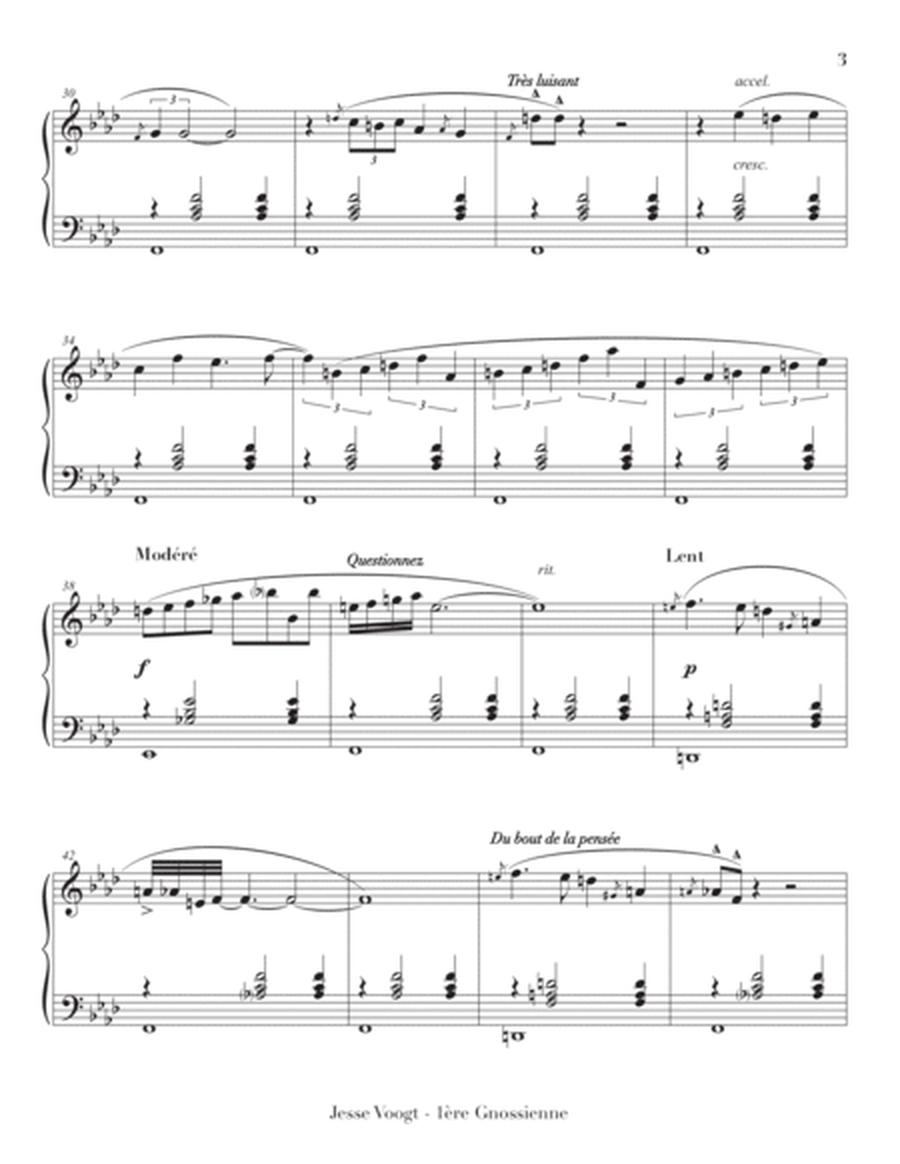
Later commentators have emphasized the “personal” and “domestic” character of the First Gnossienne, dedicated simply à maman.¹ Its rubrics — Du bout de la pensée, Très luisant, Questionnez, and the notorious Sur la langue — combine filial intimacy with an ironic detachment clearly indebted to Satie.² That such openly plagiarized phrases could appear in a score intended for distribution speaks both to the porous boundary between private life and artistic expression in the early twentyfirst century and to the absence of meaningful editorial scrutiny in the self-publishing practices of the time.
The Second Gnossienne, dedicated to Satie himself, introduces English rubrics: Crystalline, Blissfully ignorant, Without analyzing.³ These curious directives reflect the composer’s fascination with performance instructions that are at once precise and impossible. Some have linked them to his peculiar hobby of collecting now obsolete smartphones,⁴ devices he reportedly treated as minor artworks. In this context, the alternation of terms such as Crystalline and Slightly obscured by your ceaseless thoughts reads as both playful paradox and subtle homage to Satie’s own linguistic games.⁵
Unlike the first two, the Third Gnossienne has long been treated as an anomaly. The composer insisted it was not an original work but a reconstruction of an ancient score recovered in Crete.⁶ In his now-lost preface (summarized by Antonopoulos, Recherches Néominoennes, 2089, pp. 44–47), he described “a notation neither wholly pictographic nor alphabetic, but a labyrinth of signs waiting to be walked.”
The surviving score preserves rubrics such as Σκιὰ · Χοῦς, πάλιν τὸ αὐτό;, and ἰχθυπέταλος ἄνωθεν. Some regard them as performance directions, others as ritual formulae with no musical force (Palaeographica Minoa IV, 1932, fig. 12; contra Papadakis, De Labyrintho, 1971, p. 212). Particularly puzzling are the spatial markers — “fish-petaled, from above” and “flash from below” — which the composer claimed to have transcribed “with the greatest fidelity permitted by modern notation.”⁷
The conclusion — λαβύρινθος followed by ὡς κυνίδιον καθεύδον — has been called “the most intractable crux of the Knossian corpus.”⁸ To some, the image of a sleeping puppy proves the text a parody; yet the composer himself wrote: “This is not mine; I only lend it breath.”
Whether forgery, reconstruction, or private liturgy, the Third Gnossienne endures as a work suspended between scholarship and myth — a labyrinth without exit, or perhaps one whose center was never meant to be found.
This product was created by a member of ArrangeMe, Hal Leonard's global self-publishing community of independent composers, arrangers, and songwriters. ArrangeMe allows for the publication of unique arrangements of both popular titles and original compositions from a wide variety of voices and backgrounds.
About Digital Downloads
Digital Downloads are downloadable sheet music files that can be viewed directly on your computer, tablet or mobile device. Once you download your digital sheet music, you can view and print it at home, school, or anywhere you want to make music, and you don't have to be connected to the internet. Just purchase, download and play!
PLEASE NOTE: Your Digital Download will have a watermark at the bottom of each page that will include your name, purchase date and number of copies purchased. You are only authorized to print the number of copies that you have purchased. You may not digitally distribute or print more copies than purchased for use (i.e., you may not print or digitally distribute individual copies to friends or students).
See Similar Sheet Music and Digital Downloads