19793646
Three Inventions
19793646
19793646
19793646
Copyright Material for Preview Only - Sheet Music Plus
Chamber Music Piano
SKU: PR.110417910
For Piano. Composed by Eric Ewazen. This edition: saddle-wire stitch. Sws. Contemporary. Performance Score. With Standard notation. 11 pages. Duration 0:10:00. Theodore Presser Company #110-41791. Published by Theodore Presser Company (PR.110417910).
ISBN 9781491134580. UPC: 680160597956. 9 x 12 inches.
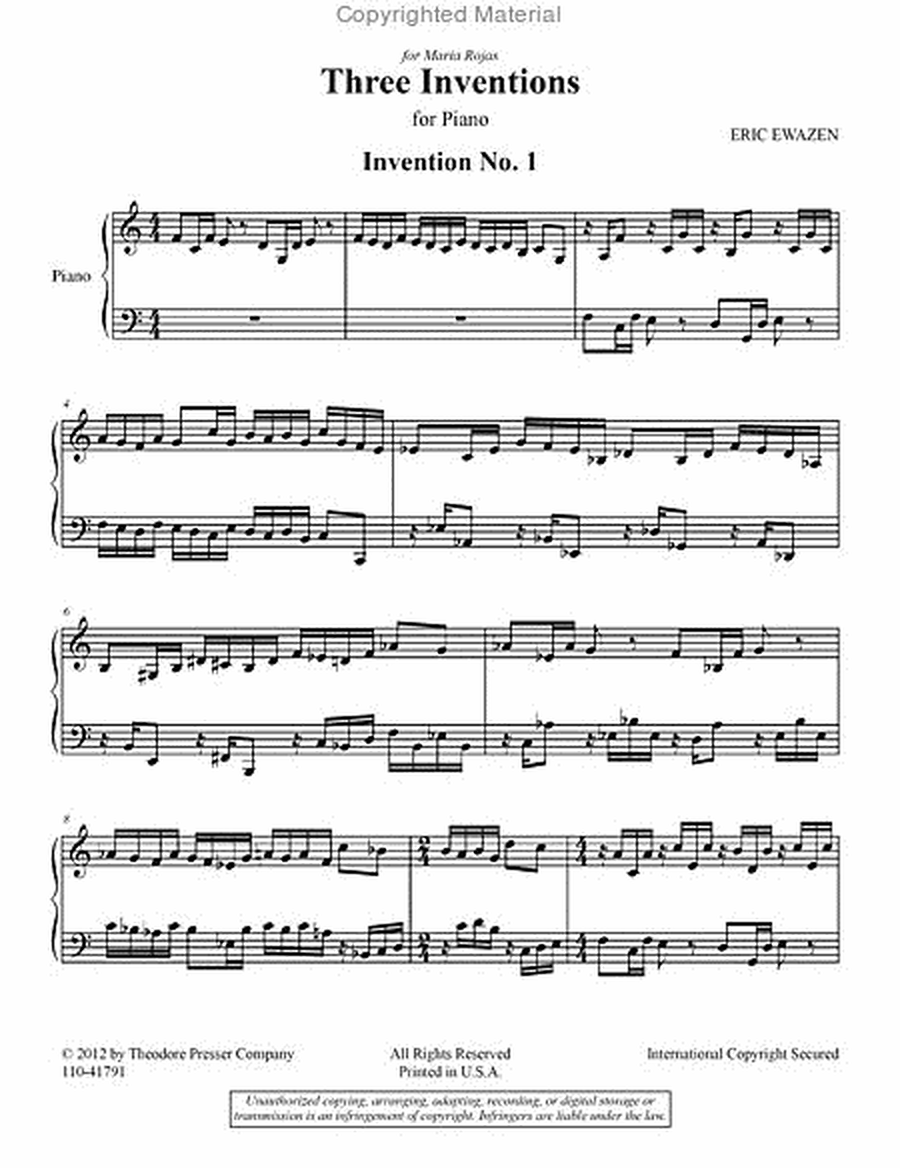
Eric Ewazen’s THREE INVENTIONS were inspired by Bach’s Two-part Inventions, yet they sound thoroughly like Ewazen. Originally composed for harpsichord and adapted for piano later, Ewazen’s inventions maintain a pure “one note per hand” texture until their final chord, with strong-but-free imitative counterpoint between the two voices. While Ewazen may be best known for his wind music, he is a pianist himself, and composers’ works for their own instrument are a direct insight into how they write for their own performances. The harpsichord version of THREE INVENTIONS is also available as a separate publication.
THREE INVENTIONS was written for my dear friend Maria Rojas, who premiered the work on a faculty recital at Juilliard. Maria is both a pianist and a harpsichordist, and I first met her when she gave a demonstration of the harpsichord for the students in my theory classes.I’ve always been captivated by Bach’s series of Two-Part and Three-Part Inventions. With the Two-Part Inventions, I’m amazed how Bach could create such wonderful intricacy and counterpoint with only two voices. I consequently modeled my inventions after the counterpoint of Bach, involving the traditional contrapuntal devices he used: imitation, development, harmonic and modal shifts, fragmentation, and sequence, essentially creating a dialog between two completely equal voices conversing with each other!Bach wrote 15 Two-Part Inventions (as well as 15 Three-Part Inventions, not to mention the 48 preludes and fugues in The Well-Tempered Clavier!), and that’s just the start of his voluminous repertoire for the keyboard! I was happy just to write three!!!Each of my inventions has a distinctive mood. The first is in a relaxed, yet cheerful C Major tonality (as a nod to Bach’s Invention No. 1 in C Major); the second is heartfelt and lyrical; and the third invention (involving a Gigue rhythm in the compound meter of 12/8) is energetic, and full of life and spontaneity. The third is primarily in a minor tonality, resulting in a feeling of drama, bringing the THREE INVENTIONS to an exciting finale.
Chamber Music Piano
SKU: PR.110417910
For Piano. Composed by Eric Ewazen. This edition: saddle-wire stitch. Sws. Contemporary. Performance Score. With Standard notation. 11 pages. Duration 0:10:00. Theodore Presser Company #110-41791. Published by Theodore Presser Company (PR.110417910).
ISBN 9781491134580. UPC: 680160597956. 9 x 12 inches.
Eric Ewazen’s THREE INVENTIONS were inspired by Bach’s Two-part Inventions, yet they sound thoroughly like Ewazen. Originally composed for harpsichord and adapted for piano later, Ewazen’s inventions maintain a pure “one note per hand” texture until their final chord, with strong-but-free imitative counterpoint between the two voices. While Ewazen may be best known for his wind music, he is a pianist himself, and composers’ works for their own instrument are a direct insight into how they write for their own performances. The harpsichord version of THREE INVENTIONS is also available as a separate publication.
THREE INVENTIONS was written for my dear friend Maria Rojas, who premiered the work on a faculty recital at Juilliard. Maria is both a pianist and a harpsichordist, and I first met her when she gave a demonstration of the harpsichord for the students in my theory classes.I’ve always been captivated by Bach’s series of Two-Part and Three-Part Inventions. With the Two-Part Inventions, I’m amazed how Bach could create such wonderful intricacy and counterpoint with only two voices. I consequently modeled my inventions after the counterpoint of Bach, involving the traditional contrapuntal devices he used: imitation, development, harmonic and modal shifts, fragmentation, and sequence, essentially creating a dialog between two completely equal voices conversing with each other!Bach wrote 15 Two-Part Inventions (as well as 15 Three-Part Inventions, not to mention the 48 preludes and fugues in The Well-Tempered Clavier!), and that’s just the start of his voluminous repertoire for the keyboard! I was happy just to write three!!!Each of my inventions has a distinctive mood. The first is in a relaxed, yet cheerful C Major tonality (as a nod to Bach’s Invention No. 1 in C Major); the second is heartfelt and lyrical; and the third invention (involving a Gigue rhythm in the compound meter of 12/8) is energetic, and full of life and spontaneity. The third is primarily in a minor tonality, resulting in a feeling of drama, bringing the THREE INVENTIONS to an exciting finale.
Tell a friend (or remind yourself) about this product. We'll instantly send an email containing product info and a link to it. You may also enter a personal message.
We do not use or store email addresses from this form for any other purpose than sending your share email.
Read our Privacy Policy.
After purchase, you can download your MP3 from your Sheet Music Plus Digital Library - no software installation is necessary! You can also listen to your MP3 at any time in your Digital Library.
After purchase, you can download your Smart Music from your Sheet Music Plus Digital Library - no software installation is necessary! You can also download at any time in your Digital Library.
After purchase you can download your video from your Digital Library. Your video is in XX format and is playable on most pre-installed video players.