Details
- Ensembles:
- Chamber Music
- Genres:
- Traditional
- Composers:
- Chen Yi
- Publishers:
- Theodore Presser Company
- Series:
- Women Composers and Arrangers Composers and Arrangers of Color Music of Asian Composers and Artists
- UPC:
- 680160625253
- Format:
- Score
- Item types:
- Physical
- Artist:
- Chen Yi
- Usages:
- School and Community
- Number of Pages:
- 36
- Size:
- 9 x 12 inches
- Shipping Weight:
- 1.77 pounds
SKU: PR.11441684S
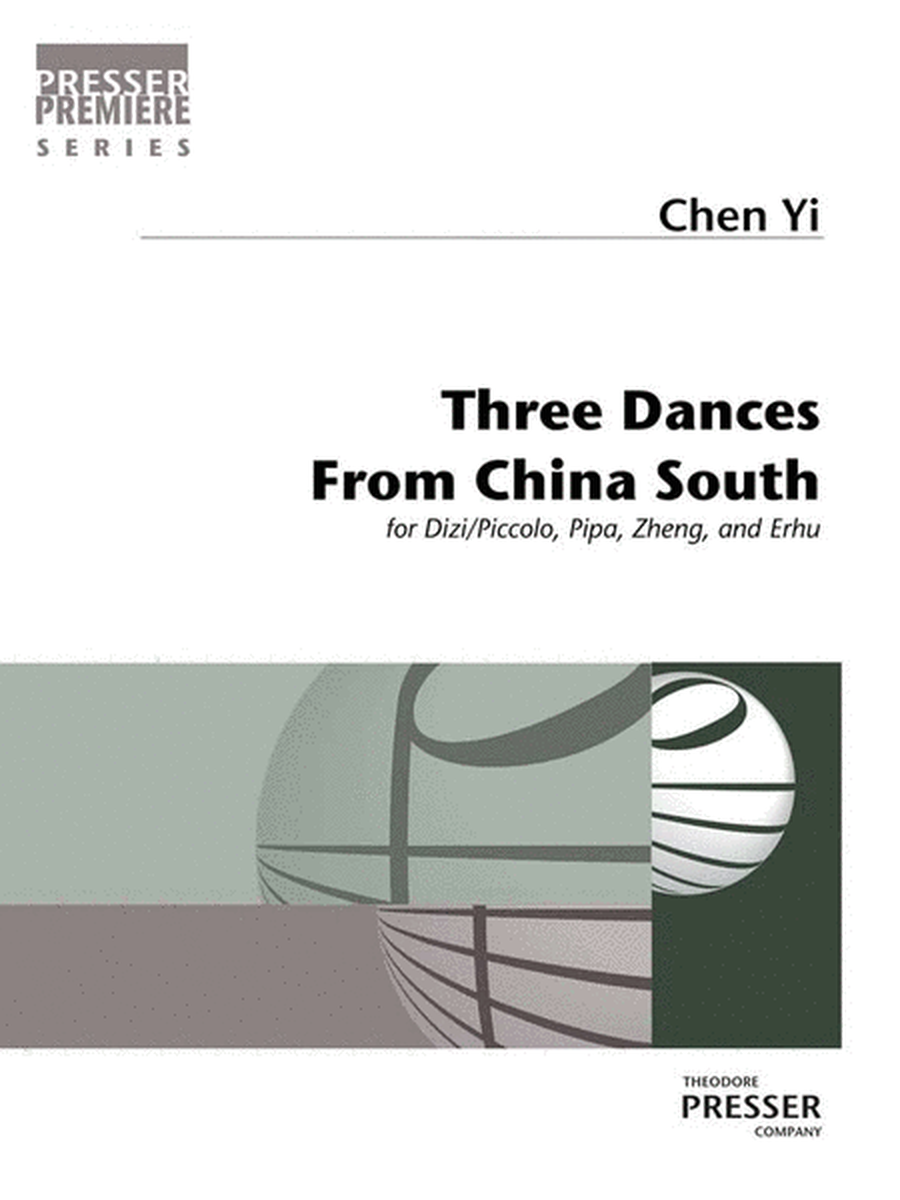
For Dizi, Erhu, Pipa, And Zheng. Composed by Chen Yi. This edition: saddle-wire stitch. Sws. Traditional. Full score. With Standard notation. Composed 2014. 36 pages. Theodore Presser Company #114-41684S. Published by Theodore Presser Company (PR.11441684S).UPC: 680160625253. 9 x 12 inches.
On the occasion of its 30th anniversary, the ensemble Music From China commissioned Chen Yi for a new work, which became Three Dances from China South, scored for Chinese instruments. Its three descriptive movements (Lions Playing Ball, Bamboo Dance, Lusheng Dance) are each inspired by folk dances from the southeastern provinces of China.
My chamber ensemble work Three Dances From China South is commissioned by Music From China tocelebrate its 30th anniversary, and scored for Chinese traditional instruments dizi, erhu, pipa, and zheng.xa0 The commission has been made possible by the Chamber Music America Classical CommissioningProgram, with generous funding provided by The Andrew W. Mellon Foundation, and the Chamber Music America Endowment Fund. xa0The world premiere is given at Weill Recital Hall in Carnegie Hall in New York City, on November 21, 2014. xa0My Three Dances From China South is dedicated to Susan Cheng, the founder and Executive Director of Music From China, to celebrate the 30th anniversary of MFC. There are three movements in my Three Dances From China South for dizi, erhu, pipa, and zheng. xa0Thematerial in the first movement Lions Playing Ball is drawn from a folk tune played in the accompanyingensemble for the folk dance under the same title in Chaozhou region in Guangdong province. xa0The image of the folk dance is vivid and entertaining. xa0The movement includes several variations on the theme. xa0The variation methods are inspired by the various rhythmic patterns used in the traditional ensemble playing.xa0 The melodic material features a special mode with a tritone interval taken from the folk tune. xa0There are also lyrical sections with polyphonic layers in the variations.The music in the second movement is inspired by the folk Bamboo Dance, which is popular in Li minoritypeople from Hainan Island in the south. xa0The aged old folk dance is for ritual ceremony and harvest celebration in the history, in which there are pairs of people holding the ends of the long bamboo rods and clapping them loudly in stable pulse, for groups of dancers to dance between the bamboo shapes on the floor, in musical rhythms and ensemble patterns. xa0A musical motive with a jumping interval and articulation is used throughout the movement.The third movement is called Lusheng Dance. xa0I have witnessed the folk dance performance of the Dong minority people in Guangxi province in the 1980’s. xa0The exciting scene inspired me to imitate the large lusheng ensemble playing style in my ensemble of four Chinese instrumental musicians without using the sheng (a wind instrument with metal pipes that is popular in concert music, and similar to the folk lusheng). xa0On top of the rhythmic patterns, I imitated a two--voice folk song of Zhuang minority people in the same province. xa0The melody is played by the leading erhu and dizi.—Chen Yi.
- More by this Composer:
- Chen Yi Chen Yi Cello Chen Yi B-Flat Clarinet Chen Yi Flute
- Series:
- Women Composers and Arrangers Composers and Arrangers of Color Music of Asian Composers and Artists
- Artists:
- Chen Yi
- Ensemble:
- Chamber Music
- Publisher:
- Theodore Presser Company