Order two or more copies of the same title and we'll automatically give you 5% off list price on that title.
To get 2+ Pricing , just add two or more copies of a title to your shopping cart. Your discount will be immediately applied to your order.
Sale titles, hymnals, and ShowKits (MTI's Broadway Junior Collection, Getting to Know... Collection (G2K) and MTI's Kids Collection) do not qualify for 2+ Pricing
If you have any questions or comments regarding 2+ Pricing , please visit our Help Center to find more information or chat with our support team
Choral Choir, Choral, SAB Chorus - Level 2 - Digital Download
SKU: A0.1567501
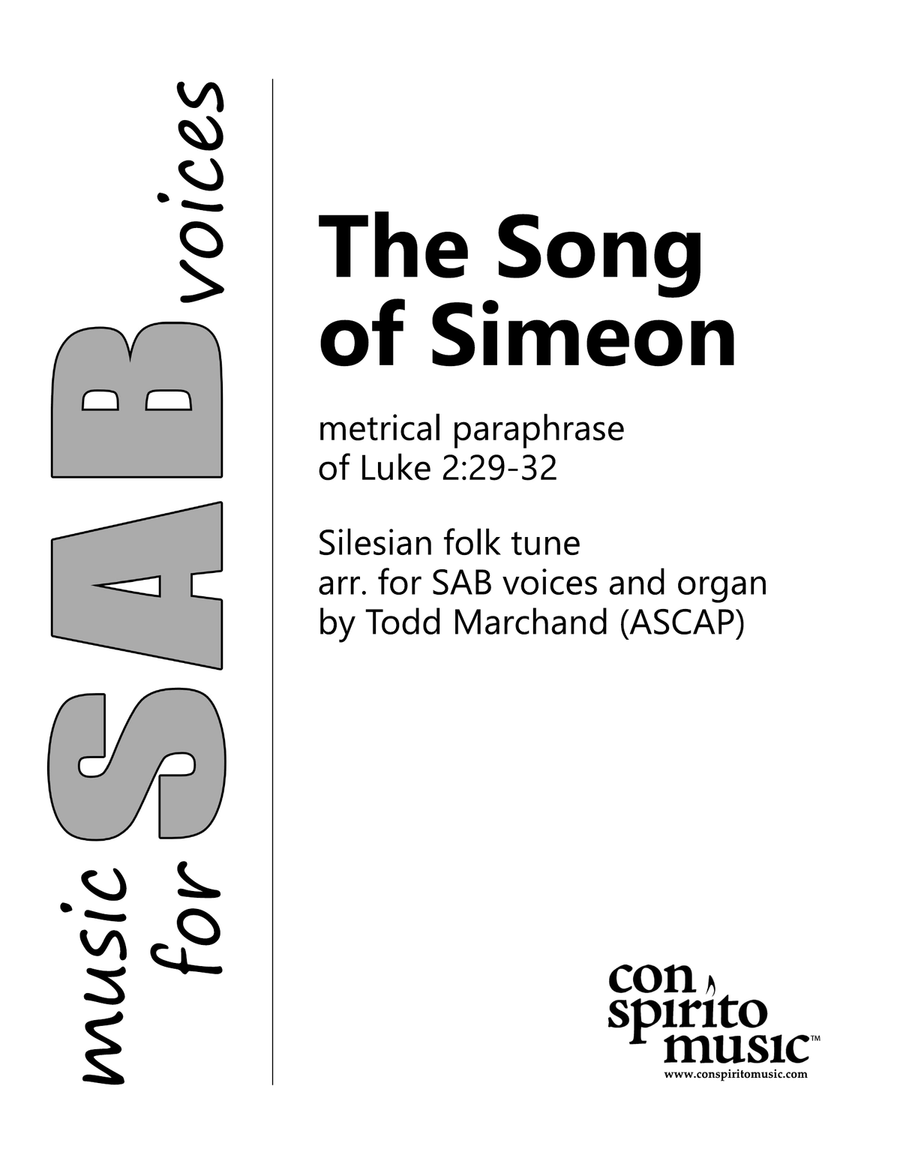
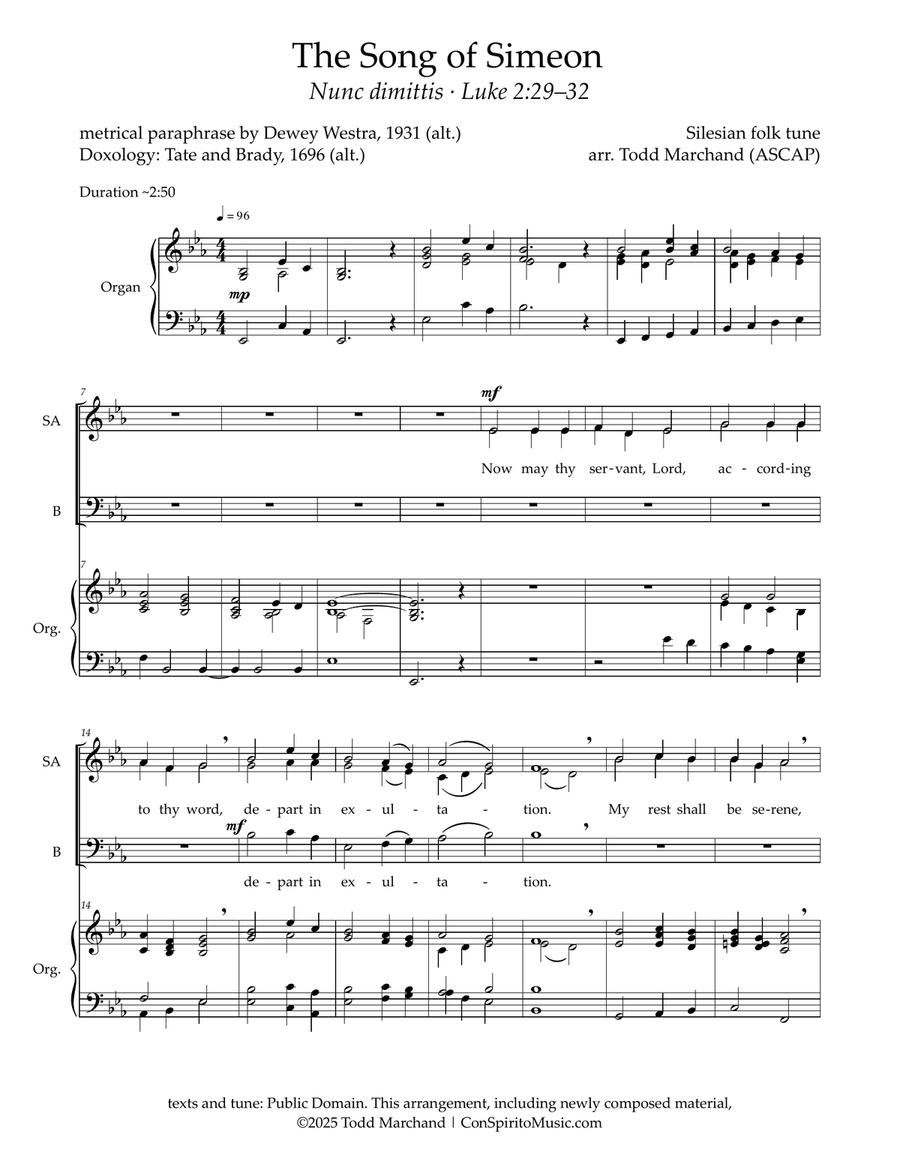
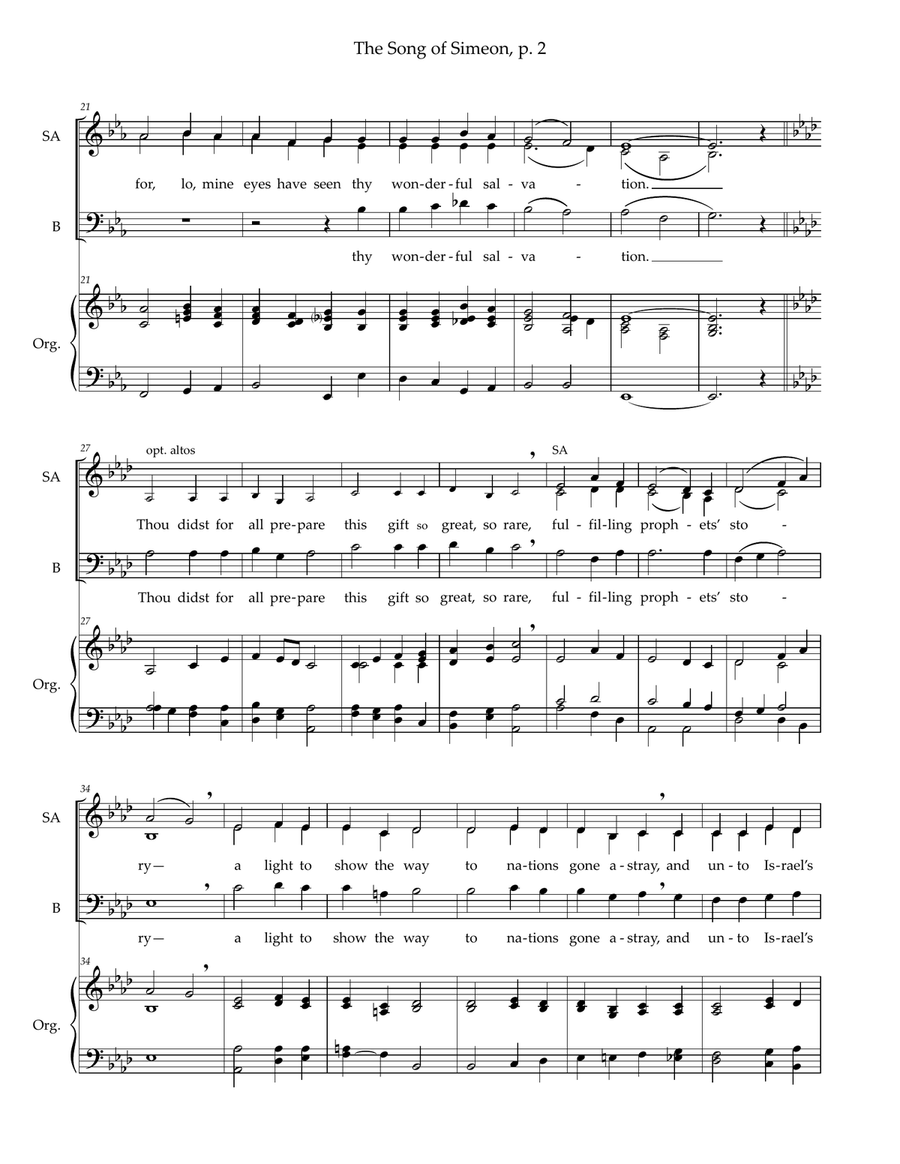
Composed by Silesian Folk Tune. Arranged by Todd Marchand. This edition: pdf, streaming. Christian, Sacred. 5 pages. Con Spirito Music #1139607. Published by Con Spirito Music (A0.1567501).
The Song of Simeon — or "Nunc dimittis," from its Latin incipit — is a canticle with text from the Gospel of Luke (2:29-32). It is the last of the three great canticles of the New Testament, the other two being the Magnificat (Song of Mary) and the Benedictus (Song of Zechariah). Since the fourth century, it has been used in Christian services of worship such as Evensong (early evening prayer) and Compline (late evening prayer) in the Western church, and Vespers in the Eastern church.
The Song of Simeon is the response of a devout Jew who had been promised by the Holy Spirit that he would not die before seeing the promised Messiah. Luke's Gospel recounts that Joseph and Mary brought the infant Jesus to the temple in Jerusalem for the Redemption of the First-Born Son, an ancient ceremony in which the father "redeems" his son with a monetary gift to the temple priest, or other sacrifice, in remembrance that God protected the first-born sons of Israel from the Plague of the First-Born in Egypt (Exodus 11-12). When Simeon sees the child, he takes Him in his arms, blesses God, and exclaims:
"Lord, now lettest thou thy servant depart in peace, according to thy word: For mine eyes have seen thy salvation, which thou hast prepared before the face of all people; a light to lighten the Gentiles, and the glory of thy people Israel."
In addition to its role in evening services, the Song of Simeon is central to the Gospel reading on the commemoration of the Presentation of Our Lord Jesus Christ in the Temple, typically 40 days after Christmas.
The text for this setting is a metrical paraphrase of the canticle written by school teacher/administrator and lay poet Dewey Westra (1931), which is followed by a paraphrase of the Doxology by poets Nahum Tate and Nicholas Brady (1696). The tune is the familiar Silesian folk melody best-known as the tune to "Fairest Lord Jesus" and "Beautiful Savior."
Voices realized by Cantamus (https://cantamus.app/); organ realized by NotePerformer (https://www.noteperformer.com)
This product was created by a member of ArrangeMe, Hal Leonard's global
self-publishing community of independent composers, arrangers, and songwriters.
ArrangeMe allows for the publication of unique arrangements of both popular
titles and original compositions from a wide variety of voices and backgrounds.
About Digital Downloads
Digital Downloads are downloadable sheet music files that can be viewed directly on
your computer, tablet or mobile device. Once you download your digital sheet music,
you can view and print it at home, school, or anywhere you want to make music, and
you don't have to be connected to the internet. Just purchase, download and play!
PLEASE NOTE: Your Digital Download will have a watermark at the bottom of each page
that will include your name, purchase date and number of copies purchased. You are
only authorized to print the number of copies that you have purchased. You may not
digitally distribute or print more copies than purchased for use (i.e., you may not
print or digitally distribute individual copies to friends or students).
Choral Choir, Choral, SAB Chorus - Level 2 - Digital Download
SKU: A0.1567501
Composed by Silesian Folk Tune. Arranged by Todd Marchand. This edition: pdf, streaming. Christian, Sacred. 5 pages. Con Spirito Music #1139607. Published by Con Spirito Music (A0.1567501).
The Song of Simeon — or "Nunc dimittis," from its Latin incipit — is a canticle with text from the Gospel of Luke (2:29-32). It is the last of the three great canticles of the New Testament, the other two being the Magnificat (Song of Mary) and the Benedictus (Song of Zechariah). Since the fourth century, it has been used in Christian services of worship such as Evensong (early evening prayer) and Compline (late evening prayer) in the Western church, and Vespers in the Eastern church.
The Song of Simeon is the response of a devout Jew who had been promised by the Holy Spirit that he would not die before seeing the promised Messiah. Luke's Gospel recounts that Joseph and Mary brought the infant Jesus to the temple in Jerusalem for the Redemption of the First-Born Son, an ancient ceremony in which the father "redeems" his son with a monetary gift to the temple priest, or other sacrifice, in remembrance that God protected the first-born sons of Israel from the Plague of the First-Born in Egypt (Exodus 11-12). When Simeon sees the child, he takes Him in his arms, blesses God, and exclaims:
"Lord, now lettest thou thy servant depart in peace, according to thy word: For mine eyes have seen thy salvation, which thou hast prepared before the face of all people; a light to lighten the Gentiles, and the glory of thy people Israel."
In addition to its role in evening services, the Song of Simeon is central to the Gospel reading on the commemoration of the Presentation of Our Lord Jesus Christ in the Temple, typically 40 days after Christmas.
The text for this setting is a metrical paraphrase of the canticle written by school teacher/administrator and lay poet Dewey Westra (1931), which is followed by a paraphrase of the Doxology by poets Nahum Tate and Nicholas Brady (1696). The tune is the familiar Silesian folk melody best-known as the tune to "Fairest Lord Jesus" and "Beautiful Savior."
Voices realized by Cantamus (https://cantamus.app/); organ realized by NotePerformer (https://www.noteperformer.com)
This product was created by a member of ArrangeMe, Hal Leonard's global
self-publishing community of independent composers, arrangers, and songwriters.
ArrangeMe allows for the publication of unique arrangements of both popular
titles and original compositions from a wide variety of voices and backgrounds.
About Digital Downloads
Digital Downloads are downloadable sheet music files that can be viewed directly on
your computer, tablet or mobile device. Once you download your digital sheet music,
you can view and print it at home, school, or anywhere you want to make music, and
you don't have to be connected to the internet. Just purchase, download and play!
PLEASE NOTE: Your Digital Download will have a watermark at the bottom of each page
that will include your name, purchase date and number of copies purchased. You are
only authorized to print the number of copies that you have purchased. You may not
digitally distribute or print more copies than purchased for use (i.e., you may not
print or digitally distribute individual copies to friends or students).
Tell a friend (or remind yourself) about this product. We'll instantly send an email containing product info and a link to it. You may also enter a personal message.
We do not use or store email addresses from this form for any other purpose than sending your share email.
After purchase, you can download your MP3 from your Sheet Music Plus Digital Library - no software installation is necessary! You can also listen to your MP3 at any time in your Digital Library.
Learn about Smart Music
After purchase, you can download your Smart Music from your Sheet Music Plus Digital Library - no software installation is necessary! You can also download at any time in your Digital Library.
Learn about Digital Video
After purchase you can download your video from your Digital Library. Your video is in XX format and is playable on most pre-installed video players.