5527872
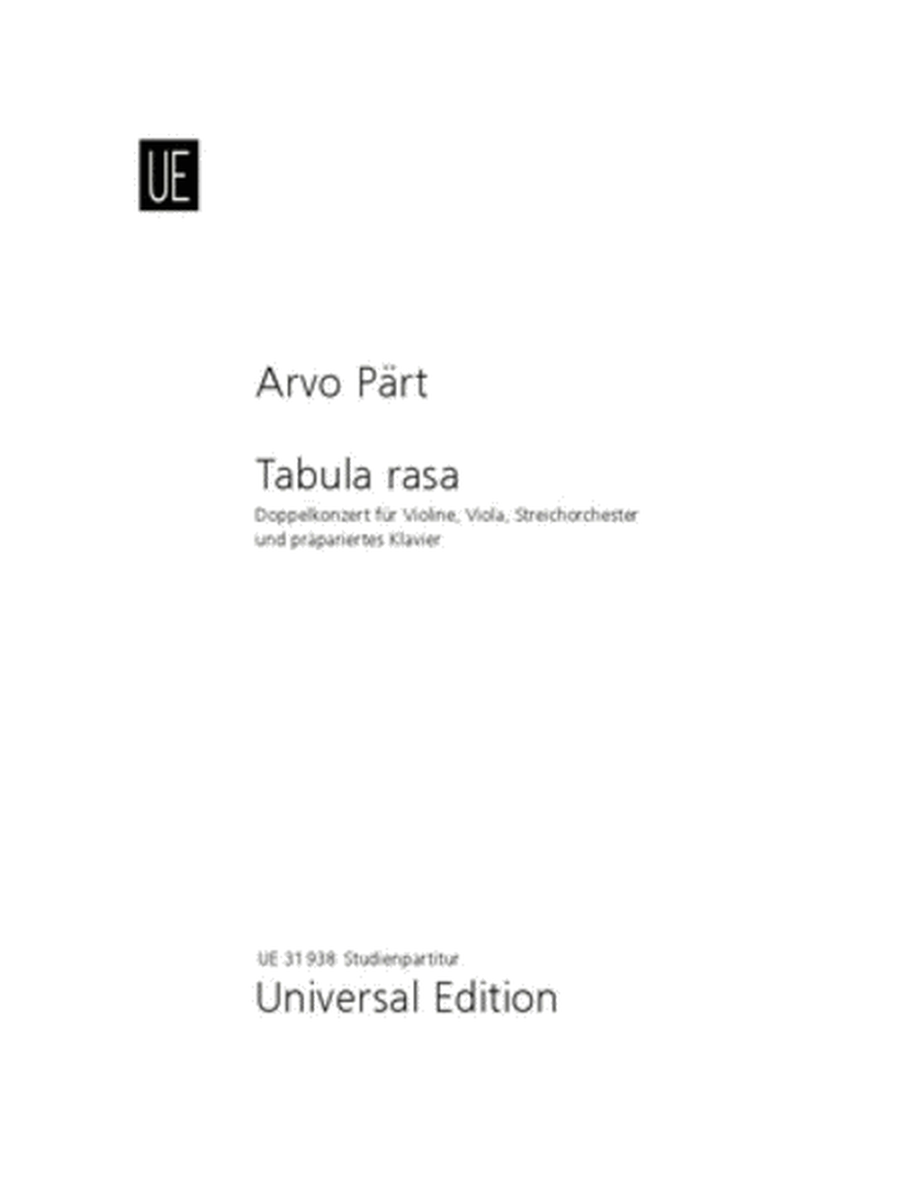
Tabula Rasa
5527872
5527872
5527872
Copyright Material for Preview Only - Sheet Music Plus
Orchestra violin, viola, string orchestra and prepared piano
SKU: PR.UE031938
Composed by Arvo Part. Study score. With Standard notation. Universal Edition #UE031938. Published by Universal Edition (PR.UE031938).
ISBN 9783702408039. UPC: 803452005698.
Tabula rasa is Part's most extensive instrumental work. Inspired by the concerto grosso from the Baroque period - a small group of instruments, against the rest of the orchestra - the first movement, Con moto (with movement), features Vivaldi-like textures resulting from its use of static rhythms and homophonic structure. The prepared piano - in which different objects are put into the instrument, thus creating different starling sounds (in this piece screws between the strings) - makes a clear reference to bells. The first movement develops through a juxtaposition of two different episodes: one rhythmically active and one calm section in which only one violin and piano take part. The motion in the active section increases gradually in register and rhythmic activity and culminates in an extensively arpeggiated, almost violent, section. In the second movement, Senza moto (without movement), the prepared piano serves an even more important function - providing the only rhythmic and coloristic contrasts to the extended canon sections in which the celli expand a diatonic scale upwards and downwards, similar to the technique used in Cantus, followed in canon by the first violins. (Per F. Broman, 1997, taken from the booklet of BIS CD 834).
Orchestra violin, viola, string orchestra and prepared piano
SKU: PR.UE031938
Composed by Arvo Part. Study score. With Standard notation. Universal Edition #UE031938. Published by Universal Edition (PR.UE031938).
ISBN 9783702408039. UPC: 803452005698.
Tabula rasa is Part's most extensive instrumental work. Inspired by the concerto grosso from the Baroque period - a small group of instruments, against the rest of the orchestra - the first movement, Con moto (with movement), features Vivaldi-like textures resulting from its use of static rhythms and homophonic structure. The prepared piano - in which different objects are put into the instrument, thus creating different starling sounds (in this piece screws between the strings) - makes a clear reference to bells. The first movement develops through a juxtaposition of two different episodes: one rhythmically active and one calm section in which only one violin and piano take part. The motion in the active section increases gradually in register and rhythmic activity and culminates in an extensively arpeggiated, almost violent, section. In the second movement, Senza moto (without movement), the prepared piano serves an even more important function - providing the only rhythmic and coloristic contrasts to the extended canon sections in which the celli expand a diatonic scale upwards and downwards, similar to the technique used in Cantus, followed in canon by the first violins. (Per F. Broman, 1997, taken from the booklet of BIS CD 834).
Tell a friend (or remind yourself) about this product. We'll instantly send an email containing product info and a link to it. You may also enter a personal message.
We do not use or store email addresses from this form for any other purpose than sending your share email.
Read our Privacy Policy.
After purchase, you can download your MP3 from your Sheet Music Plus Digital Library - no software installation is necessary! You can also listen to your MP3 at any time in your Digital Library.
After purchase, you can download your Smart Music from your Sheet Music Plus Digital Library - no software installation is necessary! You can also download at any time in your Digital Library.
After purchase you can download your video from your Digital Library. Your video is in XX format and is playable on most pre-installed video players.