19557012
Stabat Mater
19557012
19557012
19557012
Copyright Material for Preview Only - Sheet Music Plus
Choral 3-part choir mixed Voices, Piano
SKU: PR.UE034172
Composed by Arvo Part. This edition: Latin. Score. With Standard notation. Duration 0:25:00. Universal Edition #UE034172. Published by Universal Edition (PR.UE034172).
ISBN 9783702469115. UPC: 803452066262.
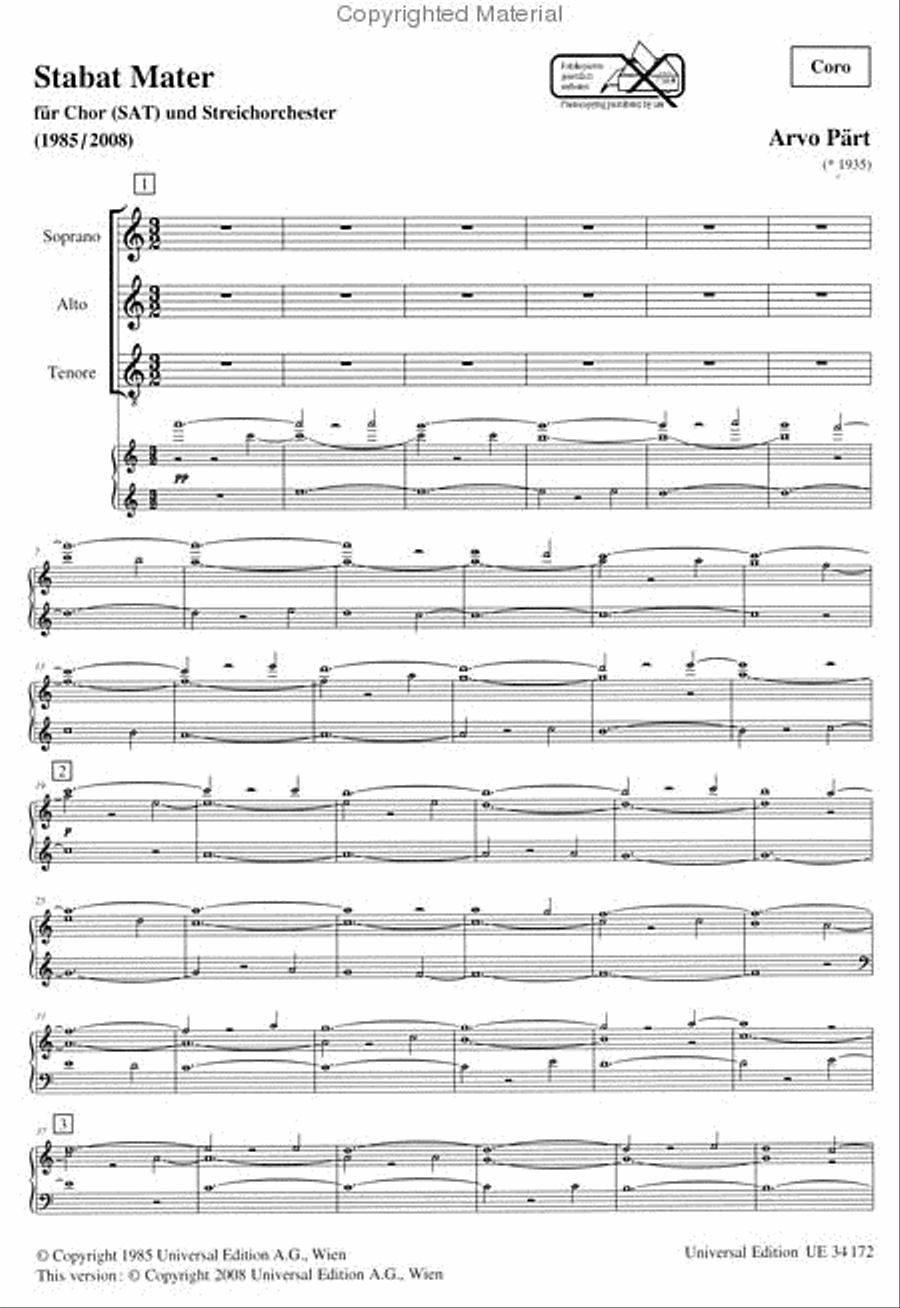
When Arvo Part sets words to music, he gives the impression of having entered into the depths of his chosen text and returned to the surface with an entirely fresh impression of what it's all about. This is certainly true of his Stabat Mater, and yet the result is to reaffirm the traditional significance of the text and to place the work securely in the long line of settings that includes those of Josquin Desprez, Lassus, and Palestrina, and in modern times Poulenc and Penderecki. Part achieves this partly by the purity and simplicity of his musical language, and partly by the way in which he draws such powerfully expressive music directly out of the rhythms and forms of the text, so that it almost seems as if the words have composed the music. That Stabat Mater poem is thought to be of 13th century Franciscan origin, though its earlier attribution to Jacopone da Todi is now generally discounted. It has the standard form of the late medieval sequence, forming a series of three-line verses, linked in pairs by rhyme, with a fixed number of syllables (8, 8, 7) in each line. Part uses a tchnique which he named "tintinnabuli" after its affinity with the way the sounds of a bell lingers as it fades into silence. A central feature of this style is his use of the number of syllables in each word to determine the shape of the melodic line. This immediately creates variety, as some lines consist of several words with only one or two syllables, while others have only two words with as many as six syllables. The text is then divided up into four sections (of 2, 3. 3, 2 strophes), each section separated by an instrumental interlude. In these interludes the music is suddenly more active, though still based on the text's underlying rhythmic pattern. The work begins with the same fundamental rhythm - but played in its slowest tempo, first high on the strings and then joined by the voices singing Amen - and ends with a mirror version of this same music. Paul Hillier (Taken from the Harmonia Mundi CD booklet).
Choral 3-part choir mixed Voices, Piano
SKU: PR.UE034172
Composed by Arvo Part. This edition: Latin. Score. With Standard notation. Duration 0:25:00. Universal Edition #UE034172. Published by Universal Edition (PR.UE034172).
ISBN 9783702469115. UPC: 803452066262.
When Arvo Part sets words to music, he gives the impression of having entered into the depths of his chosen text and returned to the surface with an entirely fresh impression of what it's all about. This is certainly true of his Stabat Mater, and yet the result is to reaffirm the traditional significance of the text and to place the work securely in the long line of settings that includes those of Josquin Desprez, Lassus, and Palestrina, and in modern times Poulenc and Penderecki. Part achieves this partly by the purity and simplicity of his musical language, and partly by the way in which he draws such powerfully expressive music directly out of the rhythms and forms of the text, so that it almost seems as if the words have composed the music. That Stabat Mater poem is thought to be of 13th century Franciscan origin, though its earlier attribution to Jacopone da Todi is now generally discounted. It has the standard form of the late medieval sequence, forming a series of three-line verses, linked in pairs by rhyme, with a fixed number of syllables (8, 8, 7) in each line. Part uses a tchnique which he named "tintinnabuli" after its affinity with the way the sounds of a bell lingers as it fades into silence. A central feature of this style is his use of the number of syllables in each word to determine the shape of the melodic line. This immediately creates variety, as some lines consist of several words with only one or two syllables, while others have only two words with as many as six syllables. The text is then divided up into four sections (of 2, 3. 3, 2 strophes), each section separated by an instrumental interlude. In these interludes the music is suddenly more active, though still based on the text's underlying rhythmic pattern. The work begins with the same fundamental rhythm - but played in its slowest tempo, first high on the strings and then joined by the voices singing Amen - and ends with a mirror version of this same music. Paul Hillier (Taken from the Harmonia Mundi CD booklet).
Tell a friend (or remind yourself) about this product. We'll instantly send an email containing product info and a link to it. You may also enter a personal message.
We do not use or store email addresses from this form for any other purpose than sending your share email.
Read our Privacy Policy.
After purchase, you can download your MP3 from your Sheet Music Plus Digital Library - no software installation is necessary! You can also listen to your MP3 at any time in your Digital Library.
After purchase, you can download your Smart Music from your Sheet Music Plus Digital Library - no software installation is necessary! You can also download at any time in your Digital Library.
After purchase you can download your video from your Digital Library. Your video is in XX format and is playable on most pre-installed video players.