18480671
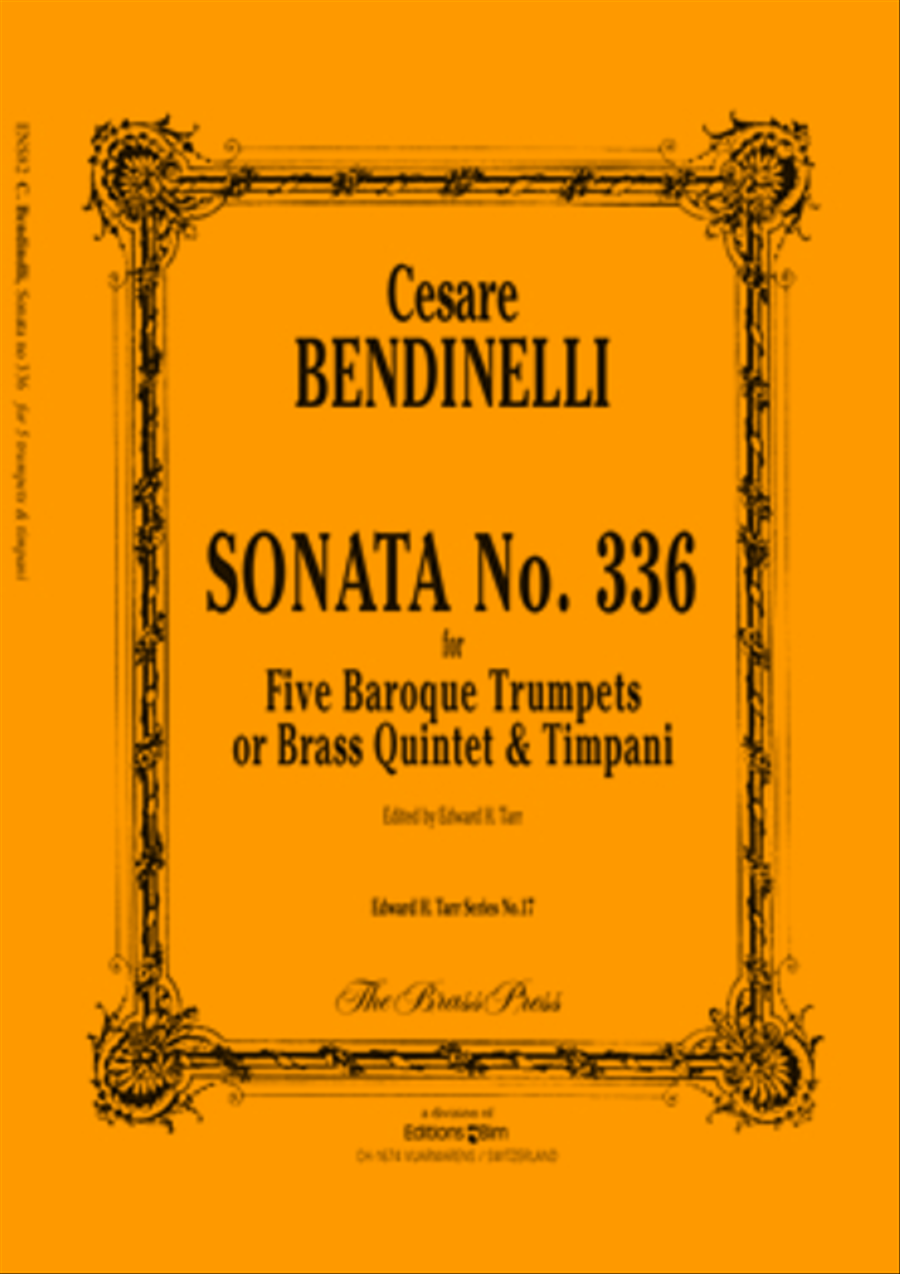
Sonata No 336
18480671
18480671
18480671
Copyright Material for Preview Only - Sheet Music Plus
Five baroque trumpets or brass quintet and timpani (2 trumpets, horn and 2 trombones or 2 trumpets and 3 trombones) - Grade 4
SKU: ET.ENS82
Composed by Cesare Bendinelli. Arranged by Edward H. Tarr. Renaissance.
ISBN 9790207002044.
Cesare Bendinelli, who was probably born around 1542, served as a trumpeter at the court of Vienna and was then chief trumpeter ("Obrister Trommeter") at the Munich court from 1580 until his death in 1617. His manuscript trumpet method of 1614, Tutta L 'arte della Trombetta (facsimile published by Editions Bim) is the earliest trumpet method now known. (For further biographical information on Bendinelli, please see the editor's article in Brass Bulletin 14, 1976.) The main contents of Bendinelli's methods are 332 so-called sonatas, which were intended to be played by a five-part trumpet ensemble. At the beginning of that section of his method, Bendinelli laid down the rules for improvising in such an ensemble. Only the second part, which he called the "sonata" part (as opposed to Monteverdi's "Quinta"), was notated, and indeed furnished the foundation for the collective improvisation. The player of the clarino part improvised certain flourishes in the lower part of the fourth octave of the harmonic series, and examples of clarino writing were given in No. 333 of the method. The players of the fourth and fifth parts, as with Monteverdi, confined themselves to a single note each, g and e respectively. The player of the third part ("alto e basso") was supposed to be quite expert in imitating exactly the notes of the sonata part one step lower in the harmonic series. The result of this kind of improvisation, as opposed to Monteverdi's overlapping, was a rather block-like effect. The last three sonatas of Bendinelli's method, Nos. 334-336, contain both the clarino and the sonata parts. For this edition the editor has reconstructed the lower parts. This is the kind of music trumpeters played in the late sixteenth century at the great courts to solemnify the activities of their sovereigns.
Five baroque trumpets or brass quintet and timpani (2 trumpets, horn and 2 trombones or 2 trumpets and 3 trombones) - Grade 4
SKU: ET.ENS82
Composed by Cesare Bendinelli. Arranged by Edward H. Tarr. Renaissance.
ISBN 9790207002044.
Cesare Bendinelli, who was probably born around 1542, served as a trumpeter at the court of Vienna and was then chief trumpeter ("Obrister Trommeter") at the Munich court from 1580 until his death in 1617. His manuscript trumpet method of 1614, Tutta L 'arte della Trombetta (facsimile published by Editions Bim) is the earliest trumpet method now known. (For further biographical information on Bendinelli, please see the editor's article in Brass Bulletin 14, 1976.) The main contents of Bendinelli's methods are 332 so-called sonatas, which were intended to be played by a five-part trumpet ensemble. At the beginning of that section of his method, Bendinelli laid down the rules for improvising in such an ensemble. Only the second part, which he called the "sonata" part (as opposed to Monteverdi's "Quinta"), was notated, and indeed furnished the foundation for the collective improvisation. The player of the clarino part improvised certain flourishes in the lower part of the fourth octave of the harmonic series, and examples of clarino writing were given in No. 333 of the method. The players of the fourth and fifth parts, as with Monteverdi, confined themselves to a single note each, g and e respectively. The player of the third part ("alto e basso") was supposed to be quite expert in imitating exactly the notes of the sonata part one step lower in the harmonic series. The result of this kind of improvisation, as opposed to Monteverdi's overlapping, was a rather block-like effect. The last three sonatas of Bendinelli's method, Nos. 334-336, contain both the clarino and the sonata parts. For this edition the editor has reconstructed the lower parts. This is the kind of music trumpeters played in the late sixteenth century at the great courts to solemnify the activities of their sovereigns.
Tell a friend (or remind yourself) about this product. We'll instantly send an email containing product info and a link to it. You may also enter a personal message.
We do not use or store email addresses from this form for any other purpose than sending your share email.
Read our Privacy Policy.
After purchase, you can download your MP3 from your Sheet Music Plus Digital Library - no software installation is necessary! You can also listen to your MP3 at any time in your Digital Library.
After purchase, you can download your Smart Music from your Sheet Music Plus Digital Library - no software installation is necessary! You can also download at any time in your Digital Library.
After purchase you can download your video from your Digital Library. Your video is in XX format and is playable on most pre-installed video players.