1773549
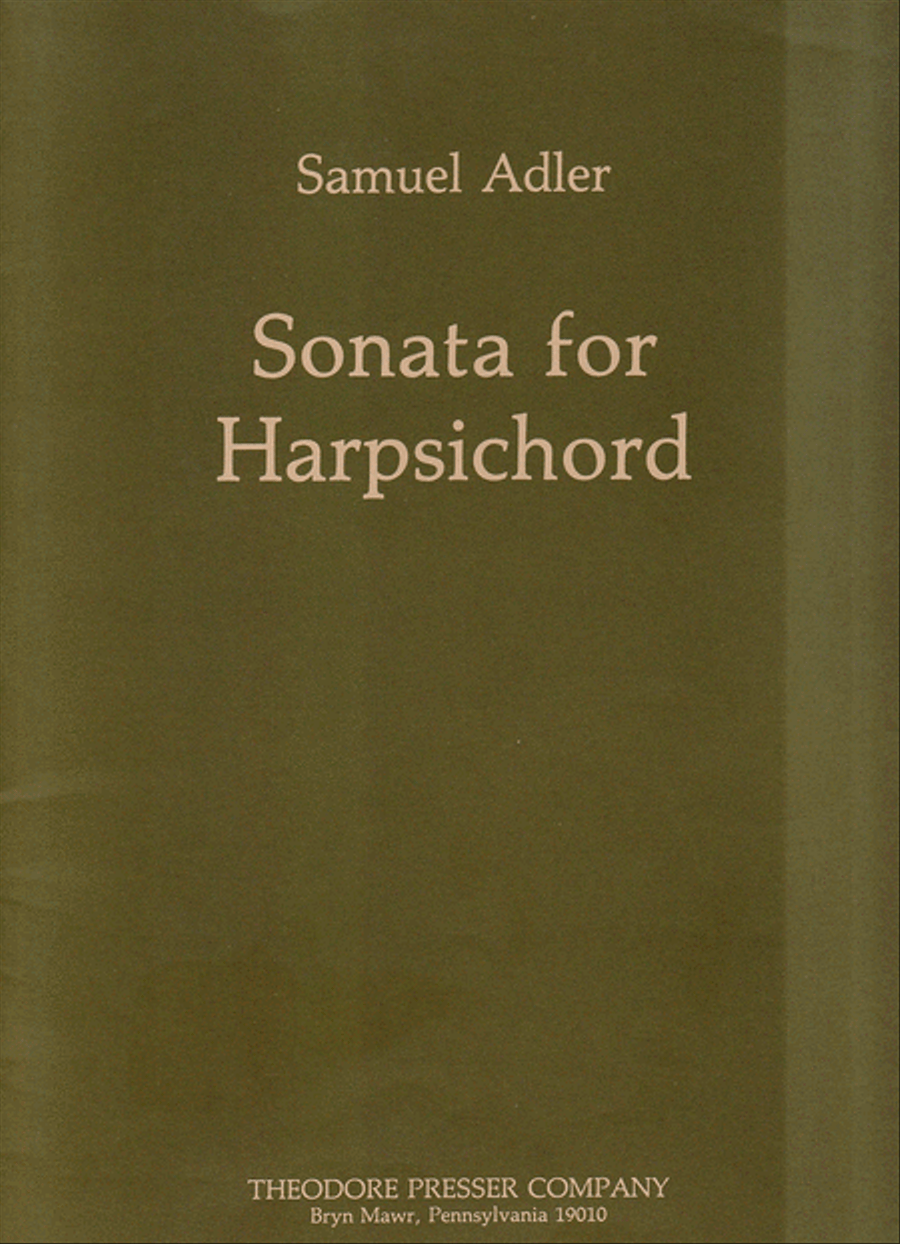
Sonata For Harpsichord
1773549
1773549
1773549
Copyright Material for Preview Only - Sheet Music Plus
Chamber Music harp
SKU: PR.110406720
Composed by Samuel Adler. This edition: saddle-wire stitch. Sws. Classical. Softcover. With Standard notation. Duration 0:14:00. Theodore Presser Company #110-40672. Published by Theodore Presser Company (PR.110406720).
UPC: 680160001316.
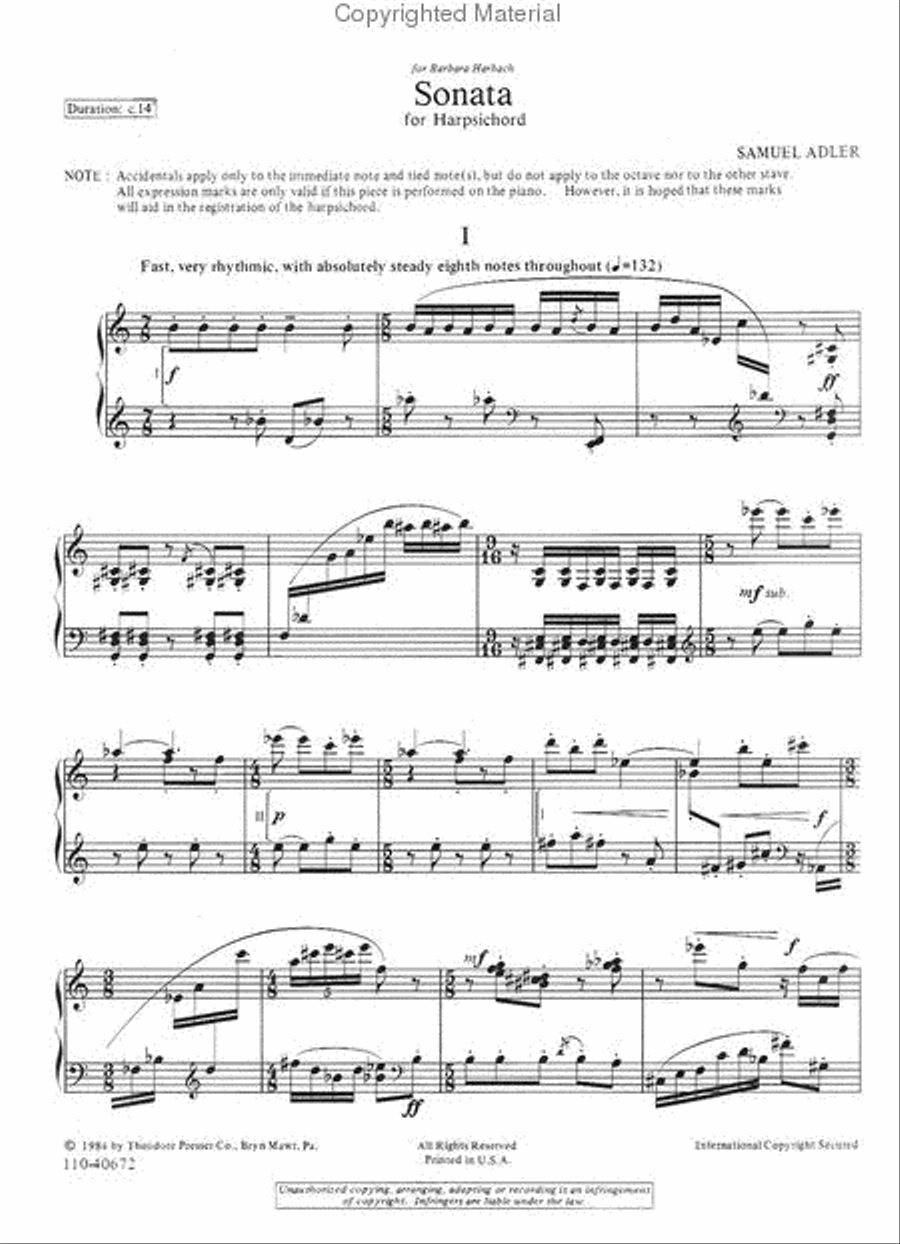
I have always been fond of writing works for specific people or organizations. It has been my good fortune during most of my creative career to be asked to compose for many extraordinary performers. The Sonata for Harpsichord Solo is such a case in point: it was written in 1982 for Barbara Harbach, a superb performer, close friend, and collaborator on many musical projects. The Sonata was premiered on March 2, 1984, in a recital given by Dr. Harbach at Nazareth College in Rochester, New York. During my formative years as a composer, one seldom heard of the harpsichord as a modern instrument, though while I attended undergraduate school at Boston University, some of us banded together to construct a small harpsichord from one of the first do-it-yourself kits which began to appear in the late '40s. It was also during this time that I heard the Sonatina for Violin and Harpsichord by my teacher Walter Piston and consequently specified that the accompanying instrument for my second violin sonata could either be a piano or a harpsichord. It was not until recently, however, that my interest in the harpsichord as a solo instrument for new music was aroused. This was because of the emergence of so many young virtuosi, such as Barbara Harbach, who are interested in the performance of new music besides the great harpsichord music of the Classical, Baroque, and pre-Baroque eras. The keyboard music of Domenico Scarlatti has always intrigued and fascinated me. The brevity, excitement, and clarity of this sparkling music is charming as well as exhilarating. It is this type of Baroque sonata that inspired the conception and form of my harpsichord sonata. The entire work is loosely based on the musical translation of Barabara Harbach's name, especially the conflict of the B (B-flat) and H (B-natural in German notation). This secondo rub or dissonance especially pervades the first movement, which is in a modified sonata form, pitting jagged and tense melodic elements against most lyrical and smooth lines. This second movement is a song-like melody accompanied by rolled chords which may be played on the lute stop of the instrument if this sonata is performed on a two-manual harpsichord. The final movement is an ever-driving joyous toccata which brings the work to an exciting close with a coda made up of accelerating repeated chords. --Samuel Adler.
Chamber Music harp
SKU: PR.110406720
Composed by Samuel Adler. This edition: saddle-wire stitch. Sws. Classical. Softcover. With Standard notation. Duration 0:14:00. Theodore Presser Company #110-40672. Published by Theodore Presser Company (PR.110406720).
UPC: 680160001316.
I have always been fond of writing works for specific people or organizations. It has been my good fortune during most of my creative career to be asked to compose for many extraordinary performers. The Sonata for Harpsichord Solo is such a case in point: it was written in 1982 for Barbara Harbach, a superb performer, close friend, and collaborator on many musical projects. The Sonata was premiered on March 2, 1984, in a recital given by Dr. Harbach at Nazareth College in Rochester, New York. During my formative years as a composer, one seldom heard of the harpsichord as a modern instrument, though while I attended undergraduate school at Boston University, some of us banded together to construct a small harpsichord from one of the first do-it-yourself kits which began to appear in the late '40s. It was also during this time that I heard the Sonatina for Violin and Harpsichord by my teacher Walter Piston and consequently specified that the accompanying instrument for my second violin sonata could either be a piano or a harpsichord. It was not until recently, however, that my interest in the harpsichord as a solo instrument for new music was aroused. This was because of the emergence of so many young virtuosi, such as Barbara Harbach, who are interested in the performance of new music besides the great harpsichord music of the Classical, Baroque, and pre-Baroque eras. The keyboard music of Domenico Scarlatti has always intrigued and fascinated me. The brevity, excitement, and clarity of this sparkling music is charming as well as exhilarating. It is this type of Baroque sonata that inspired the conception and form of my harpsichord sonata. The entire work is loosely based on the musical translation of Barabara Harbach's name, especially the conflict of the B (B-flat) and H (B-natural in German notation). This secondo rub or dissonance especially pervades the first movement, which is in a modified sonata form, pitting jagged and tense melodic elements against most lyrical and smooth lines. This second movement is a song-like melody accompanied by rolled chords which may be played on the lute stop of the instrument if this sonata is performed on a two-manual harpsichord. The final movement is an ever-driving joyous toccata which brings the work to an exciting close with a coda made up of accelerating repeated chords. --Samuel Adler.
Tell a friend (or remind yourself) about this product. We'll instantly send an email containing product info and a link to it. You may also enter a personal message.
We do not use or store email addresses from this form for any other purpose than sending your share email.
Read our Privacy Policy.
After purchase, you can download your MP3 from your Sheet Music Plus Digital Library - no software installation is necessary! You can also listen to your MP3 at any time in your Digital Library.
After purchase, you can download your Smart Music from your Sheet Music Plus Digital Library - no software installation is necessary! You can also download at any time in your Digital Library.
After purchase you can download your video from your Digital Library. Your video is in XX format and is playable on most pre-installed video players.