
Ships to you
Ships to you
SKU: PR.114408630
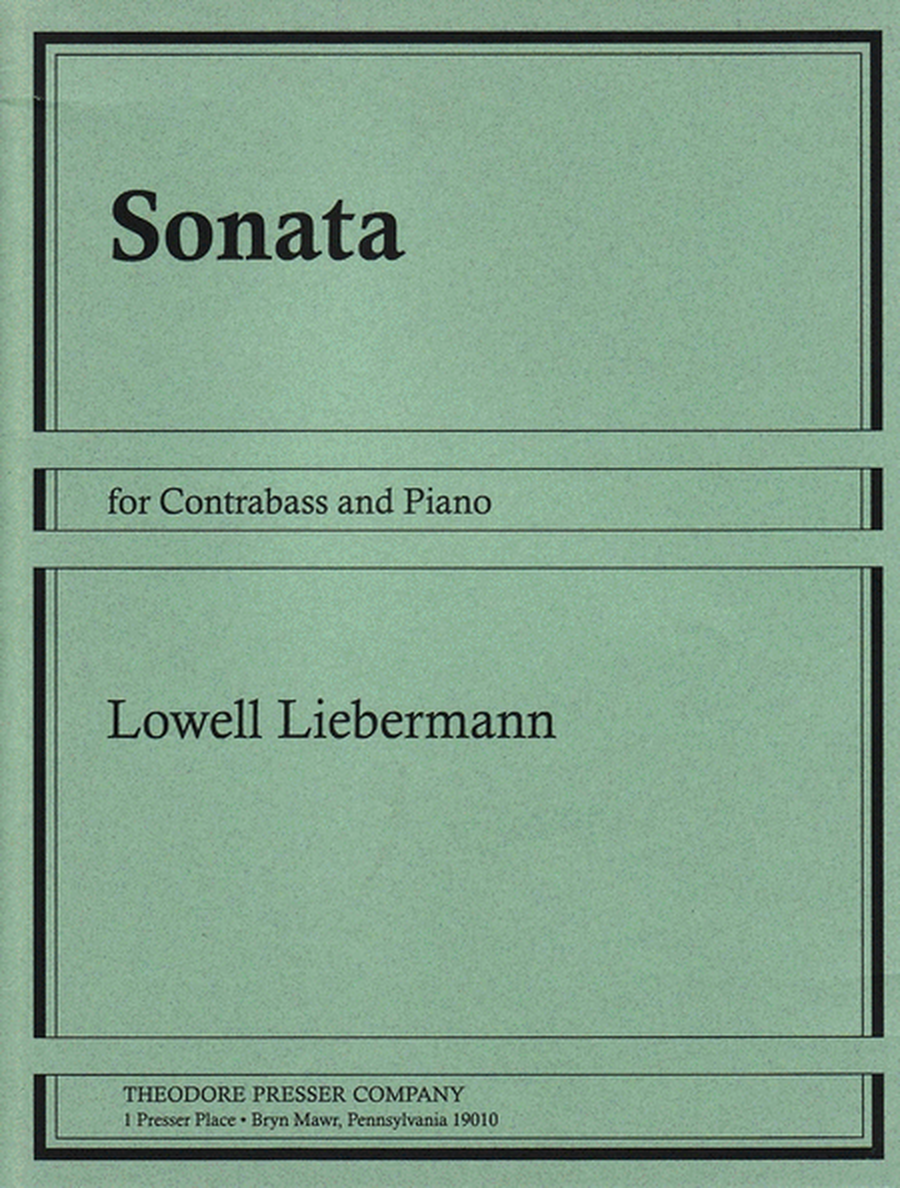
Op. 24. Composed by Lowell Liebermann. This edition: saddle-wire stitch. Sws. Score and parts. With Standard notation. Composed 1987. Opus 24. 28 pages. Duration 0:25:00. Theodore Presser Company #114-40863. Published by Theodore Presser Company (PR.114408630).ISBN 9781491109298. UPC: 680160013166. 9 x 12 inches.
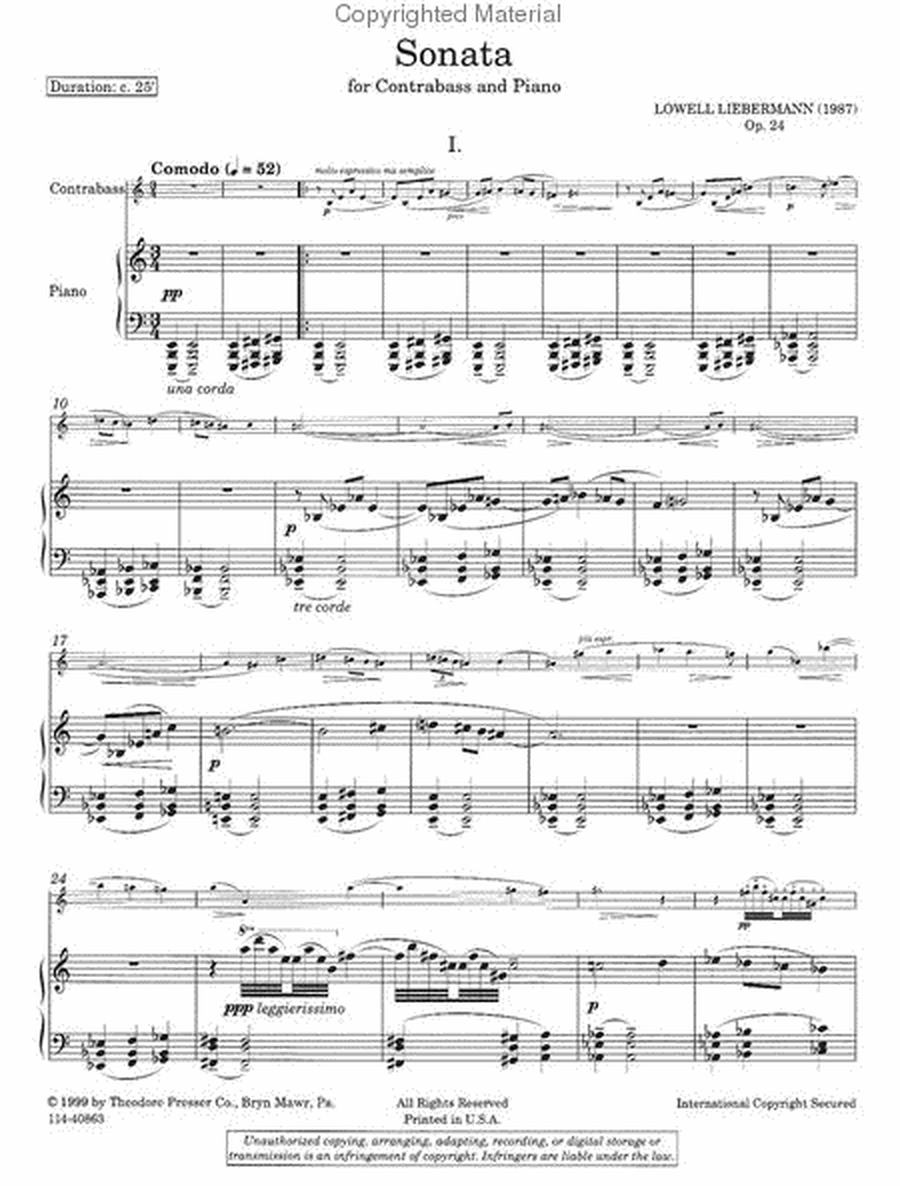
Premiered by Richard Frederickson, contrabass and Colette Valentine, piano at The Corcoran Gallery, Washington DC March 18, 1989 The Sonata for Contrabass and Piano Op. 24 was completed on Christmas Day 1987. It is dedicated to Richard Fredrickson, who gave the work its world premiere. The Sonata is in four sections which are played without pause. Each section makes use of a distinctive accompanying ostinato idea. The first section, marked Comodo, begins with a somewhat pastoral feeling, with a sarabande-like ostinato in the piano. The mood quickly becomes more agitated and leads to a group of chaconne-variations. The second section, Adagio, follows immediately; a slow and sustained nocturne whose melody makes use of the first few notes of the famous contrabass-solo from the fourth act of Verdi's Otello. After this, the third section, Presto, serves as a mordant and virtuosic scherzo. Forming a bridge between the third and fourth sections is a complete quotation of the Verdi passage. The fourth and final section is an abbreviated recapitulation of the opening section. The Verdi references are of no programmatic significance (and he is far from being a favorite composer;) rather they are incorporated for reasons of structural and motivic development.
Premiered byRichard Frederickson, contrabassand Colette Valentine, pianoat The Corcoran Gallery, Washington DCMarch 18, 1989The Sonata for Contrabass and Piano Op. 24 was completed on Christmas Day 1987. It is dedicated to Richard Fredrickson, who gave the work its world premiere. The Sonata is in four sections which are played without pause. Each section makes use of a distinctive accompanying ostinato idea. The first section, marked Comodo, begins with a somewhat pastoral feeling, with a sarabande-like ostinato in the piano. The mood quickly becomes more agitated and leads to a group of chaconne-variations. The second section, Adagio, follows immediately; a slow and sustained nocturne whose melody makes use of the first few notes of the famous contrabass-solo from the fourth act of Verdi’s Otello. After this, the third section, Presto, serves as a mordant and virtuosic scherzo. Forming a bridge between the third and fourth sections is a complete quotation of the Verdi passage. The fourth and final section is an abbreviated recapitulation of the opening section. The Verdi references are of no programmatic significance (and he is far from being a favorite composer;) rather they are incorporated for reasons of structural and motivic development.
Premiered byRichard Frederickson, contrabassand Colette Valentine, pianoat The Corcoran Gallery, Washington DCMarch 18, 1989The Sonata for Contrabass and Piano Op. 24 was completed on Christmas Day 1987.xa0 It is dedicated to Richard Fredrickson, who gave the work its world premiere.xa0 The Sonata is in four sections which are played without pause.xa0 Each section makes use of a distinctive accompanying ostinato idea.xa0 The first section, marked Comodo, begins with a somewhat pastoral feeling, with a sarabande-like ostinato in the piano.xa0 The mood quickly becomes more agitated and leads to a group of chaconne-variations.xa0 The second section, Adagio, follows immediately; a slow and sustained nocturne whose melody makes use of the first few notes of the famous contrabass-solo from the fourth act of Verdi’s Otello.xa0 After this, the third section, Presto, serves as a mordant and virtuosic scherzo.xa0 Forming a bridge between the third and fourth sections is a complete quotation of the Verdi passage.xa0 The fourth and final section is an abbreviated recapitulation of the opening section.xa0 The Verdi references are of no programmatic significance (and he is far from being a favorite composer;) rather they are incorporated for reasons of structural and motivic development.
See Similar Sheet Music and Digital Downloads