Details
- Instrument:
- Piano Accompaniment Viola Solo
- Ensembles:
- Chamber Music
- Genres:
- Classical
- Composers:
- Lowell Liebermann
- Publishers:
- Theodore Presser Company
- UPC:
- 680160008001
- Format:
- Score Set of Parts Score and Parts
- Item types:
- Physical
- Musical forms:
- Sonata
- Artist:
- Lowell Liebermann
- Usages:
- School and Community
- Shipping Weight:
- 0.75 pounds
SKU: PR.114404680
For Viola and Piano. Composed by Lowell Liebermann. Perfect. Classical. Score and parts. With Standard notation. Composed October 1 1984. Opus 13. Duration 0:27:30. Theodore Presser Company #114-40468. Published by Theodore Presser Company (PR.114404680).UPC: 680160008001.
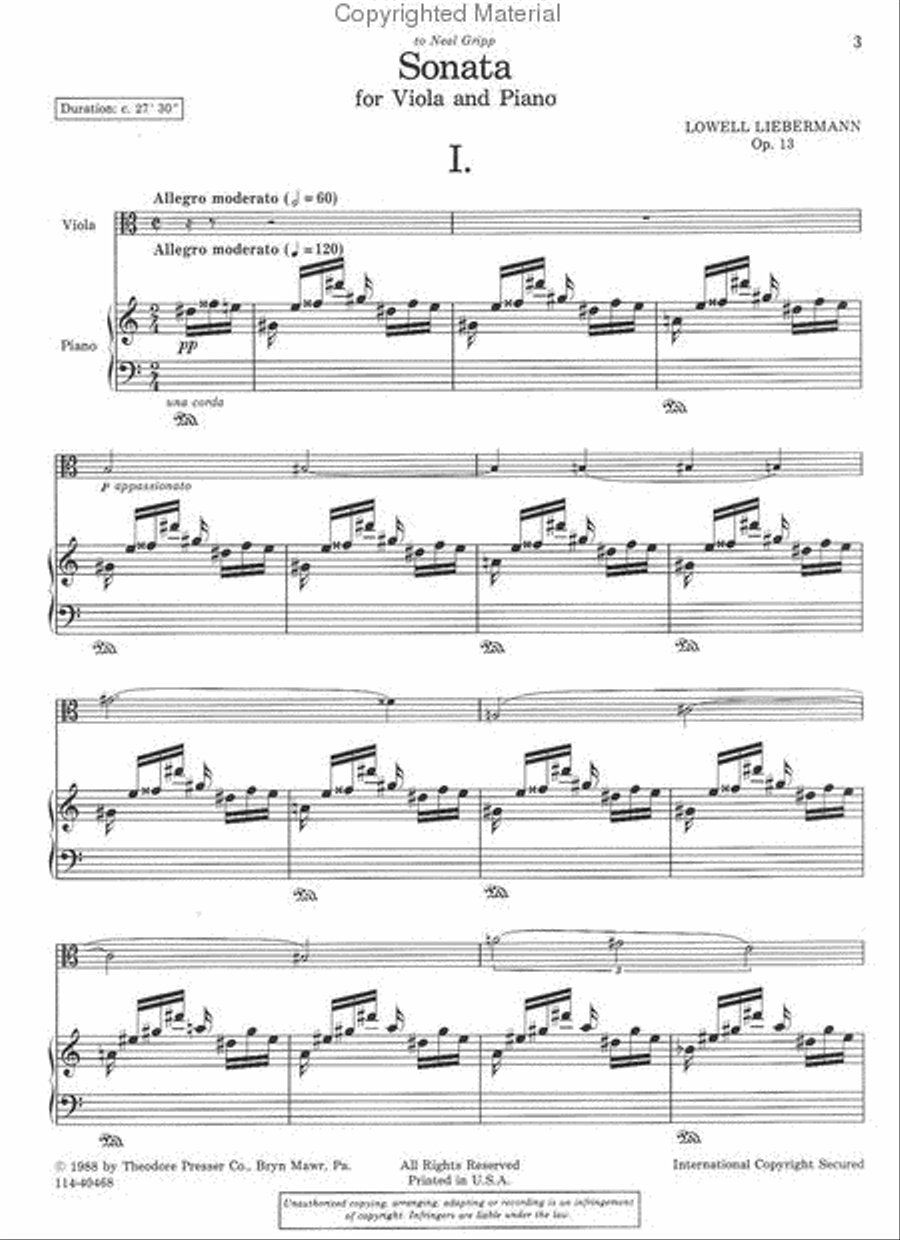
Organic unity in terms of structure and thematic material is a prime factor in this work. The Sonata centers around G-sharp major/minor; the inherent half-step conflict is of prime importance to the tonal and thematic development. The first movement has an arc-like structure. The opening theme in the viola is actually first heard in augmentation, with the piano measures half as long as the viola measures. This polymetric device is further exploited in the movement's central development section and coda, where the viola and piano parts end out of phase by half a measure until the final chord. The second movement is a series of continuous passacaglia variations on a theme derived from a 17-note figure heard in the first movement. The passacaglia theme is heard at the beginning of the second movement in the piano alone. Each of the successive 17 variations is transposed to a successive note of the theme itself, so the entire movement becomes, in effect, a single large variation. Since the variations are continuous and the theme not always the most prominent material, another form emerges, whose thematic structure is related to the phraseology of the theme (again enhancing the idea of the whole movement as being a single large variation.) The third movement begins with a short recitativo section alternating viola and piano, which leads directly into the body of the movement, marked Allegro feroce. Here, in a rondo-like structure, previous material from the other movements is further developed and summarized. The opening four chromatically descending chords of Gesualdo's madrigal Moro lasso occur at several strategic points in the first movement and in the coda of the last movement. These quotations have no ulterior programmatic significance, but are consistent (and at the time of composition, seemingly inevitable) with the work's motivic development. The Sonata is dedicated to violist Neal Gripp, who gave the work its premiere with pianist Daniel Lessner at Town Hall in New York City.
- More by this Composer:
- Lowell Liebermann Lowell Liebermann B-Flat Clarinet Lowell Liebermann Flute Lowell Liebermann Piano
- Instrument:
- Piano and Keyboard Piano Accompaniment Strings Viola Viola Solo
- Artists:
- Lowell Liebermann
- Ensemble:
- Chamber Music
- Publisher:
- Theodore Presser Company