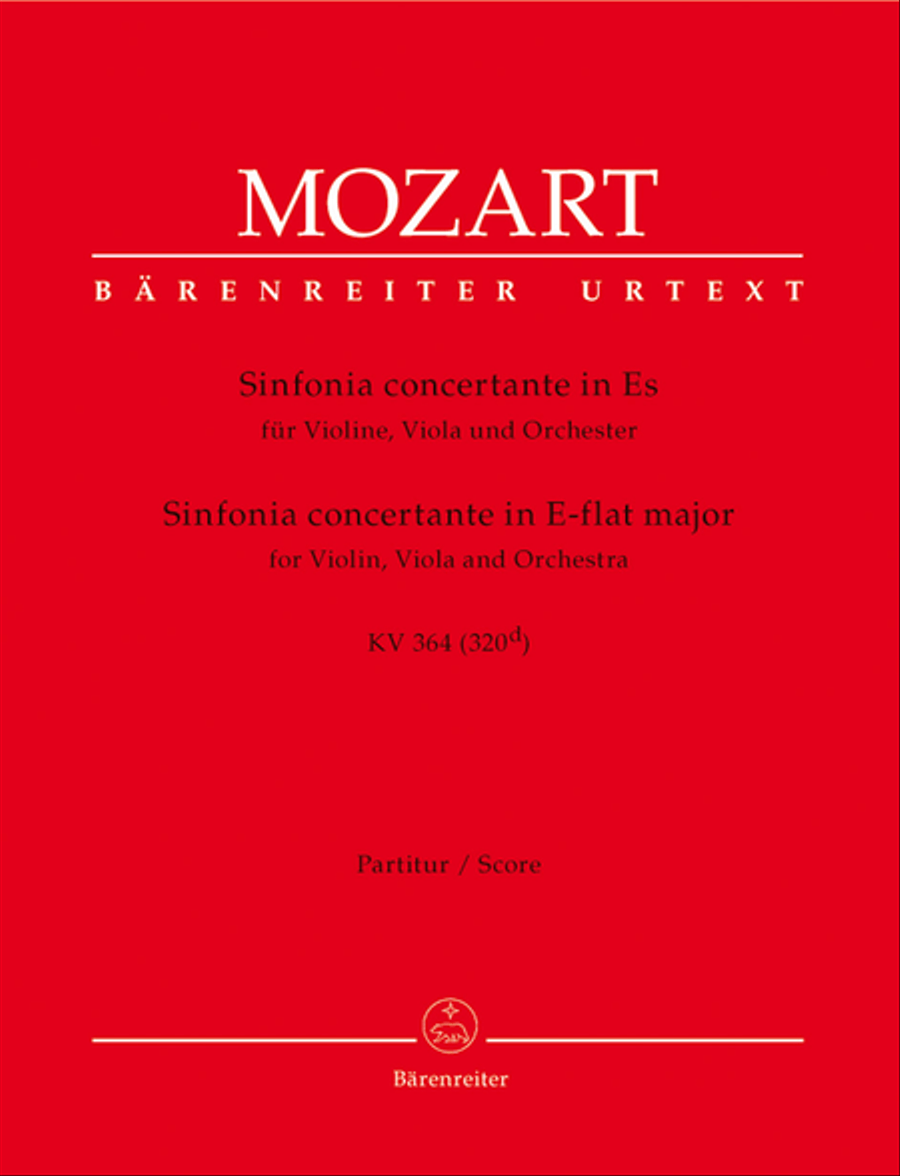
Composed by Wolfgang Amadeus Mozart. Edited by Christoph Hellmut Mahling. This edition: urtext edition. Stapled. Barenreiter Urtext. Score. K. 364 (320d). Duration 25 minutes. Baerenreiter Verlag #BA04900. Published by Baerenreiter Verlag (BA.BA04900).
ISBN 9790006460182. 12.2 x 9.57 inches. Key: E-flat major. Preface: Christoph-Hellmut Mahling.
There is no reference to the origin, occasion or a performance of the Sinfonia concertante in E-flat for Violin, Viola and Orchestra, K. 364 (320d) because in all probability it was composed in Salzburg (presumably in summer or early autumn, 1779): Mozart seems to have had no reason to write about it. It was apparently in Paris that he first had the occasion of giving the genre of the “Symphonie concertante” his special attention. On April 5, 1778, he wrote to his father: “Now I shall write a sinfonie concertante for flute wendling, oboe Ramm, Punto horn, and Ritter bassoon”.Even more discouraging must have been the fact that he had similar difficulties in Paris in having the works performed as he had in Mannheim. After the organizier of the Concerts spirituels, Le Gros, contrary to his promise, did not include the mentioned “sinfonie concertante” in his program.
Mozart had no reason to compose any more for this genre in Paris. After Mozart’s return to Salzburg, he might have been eager to introduce the new genre there, especially since adequate instrumentalists were available. Also the choice of the solo instruments (violin and viola) in the work presented here was probably influenced by the popularity of this instrumental combination in Salzburg at that time.
About Barenreiter Urtext
What can I expect from a Barenreiter Urtext edition?
MUSICOLOGICALLY SOUND - A reliable musical text based on all available sources - A description of the sources - Information on the genesis and history of the work - Valuable notes on performance practice - Includes an introduction with critical commentary explaining source discrepancies and editorial decisions
... AND PRACTICAL - Page-turns, fold-out pages, and cues where you need them - A well-presented layout and a user-friendly format - Excellent print quality - Superior paper and binding
Composed by Wolfgang Amadeus Mozart. Edited by Christoph Hellmut Mahling. This edition: urtext edition. Stapled. Barenreiter Urtext. Score. K. 364 (320d). Duration 25 minutes. Baerenreiter Verlag #BA04900. Published by Baerenreiter Verlag (BA.BA04900).
ISBN 9790006460182. 12.2 x 9.57 inches. Key: E-flat major. Preface: Christoph-Hellmut Mahling.
There is no reference to the origin, occasion or a performance of the Sinfonia concertante in E-flat for Violin, Viola and Orchestra, K. 364 (320d) because in all probability it was composed in Salzburg (presumably in summer or early autumn, 1779): Mozart seems to have had no reason to write about it. It was apparently in Paris that he first had the occasion of giving the genre of the “Symphonie concertante” his special attention. On April 5, 1778, he wrote to his father: “Now I shall write a sinfonie concertante for flute wendling, oboe Ramm, Punto horn, and Ritter bassoon”.Even more discouraging must have been the fact that he had similar difficulties in Paris in having the works performed as he had in Mannheim. After the organizier of the Concerts spirituels, Le Gros, contrary to his promise, did not include the mentioned “sinfonie concertante” in his program.
Mozart had no reason to compose any more for this genre in Paris. After Mozart’s return to Salzburg, he might have been eager to introduce the new genre there, especially since adequate instrumentalists were available. Also the choice of the solo instruments (violin and viola) in the work presented here was probably influenced by the popularity of this instrumental combination in Salzburg at that time.
About Barenreiter Urtext
What can I expect from a Barenreiter Urtext edition?
MUSICOLOGICALLY SOUND - A reliable musical text based on all available sources - A description of the sources - Information on the genesis and history of the work - Valuable notes on performance practice - Includes an introduction with critical commentary explaining source discrepancies and editorial decisions
... AND PRACTICAL - Page-turns, fold-out pages, and cues where you need them - A well-presented layout and a user-friendly format - Excellent print quality - Superior paper and binding
Ratings + Reviews
★Based on 1 Reviews
★
Anonymous
November 06, 2012
A warning
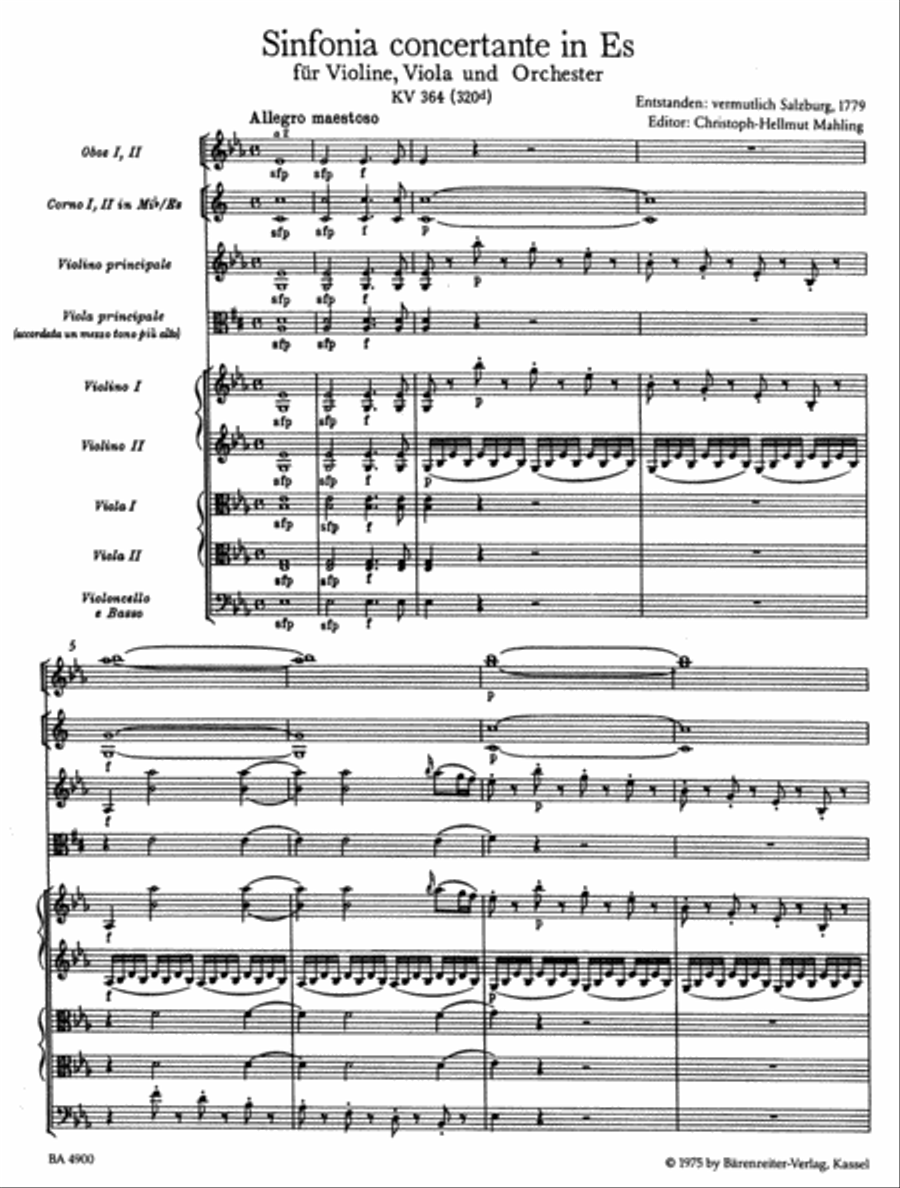
This score is, of course, excellent, as are all of Barenreiter's Urtext editions. However, the viola part in the score is given in the original scordatura notation - in D major. It makes the score a bit of a pain to read from, and dates it somewhat, as the work is almost never performed this way anymore. The print is also a bit thicker than one would expect, though reading is not an issue.
Preview: Sinfonia concertante for Violin, Viola and Orchestra E flat major, KV 364 (320d)
Tell A Friend
Tell a friend (or remind yourself) about this product. We'll instantly send an email containing product info and a link to it. You may also enter a personal message.
We do not use or store email addresses from this form for any other purpose than sending your share email.
After purchase, you can download your MP3 from your Sheet Music Plus Digital Library - no software installation is necessary! You can also listen to your MP3 at any time in your Digital Library.
Learn about Smart Music
After purchase, you can download your Smart Music from your Sheet Music Plus Digital Library - no software installation is necessary! You can also download at any time in your Digital Library.
Learn about Digital Video
After purchase you can download your video from your Digital Library. Your video is in XX format and is playable on most pre-installed video players.