

Details
- Instrument:
- 4-String Banjo Celtic Harp
- Genres:
- Early Music Mariachi Celtic Irish St. Patrick's Day
- Publishers:
- Eve Rodolfi-McTelenn
- Series:
- ArrangeMe
- Format:
- Score
- Item types:
- Digital
- Level:
- Early Intermediate
- Usages:
- School and Community
- Number of Pages:
- 15
SKU: A0.1598468
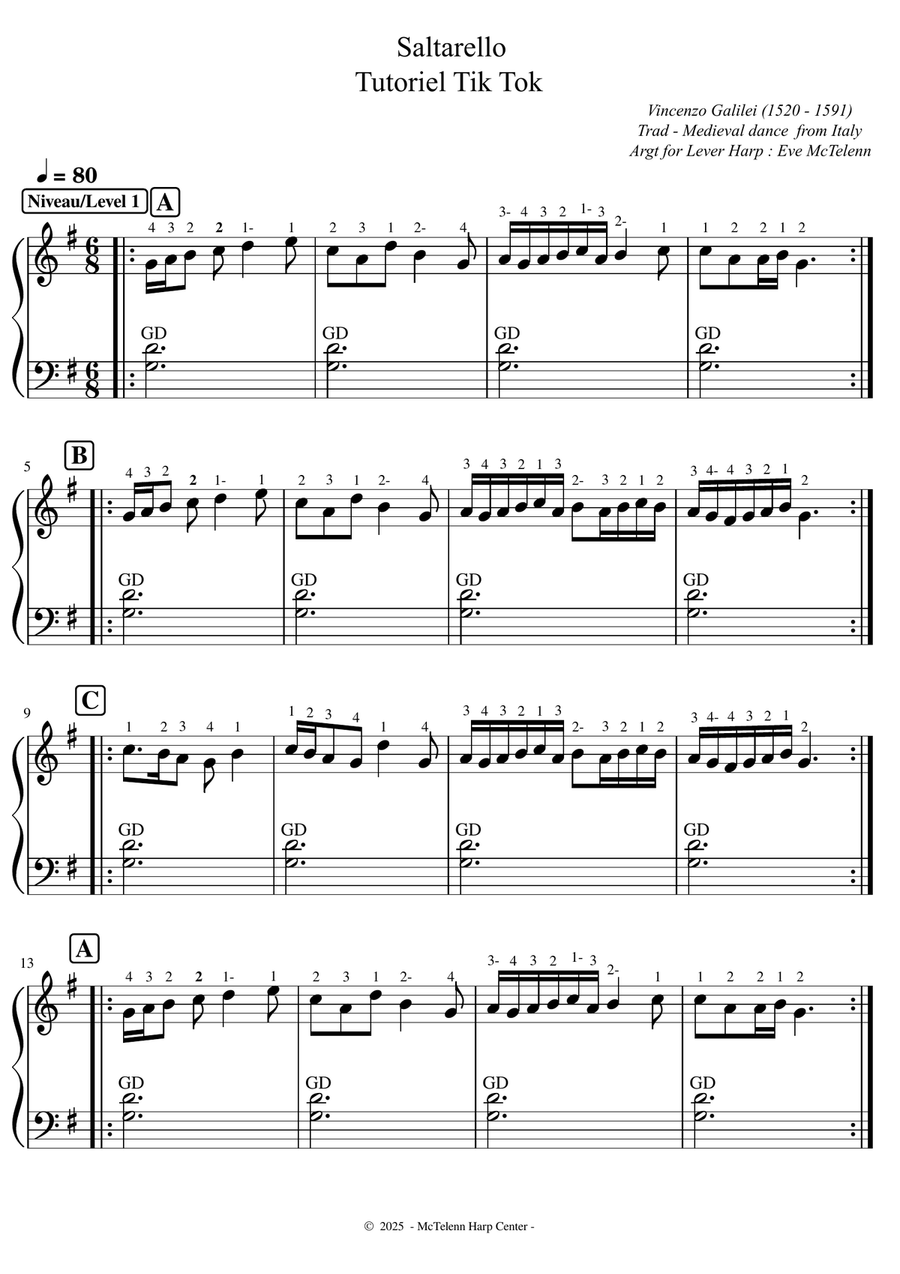
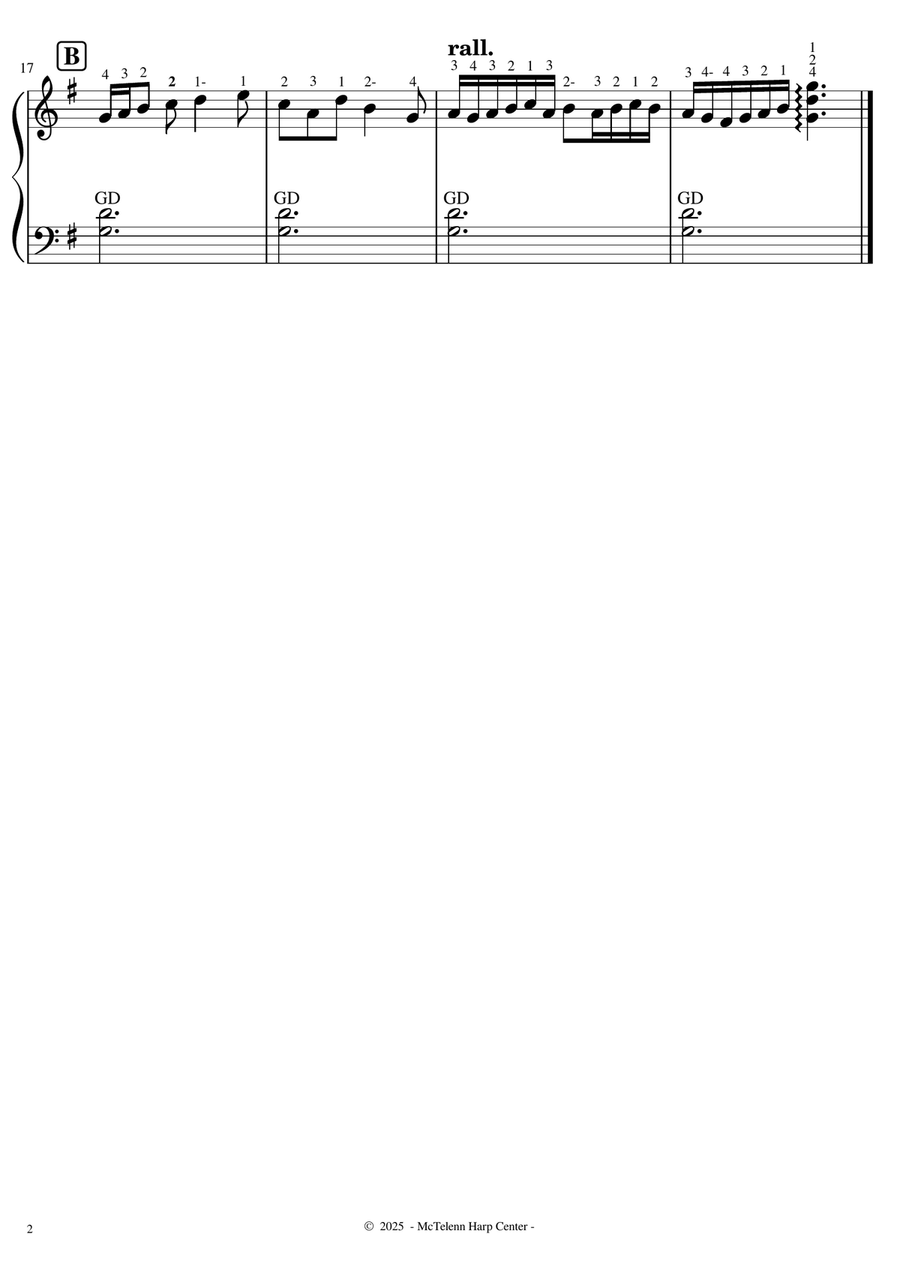
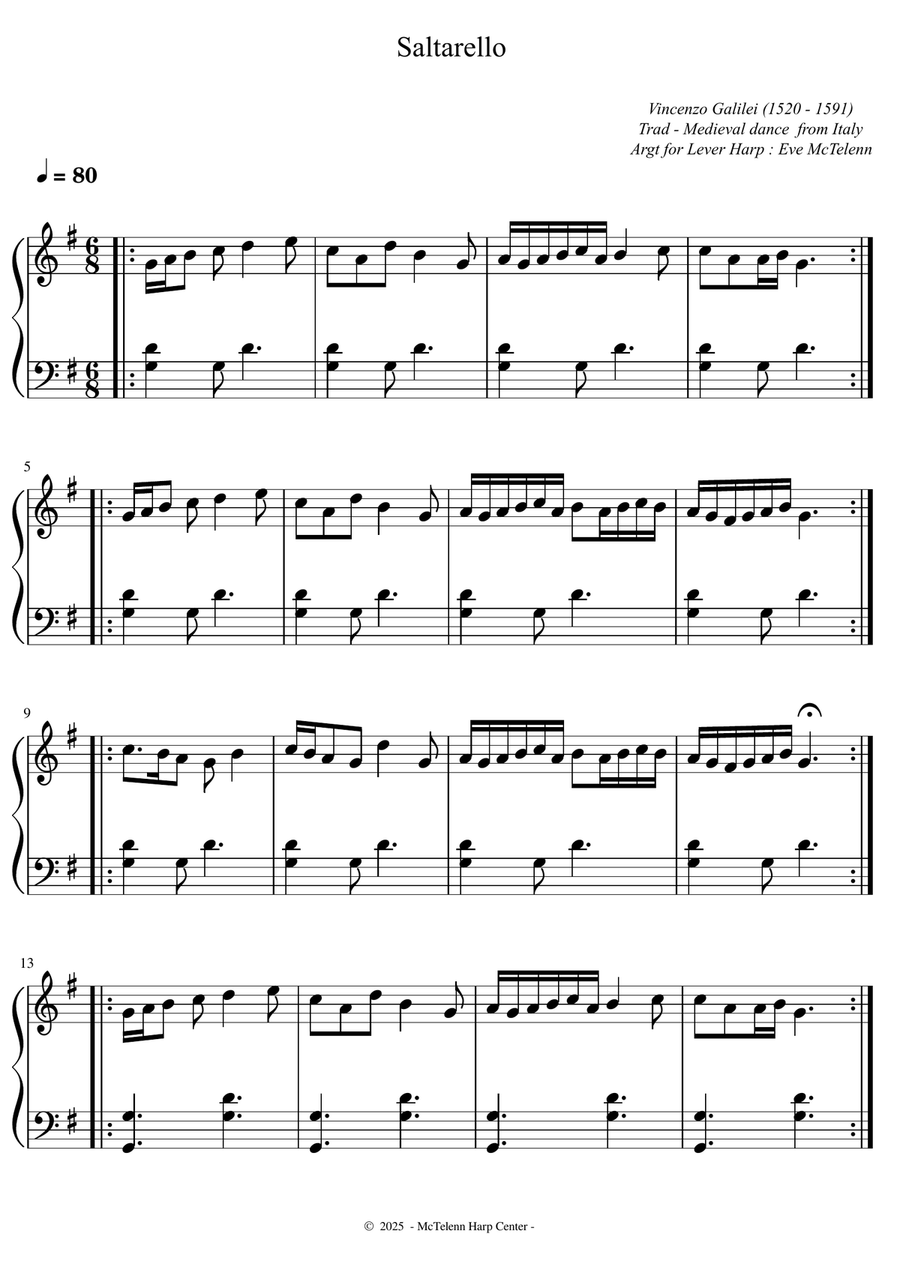
By Eve McTelenn. Composed by Anon. Arranged by Eve McTelenn. This edition: pdf, streaming. Celtic, Early Music, Historic, Irish, Mariachi. Score. 15 pages. Eve Rodolfi-McTelenn #1169237. Published by Eve Rodolfi-McTelenn (A0.1598468).Italian medieval dance - Tik Tok tutoriel version included
Key G Maj/Emin - For 27/34 String Harp -
Learn this Tunes In a original Version For Lever Harp
- Instant Access -
Discovering the Saltarello – A Medieval Dance for Harpists
The Saltarello is a lively and rhythmic Italian dance that emerged in the Middle Ages and remained popular throughout the Renaissance. Its name comes from the verb saltare, meaning "to jump," reflecting its energetic and bouncing character. Traditionally played on instruments such as the vielle, bagpipes, or harp, it is known for its infectious energy and engaging rhythm.
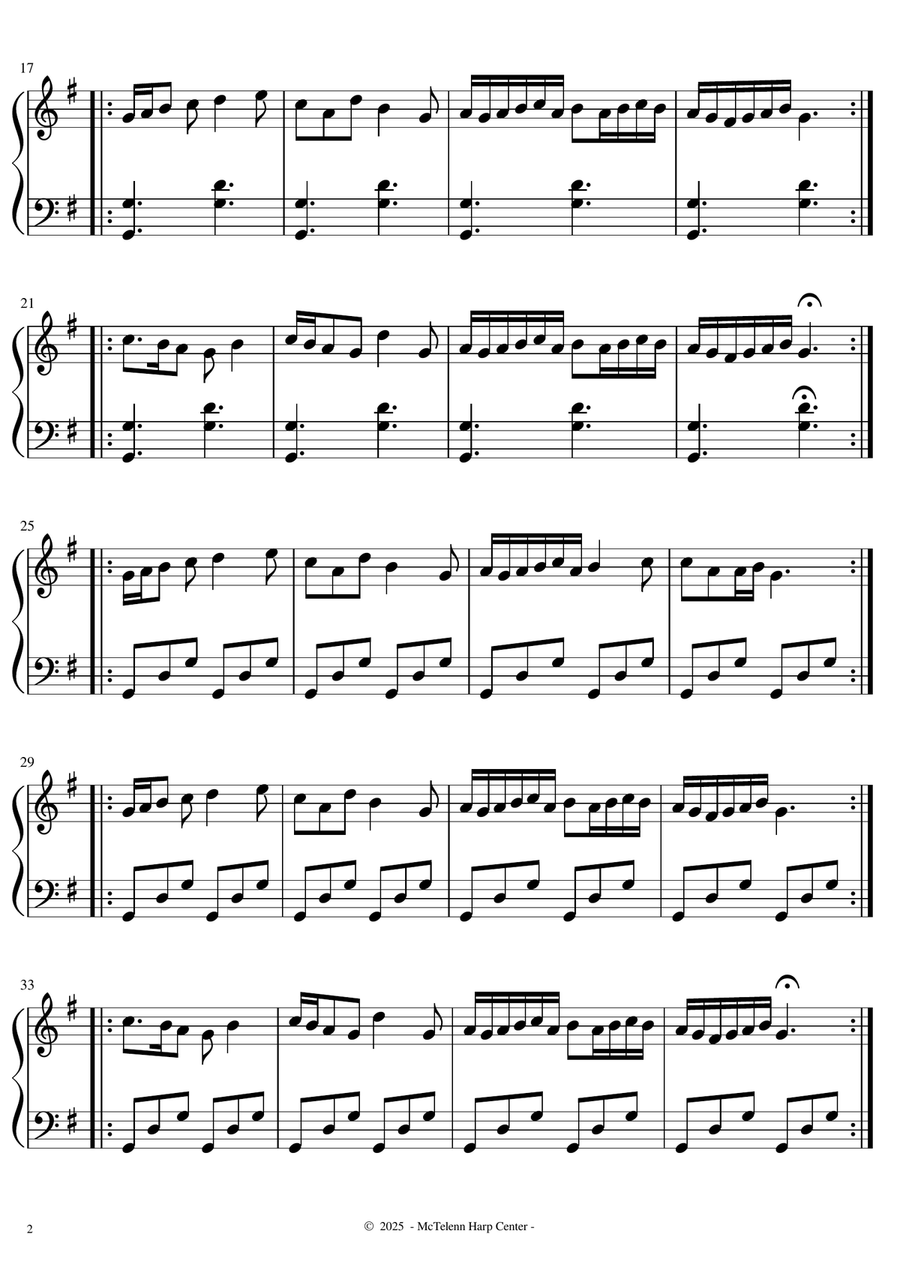
In my tutorial, I have created a basic version of the Saltarello, perfect for an introduction to this style. This arrangement helps players become familiar with the melody and phrasing typical of medieval music. To further enrich the playing experience, I have also developed several variations for the left hand, gradually introducing more elaborate accompaniments. These variations allow for the exploration of different textures and help build confidence in interpreting this repertoire.
Whether you are a beginner or a more advanced player, this progressive approach will help you develop your musicality while discovering a joyful and lively dance.
Vincenzo Galilei (1520 – 1591)
Vincenzo Galilei (1520 – July 2, 1591) was an Italian lutenist, composer, and music theorist, known for his significant contributions to late Renaissance music and for being the father of the astronomer Galileo Galilei.
Biography
Born in Santa Maria a Monte, near Pisa in Tuscany, Vincenzo showed an early talent for the lute. He studied in Venice under Gioseffo Zarlino, one of the most influential music theorists of the 16th century. In 1562, he married Giulia Ammannati, and their first child, Galileo, was born in 1564. The family moved to Florence in 1574, where Vincenzo continued his musical studies, supported by Count Giovanni Bardi.
Contributions to Music and Science
As an active member of the Florentine Camerata, a group of poets, musicians, and intellectuals led by Count Bardi, Vincenzo played a key role in the transition from Renaissance to Baroque music. He was among the first to promote monody —a musical style emphasizing a single melodic line with accompaniment—which led to the development of recitative in opera. As a theorist, Galilei conducted pioneering research in acoustics. With the help of his son Galileo, he studied the mathematical relationships between string tension and pitch, laying the groundwork for a scientific understanding of acoustical phenomena. This experimental approach influenced not only music but also Galileo’ s later scientific method, based on experimentation and quantification.
Notable Works
One of his most significant works is Fronimo Dialogo, an instructional manual on the art of playing and composing for the lute, first published in 1568 and revised in 1584. This book provides detailed guidance on intabulation and includes many musical pieces illustrating his principles. Vincenzo Galilei passed away on July 2, 1591, in Florence, leaving a lasting legacy in both the musical and scientific worlds.
About ArrangeMe
This product was created by a member of ArrangeMe, Hal Leonard's self-publishing community for independent composers, arrangers, and songwriters. Discover unique arrangements of popular titles and original compositions from diverse creators. The length, difficulty, and pricing are determined by the arranger or composer.
About Digital Downloads
Digital Downloads let you instantly access sheet music on your computer, tablet, or mobile device. Print your sheet music anywhere, anytime, or play it straight from your device—no internet connection is required after download.
Each Digital Download includes a watermark with your name, purchase date, and the number of copies purchased. You may only print or use the number of copies purchased. Redistribution or unauthorized printing is prohibited.
- ArrangeMe:
- Eve Rodolfi-McTelenn
- Series:
- ArrangeMe
- Instrument:
- Folk 4-String Banjo Strings Harp Celtic Harp
- Publisher:
- Eve Rodolfi-McTelenn