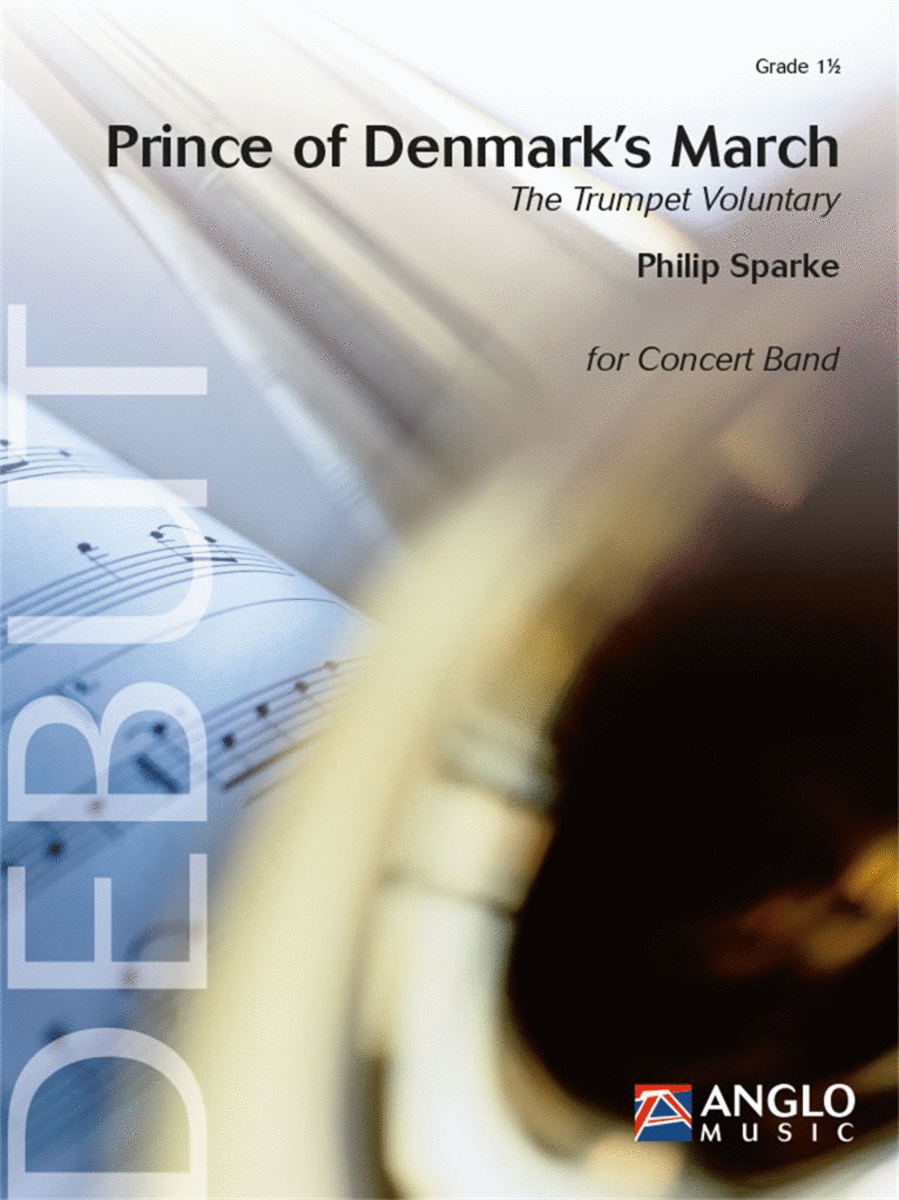
(The Trumpet Voluntary). Composed by Jeremiah Clarke. Arranged by Philip Sparke. Debut Series (Anglo). Set (Score & Parts). Composed 2001. Anglo Music Press #AMP 027-010. Published by Anglo Music Press (BT.AMP-027-010).
Jeremiah Clarke (c. 1674-1707) belongs to the generation of English composers following that of Henry Purcell. Not much is known about his early life, but by 1685 he was a chorister of the Chapel Royal, a group of liturgical musicians attached to the court. He held the post of organist at Winchester College from 1692 but later returned to London as Master of the Choristers at St Paul’s Cathedral. The Prince of Denmark’s March is perhaps his best-known work and was originally written for harpsichord, although Clarke later included it in a collection of pieces for wind instruments.
Jeremiah Clarke (vers 1674-1707) fait partie de la génération de compositeurs anglais succédant celle d’Henry Purcell. On sait très peu de choses sur ses débuts musicaux. En 1685, il entre en tant que choriste la chapelle royale d’Angleterre, un ensemble de musiciens liturgiques au service de la cour. partir de 1692, il est organiste Winchester College avant de retourner Londres où il est nommé chef des chœurs de la Cathédrale Saint-Paul. The Prince of Denmark’s March (“La Marche du Prince du Danemark”) est sans aucun doute la plus connue des œuvres de Clarke. Composée l’origine pour clavecin, elle est incluse plus tard par Clarke dans unrecueil de pièces pour instruments vent.
(The Trumpet Voluntary). Composed by Jeremiah Clarke. Arranged by Philip Sparke. Debut Series (Anglo). Set (Score & Parts). Composed 2001. Anglo Music Press #AMP 027-010. Published by Anglo Music Press (BT.AMP-027-010).
Jeremiah Clarke (c. 1674-1707) belongs to the generation of English composers following that of Henry Purcell. Not much is known about his early life, but by 1685 he was a chorister of the Chapel Royal, a group of liturgical musicians attached to the court. He held the post of organist at Winchester College from 1692 but later returned to London as Master of the Choristers at St Paul’s Cathedral. The Prince of Denmark’s March is perhaps his best-known work and was originally written for harpsichord, although Clarke later included it in a collection of pieces for wind instruments.
Jeremiah Clarke (vers 1674-1707) fait partie de la génération de compositeurs anglais succédant celle d’Henry Purcell. On sait très peu de choses sur ses débuts musicaux. En 1685, il entre en tant que choriste la chapelle royale d’Angleterre, un ensemble de musiciens liturgiques au service de la cour. partir de 1692, il est organiste Winchester College avant de retourner Londres où il est nommé chef des chœurs de la Cathédrale Saint-Paul. The Prince of Denmark’s March (“La Marche du Prince du Danemark”) est sans aucun doute la plus connue des œuvres de Clarke. Composée l’origine pour clavecin, elle est incluse plus tard par Clarke dans unrecueil de pièces pour instruments vent.
Preview: Prince of Denmark's March
Tell A Friend
Tell a friend (or remind yourself) about this product. We'll instantly send an email containing product info and a link to it. You may also enter a personal message.
We do not use or store email addresses from this form for any other purpose than sending your share email.
After purchase, you can download your MP3 from your Sheet Music Plus Digital Library - no software installation is necessary! You can also listen to your MP3 at any time in your Digital Library.
Learn about Smart Music
After purchase, you can download your Smart Music from your Sheet Music Plus Digital Library - no software installation is necessary! You can also download at any time in your Digital Library.
Learn about Digital Video
After purchase you can download your video from your Digital Library. Your video is in XX format and is playable on most pre-installed video players.