22371524
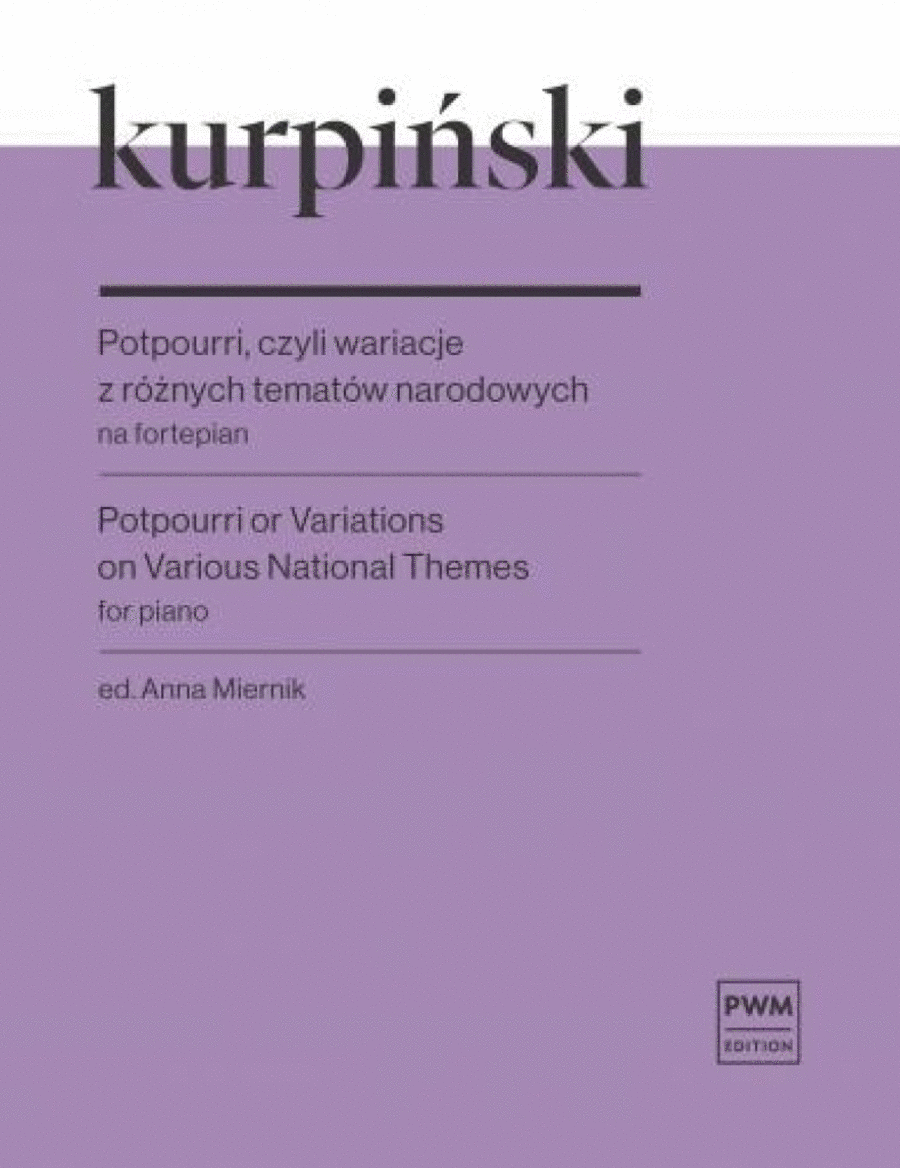
Potpourri or variations
22371524
22371524
22371524
Copyright Material for Preview Only - Sheet Music Plus
Piano
SKU: BT.PWM12844
On various national Themes. Composed by Karol Kurpinski. Book Only. Composed 2022. 36 pages. Polskie Wydawnictwo Muzyczne #PWM12844. Published by Polskie Wydawnictwo Muzyczne (BT.PWM12844).
Potpourri or Variations on Various National Themes was composed for 7-year-old Józef Krogulski, an outstanding Polish pianist who died prematurely at the age of 27. The work was published for the first time in 1813 and then in 1825 in Warsaw in the printing house of Antoni Brzezina. The French word pot¬pourri is understood as a light musical work consisting of the motifs which come from different sources. Karol Kurpiński, the composer of late Classicism and early Romanticism, combined classical formal structure and means of expression with the elements of Polish musical folklore. In the art of Kurpiński the dance forms (mainly polonaises) are dominant. The composer desired to preserve the national features of early 19th-century Polish music in his work. He was able to compose simple, beau¬tiful, catchy melodies which referred to folk songs. It should not surprise us that national melodies are also present in the piano pieces by the artist. Beside his activity as a composer, Kurpiński was also a popular conductor, he directed almost all concerts in the capital, such as the premiere of the Piano Concerto in F minor by Fryderyk Chopin on 17 March 1830 with the composer himself as a soloist. In his Potpourri Kurpiński makes use of almost all possibilities of the piano in terms of virtu-osity. There are different passages as well as octaves, chords, tremolo, seconds and thirds, chromatic cadences, dotted rhythms, appoggiatura, arpeggio, sequences of double tritones, hidden melody in semiquaver triplets. Let’s not even try to guess how talented and skilled had to be seven-year-old Józef Krogulski if Kurpiński’s work could be challenging for many professional pianists. After the introduction Poco adagio, filled at once with virtuosic elements, there is the Dumka. The references to this Ukrainian multi-strophic song in the form of a ballad of a maudlin character, often with declarations of regret after losing someone or longing for a place or an event, can be found in music of many 19th-century composers. For example, it is present in Fryderyk Chopin’s art, in the song Dwojaki koniec for voice and piano, op. 74 no. 11 (1845). In Kurpiński’s piece the calmly developed melody of the Dumka in the variation-like fragments leads to the culmination and then becomes Alla polacca. In Potpourri, similarly to another works of the composer, his love for polo-naises is noticeable: Alla polacca is the longest fragment of the work, in which Kurpiński displays his melodic creativeness. After a Polonaise, there is a short Krakowiak, which prepares the listener for a virtuosic Mazur, triumphantly ending the work thanks to numerous passages in the key of D major covering an almost whole keyboard.
Piano
SKU: BT.PWM12844
On various national Themes. Composed by Karol Kurpinski. Book Only. Composed 2022. 36 pages. Polskie Wydawnictwo Muzyczne #PWM12844. Published by Polskie Wydawnictwo Muzyczne (BT.PWM12844).
Potpourri or Variations on Various National Themes was composed for 7-year-old Józef Krogulski, an outstanding Polish pianist who died prematurely at the age of 27. The work was published for the first time in 1813 and then in 1825 in Warsaw in the printing house of Antoni Brzezina. The French word pot¬pourri is understood as a light musical work consisting of the motifs which come from different sources. Karol Kurpiński, the composer of late Classicism and early Romanticism, combined classical formal structure and means of expression with the elements of Polish musical folklore. In the art of Kurpiński the dance forms (mainly polonaises) are dominant. The composer desired to preserve the national features of early 19th-century Polish music in his work. He was able to compose simple, beau¬tiful, catchy melodies which referred to folk songs. It should not surprise us that national melodies are also present in the piano pieces by the artist. Beside his activity as a composer, Kurpiński was also a popular conductor, he directed almost all concerts in the capital, such as the premiere of the Piano Concerto in F minor by Fryderyk Chopin on 17 March 1830 with the composer himself as a soloist. In his Potpourri Kurpiński makes use of almost all possibilities of the piano in terms of virtu-osity. There are different passages as well as octaves, chords, tremolo, seconds and thirds, chromatic cadences, dotted rhythms, appoggiatura, arpeggio, sequences of double tritones, hidden melody in semiquaver triplets. Let’s not even try to guess how talented and skilled had to be seven-year-old Józef Krogulski if Kurpiński’s work could be challenging for many professional pianists. After the introduction Poco adagio, filled at once with virtuosic elements, there is the Dumka. The references to this Ukrainian multi-strophic song in the form of a ballad of a maudlin character, often with declarations of regret after losing someone or longing for a place or an event, can be found in music of many 19th-century composers. For example, it is present in Fryderyk Chopin’s art, in the song Dwojaki koniec for voice and piano, op. 74 no. 11 (1845). In Kurpiński’s piece the calmly developed melody of the Dumka in the variation-like fragments leads to the culmination and then becomes Alla polacca. In Potpourri, similarly to another works of the composer, his love for polo-naises is noticeable: Alla polacca is the longest fragment of the work, in which Kurpiński displays his melodic creativeness. After a Polonaise, there is a short Krakowiak, which prepares the listener for a virtuosic Mazur, triumphantly ending the work thanks to numerous passages in the key of D major covering an almost whole keyboard.
Tell a friend (or remind yourself) about this product. We'll instantly send an email containing product info and a link to it. You may also enter a personal message.
We do not use or store email addresses from this form for any other purpose than sending your share email.
Read our Privacy Policy.
After purchase, you can download your MP3 from your Sheet Music Plus Digital Library - no software installation is necessary! You can also listen to your MP3 at any time in your Digital Library.
After purchase, you can download your Smart Music from your Sheet Music Plus Digital Library - no software installation is necessary! You can also download at any time in your Digital Library.
After purchase you can download your video from your Digital Library. Your video is in XX format and is playable on most pre-installed video players.