Details
- Format:
- Collection / Songbook
- Item types:
- Physical
- Instructionals:
- Methods and More
- Usages:
- School and Community
- Shipping Weight:
- 0.5 pounds
SKU: AP.99-9834304846
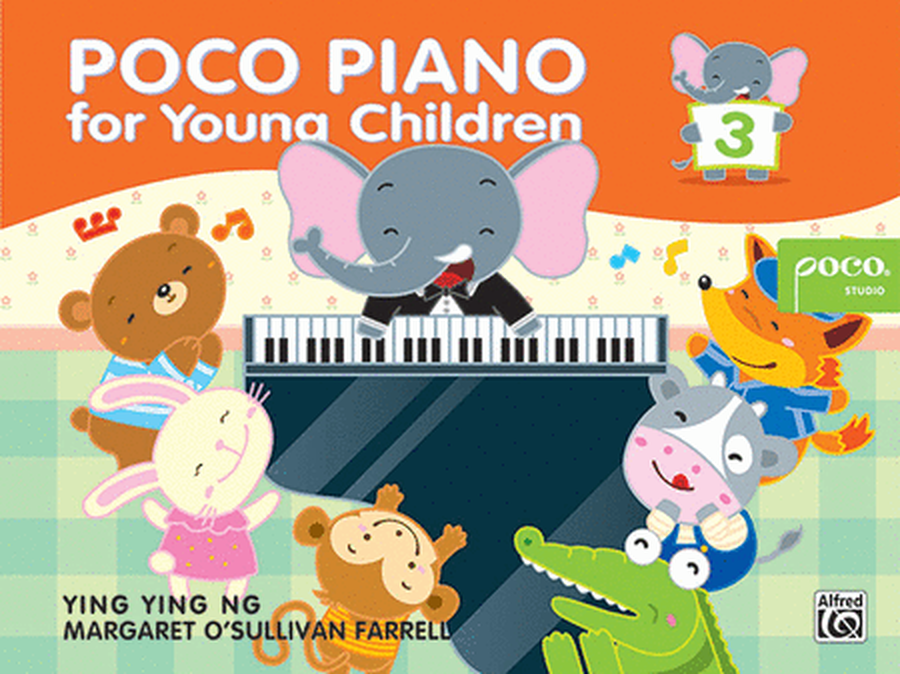
Book 3. Composed by Margaret O'Sullivan Farrell and Ying Ying Ng. Method/Instruction; Piano Method. Poco Studio. Children. Book. Alfred Music #99-9834304846. Published by Alfred Music (AP.99-9834304846).ISBN 9789834304843. English.
Book 3 introduces the concepts of key, key signature, scales, triads, tones (whole steps), and semitones (half steps) in a novel and exciting way. Each key is a group of characters or objects with note-names (i.e. a band, a birthday party, a clothes-line with garments). Certain notes belong, while all other notes (accidentals) are outsiders. Transposition is a natural outcome of this concept, with a tune moving from one group to another. The child masters eight new notes (up to Treble High G and down to Bass Low F), which facilitates the playing of more adventurous repertoire. The semiquaver (sixteenth note), semiquaver rest (sixteenth rest), dotted crotchet (dotted quarter note), and dotted quaver (dotted eighth note) are introduced, and tempo markings are now in Italian. As in the previous two books, ensemble-playing is encouraged.
- Instrument:
- Piano and Keyboard Piano Piano Method Piano and Keyboard Piano Piano Solo