Details
- Item types:
- Digital
- Instructionals:
- Etudes and Exercises Methods and More
- Level:
- Early Intermediate
- Usages:
- School and Community Sacred
- Number of Pages:
- 8
SKU: A0.1314698
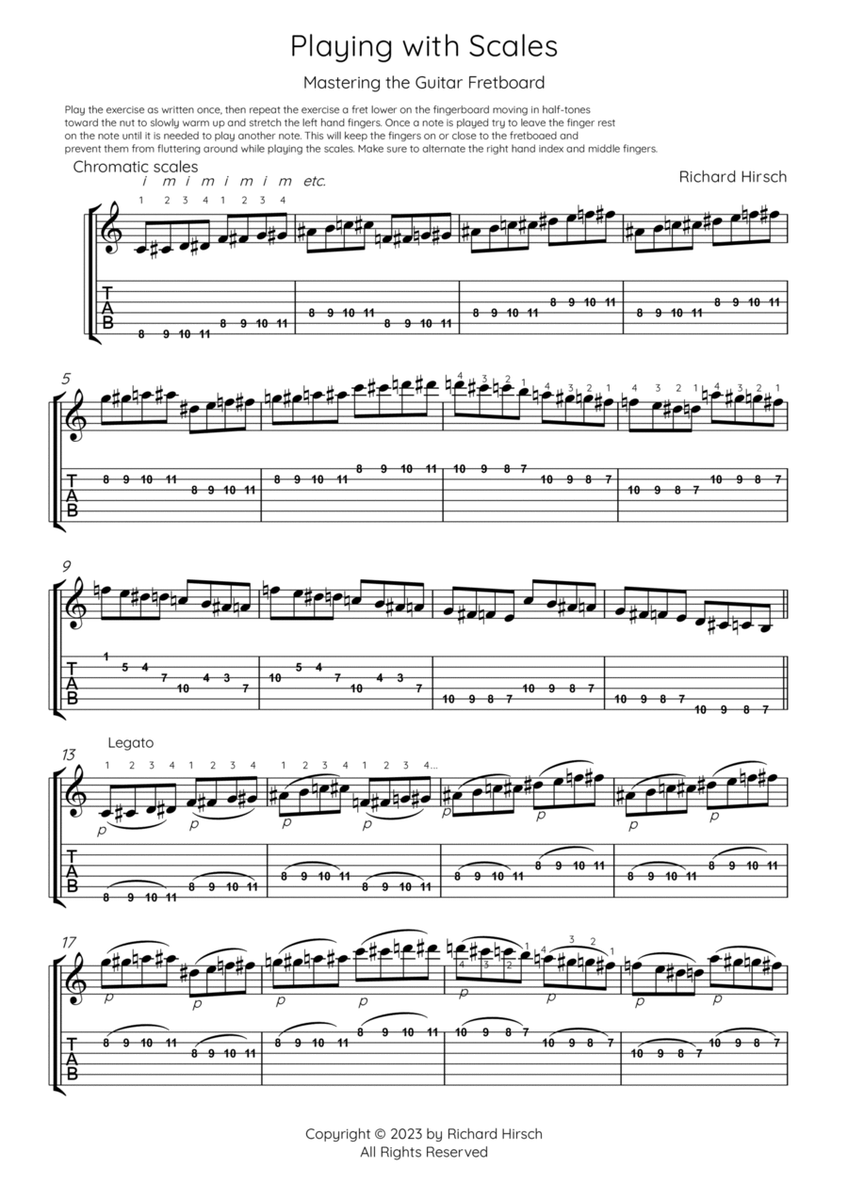
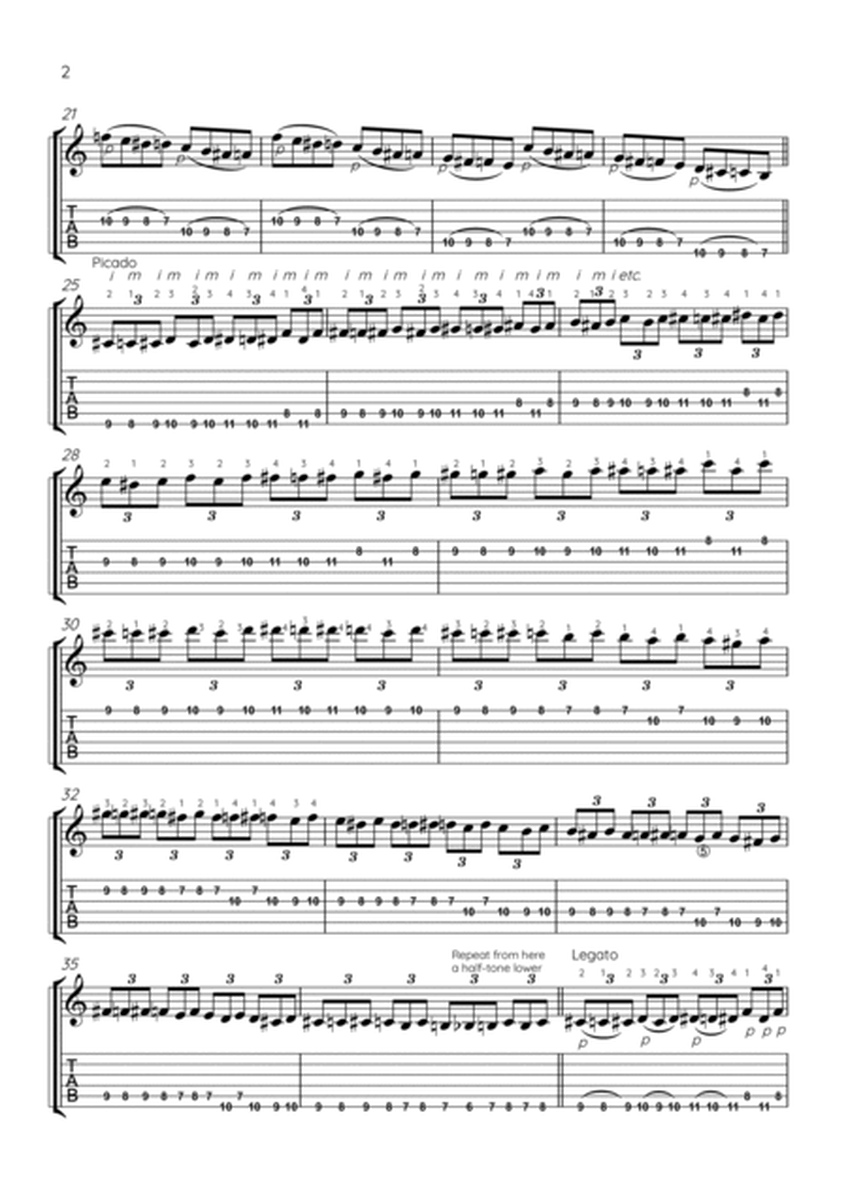
Composed by Richard Hirsch. Instructional. Educational Exercises. 8 pages. Richard Hirsch #903442. Published by Richard Hirsch (A0.1314698).Many amateur guitarists and beginning students of guitar are ‘stuck in the first position’. The rest of the fretboard is ‘terra incognita’. They don’t know where the notes are and they don’t know how to get to them and use them in playing melodies. To help remedy this situation, I offer a collection of scales and exercises I have developed over the years that have helped me master the fretboard of the guitar and that I have used to warm up my left and right hands before practicing or playing proper pieces.
Guitarists afraid to move up the fretboard miss out on all the tonal nuances that the guitar has to offer. They also often have undeveloped left hand technique with a little finger that flies around helplessly and uselessly. These scales and exercises will, if played regularly, put the little finger to good use and guide the left hand to orient to the fretboard properly, staying close to the fretboard with fingers that move as little and as efficiently as possible. They are also relaxing and fun to play around with. I read somewhere a while back that medical science had found that pianists were less likely to develop brain diseases. The scientists attributed this to the many hours pianists spend playing scales, as this is like a gentle brain massage. So scales are not only good warm up exercises for the fingers but also good warm-ups for the brain.
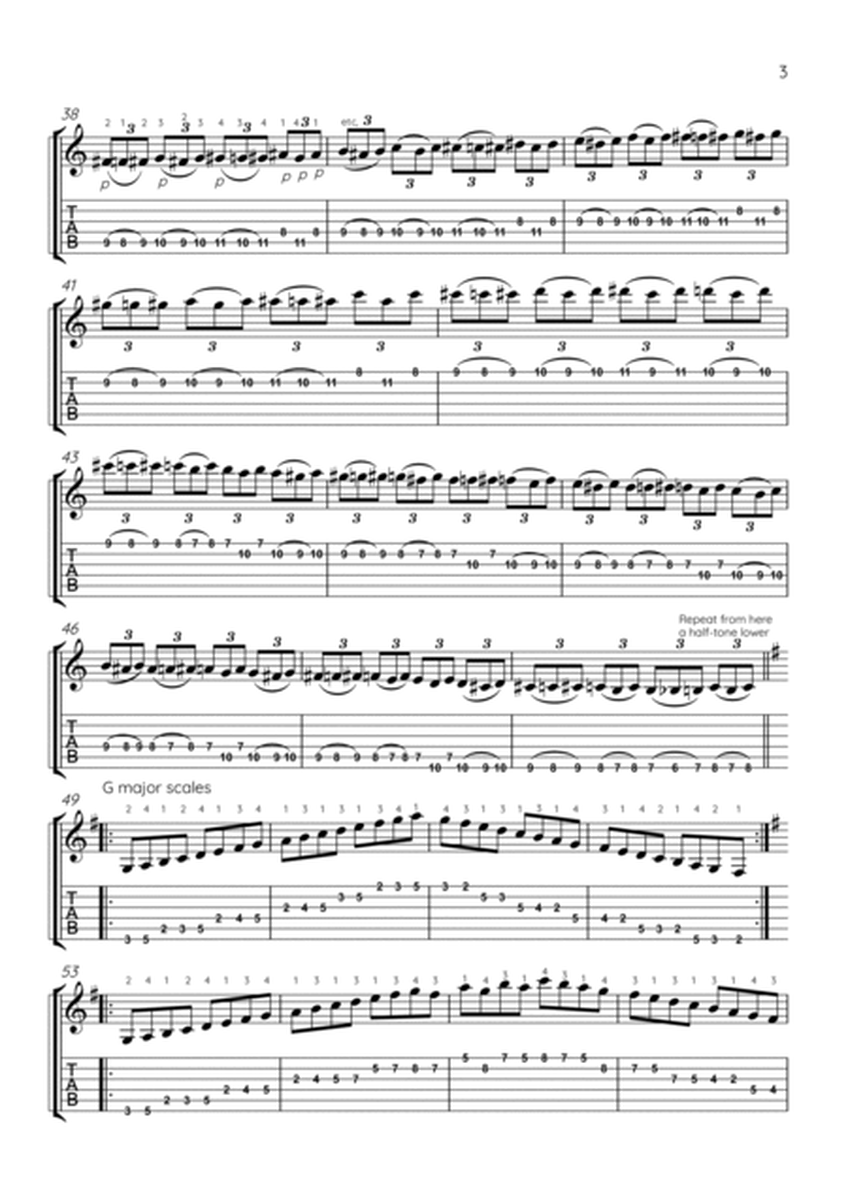
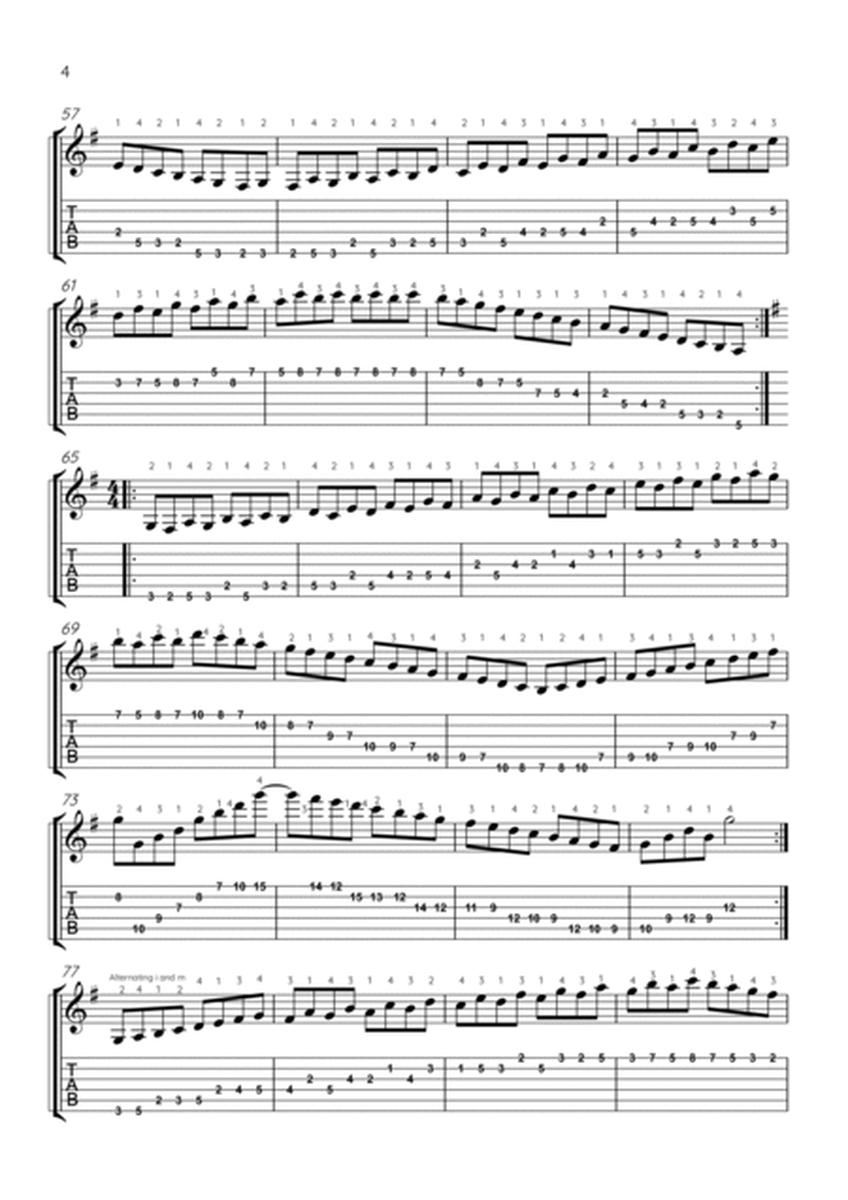
The scale exercises written here in the keys of G and C should be played in different keys in higher positions on the fretboard. Students can try to see just how far up the neck they can go to reach the highest notes. After a while, what seemed challenging and strange will start to feel comfortable and familiar. Don’t hesitate to develop new variants of the scales when you grow tired of playing them as I propose here. Have fun playing and playing with the scales!
The exercises often start in one position and move toward other higher or lower positions on the fretboard. When moving from one position to another, follow the suggested fingerings to utilise what is called a lead finger to move the hand to the next position. This will make the movement smooth and not interrupt the flow of the scale. In the end all movement should look and feel seamless and effortless.
I have chosen scales in major keys I think are particularly good to play on the guitar. To practice a scale in a minor key, start the exercise in the related major key from the fundamental of the minor key, for example, to play an E minor scale start the G major exercise on an E and play from there. This is one way of creating new variants of these scales. Another way to vary the exercises is to play the scales in different time signatures or rhythms.
I believe these exercises are particularly helpful for amateur guitarists who play in ensembles of different kinds, duos, trios, quartets, where the guitarist often only has one melodic line to play. Such melodies often sound much better played in higher positions where the guitar can be made to sing, rather than in the first position where the same tones, especially on open strings, often sound rather dull. From my own experience, I find that when I play a melody in a higher position using all the fingers of the left hand, the melody not only sounds better, the fingers remember the melody better.
About ArrangeMe
This product was created by a member of ArrangeMe, Hal Leonard's self-publishing community for independent composers, arrangers, and songwriters. Discover unique arrangements of popular titles and original compositions from diverse creators. The length, difficulty, and pricing are determined by the arranger or composer.
About Digital Downloads
Digital Downloads let you instantly access sheet music on your computer, tablet, or mobile device. Print your sheet music anywhere, anytime, or play it straight from your device—no internet connection is required after download.
Each Digital Download includes a watermark with your name, purchase date, and the number of copies purchased. You may only print or use the number of copies purchased. Redistribution or unauthorized printing is prohibited.