19832018
Pilgrims' Chorus
19832018
19832018
19832018
Copyright Material for Preview Only - Sheet Music Plus
Organ - intermediate to advanced
SKU: HL.49019278
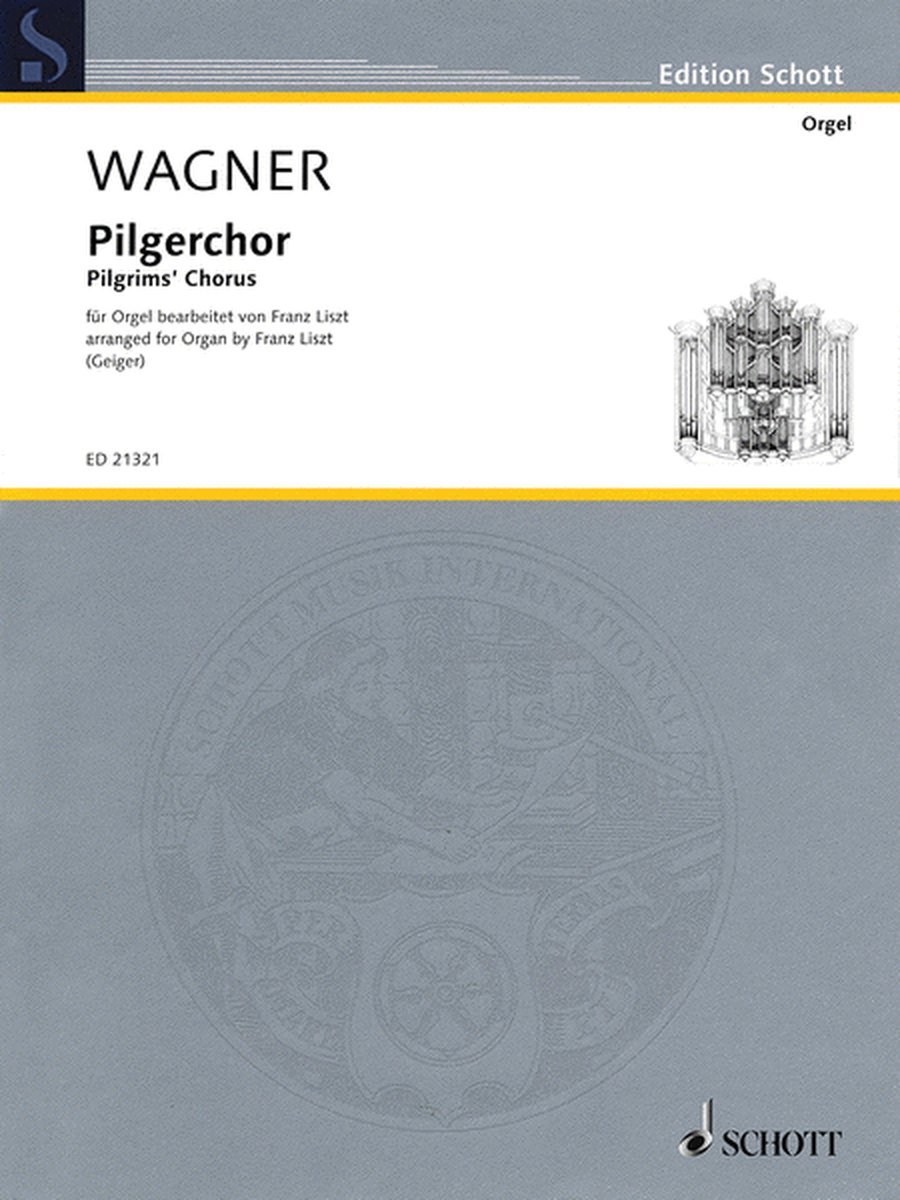
Organ. Composed by Richard Wagner. Edited by Jürgen Geiger. Arranged by Franz Liszt. This edition: Saddle stitching. Sheet music. Edition Schott. Classical. Softcover. 13 pages. Schott Music #ED21321. Published by Schott Music (HL.49019278).
ISBN 9790001181709. UPC: 884088899905. 9.0x12.0x0.086 inches.
During his time in Weimar (1848-1861), Liszt developed a then entirely new organ style which stands out for both orchestral and pianistic elements. Together with the choirmaster Alexander Wilhelm Gottschalg (1827-1908) from Tiefurt, he regularly initiated so-called 'organ conferences'. And it was at the suggestion of Gottschalg that the present arrangement of the Pilgrim's Choir from the opera 'Tannhäuser' was written. With his version for organ, Liszt, by means of this example, laid the foundations for the (not always undisputed) tradition, extending to the present day, of organ transcriptions from the operas of Wagner. 'Organistic' elements in the pilgrims' Choir are the classical chorale theme, the solemn 'sacred' atmosphere of the solemn tempo as well as the expressive cantability. The linear intensification, from the antiphonal-organ-like piano dolce of the beginning to the 'full organ', can be realized in a convincing manner with an orchestrally conceived three-manual organ, with the sensitive use of the swell box and the successive, seamless build-up of the crescendo pedal being of particular significance. Important repertoire piece marking the 200th birthday of Richard Wagner in 2013.
Organ - intermediate to advanced
SKU: HL.49019278
Organ. Composed by Richard Wagner. Edited by Jürgen Geiger. Arranged by Franz Liszt. This edition: Saddle stitching. Sheet music. Edition Schott. Classical. Softcover. 13 pages. Schott Music #ED21321. Published by Schott Music (HL.49019278).
ISBN 9790001181709. UPC: 884088899905. 9.0x12.0x0.086 inches.
During his time in Weimar (1848-1861), Liszt developed a then entirely new organ style which stands out for both orchestral and pianistic elements. Together with the choirmaster Alexander Wilhelm Gottschalg (1827-1908) from Tiefurt, he regularly initiated so-called 'organ conferences'. And it was at the suggestion of Gottschalg that the present arrangement of the Pilgrim's Choir from the opera 'Tannhäuser' was written. With his version for organ, Liszt, by means of this example, laid the foundations for the (not always undisputed) tradition, extending to the present day, of organ transcriptions from the operas of Wagner. 'Organistic' elements in the pilgrims' Choir are the classical chorale theme, the solemn 'sacred' atmosphere of the solemn tempo as well as the expressive cantability. The linear intensification, from the antiphonal-organ-like piano dolce of the beginning to the 'full organ', can be realized in a convincing manner with an orchestrally conceived three-manual organ, with the sensitive use of the swell box and the successive, seamless build-up of the crescendo pedal being of particular significance. Important repertoire piece marking the 200th birthday of Richard Wagner in 2013.
Tell a friend (or remind yourself) about this product. We'll instantly send an email containing product info and a link to it. You may also enter a personal message.
We do not use or store email addresses from this form for any other purpose than sending your share email.
Read our Privacy Policy.
After purchase, you can download your MP3 from your Sheet Music Plus Digital Library - no software installation is necessary! You can also listen to your MP3 at any time in your Digital Library.
After purchase, you can download your Smart Music from your Sheet Music Plus Digital Library - no software installation is necessary! You can also download at any time in your Digital Library.
After purchase you can download your video from your Digital Library. Your video is in XX format and is playable on most pre-installed video players.